





For contemporary jeweler Marie-Caroline Locquet, adornment has little to do with traditional displays of wealth, power, or social status. Instead, her conceptual works are designed as acts of provocation—crafted restraints and defensive weapons that transform jewelry into a unique physical experience exploring shared human vulnerability. Through subtle and sometimes startling implications of violence and sexual dominance, her pieces evoke a delicate tension between deep physical discomfort and irresistible erotic attraction.
This uncompromising vision has earned Locquet recognition as a finalist for the prestigious Young Artist Award. Supported generously by Karen and Michael Rotenberg, the biennial award celebrates promise, innovation, and distinct individuality in the work of emerging jewelry artists aged 35 or younger. Through this vital prize, the Art Jewelry Forum (AJF) champions bold and disruptive creations that push the boundaries of the medium and inspire future developments across the contemporary art landscape.
In a wide-ranging conversation with AJF, Locquet discusses her artistic journey, the conceptual roots of her radical work, the complex mechanics of her sculptural neckpieces, and her views on the enduring risks of contemporary jewelry.
Challenging the Boundaries of Jewelry
Locquet’s path into the discipline began during the earliest days of her formal art studies, when she first encountered works that completely shattered her preconceptions about what jewelry could be. Rather than drawing her toward traditional notions of beauty or opulence, these pioneering pieces felt strange, uneasy, and inherently dangerous.
"The works I am talking about were not about beauty, showing wealth, etc.," Locquet recalls, pointing to radical pieces like Bernhard Schobinger’s bottleneck creations and the pioneering work of Dorothea Pruhl. "They were ‘strange,’ ‘uneasy,’ somehow ‘dangerous’—in fact, radical… It really changed my point of view on art. In a way, jewelry interests me as an object of disruption, reflection, and provocation."
Entering the field driven by deep curiosity and rigorous questioning, Locquet found herself consumed by a central inquiry: Why make and wear jewelry that appears deeply disturbing at first glance? What does it truly mean to craft an object that seems fundamentally "unwearable"? This exploration of unwearability quickly established itself as the beating heart of her ongoing research.

Being named a finalist for the Young Artist Award serves as a powerful validation of that trajectory. "Being selected as a finalist is a meaningful recognition of a direction I have been pursuing for several years," she notes. "It gives me confidence to keep going radical, pushing things further, and challenging myself, the wearer, and the viewer."
The Weight of Adornment and Shared Fragility
Locquet’s artistic perspective is deeply rooted in her upbringing in the north of France, where she observed firsthand the heavy social pressures of self-demonstration and the subtle ways people use adornment to camouflage their social affiliations. Consequently, her attraction to jewelry stems from a conceptual fascination rather than a simple aesthetic affinity.
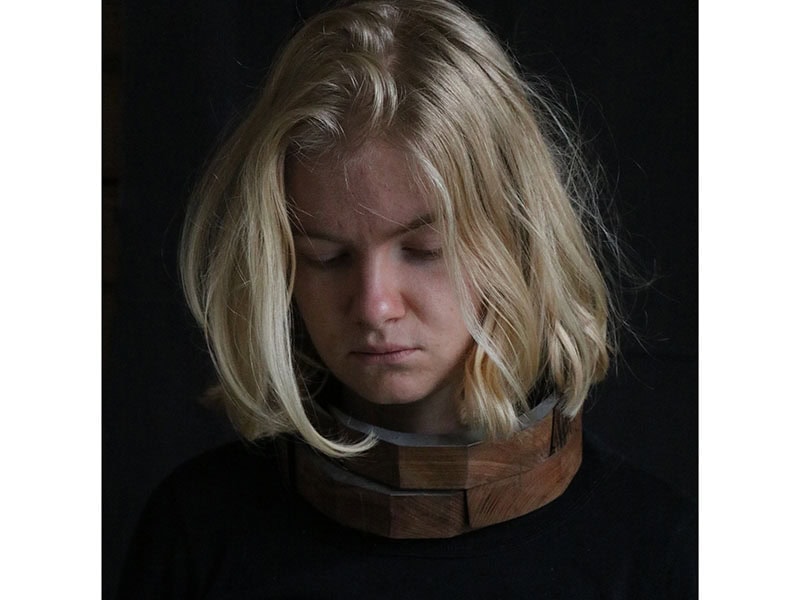
In her practice, every single piece redefines the traditional status of jewelry, shifting it away from a showcase of status and toward a disruptive confrontation within public spaces. Her work rejects seduction and polite representation in favor of exploring disturbance, violence, fragility, domination, vulnerability, and confinement. By pushing materials to their absolute limits, she strips them bare to reveal their true nature through forms that dance on the razor’s edge between desire and death. Whether functioning as defensive weapons or strict restraint devices, her pieces offer an unforgettable wearing experience that constantly maintains a tense equilibrium between social discomfort and the temptation of an embrace.
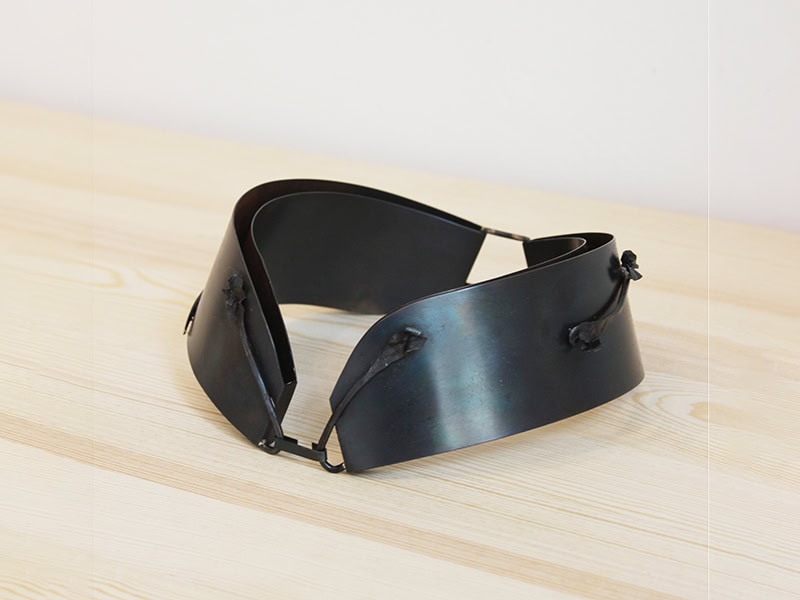
Over the years, this thematic exploration into confinement, violence, and bodily vulnerability has led Locquet to investigate historic and cultural references. She draws inspiration from the collier d’appartenance—collars historically used in submissive relationships—as well as the "slave collar" originating from 19th-century Norman and Auvergnat traditions, which were given to women at marriage as tokens of possession. She also looks closely at animal-labor tools like the traditional horse collar.
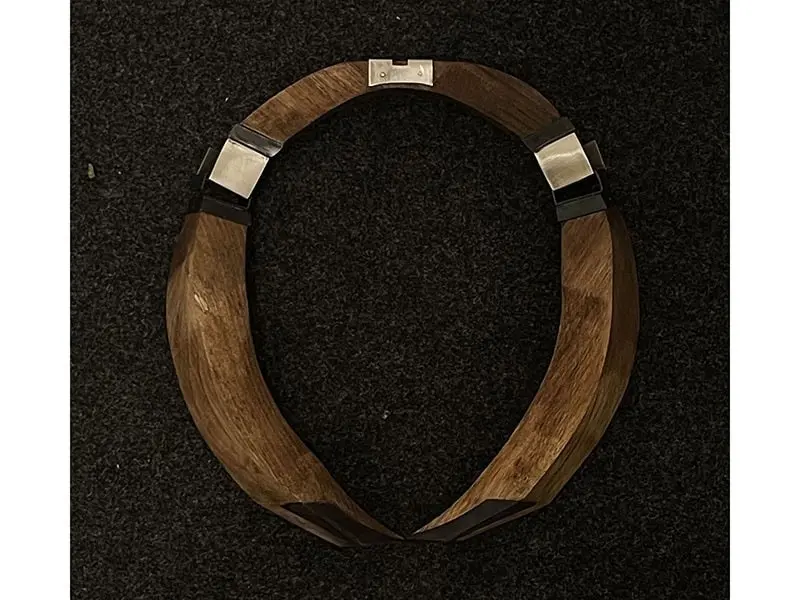
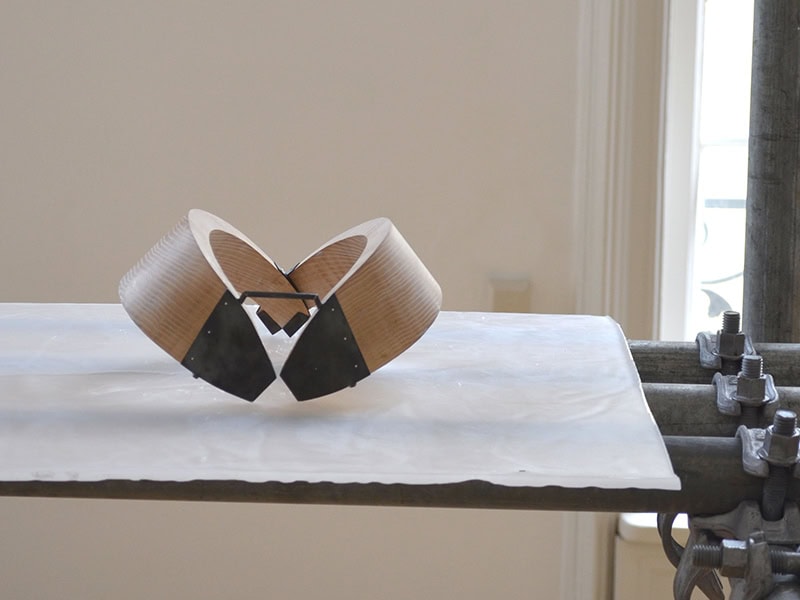
These varied threads converge brilliantly in her 2024 neckpiece, Hands, constructed from elm wood, zinc-plated steel, and silver. The piece serves as a masterclass in her obsessive research into mechanical systems, dynamic movements, clasps, and the fluid border between jewelry and sculpture.
"The piece unfolds and occupies the space like a complex mechanical object, before closing around the neck… like an act of strangulation," Locquet explains, describing it as her most complex and intimate creation to date.
Examining Society Through the Worn and Unwearable
For Locquet, the true excitement of the art jewelry field lies in its capacity to shape a comprehensive artistic approach that bridges the physical object, rigorous theoretical research, and the creation of immersive spaces that resonate with the work. More broadly, she is fascinated by how bodily ornament constructs the visual identity of a society, noting that everything we wear reflects the boundaries and values of our cultural world.
This fascination prompted her to initiate a massive iconographic research project and collection centered around worn and unwearable items, playfully titled "Unwearable—adornment is impure, makeup is obscene, disguise is an abomination." The project highlights how ornament, when brought into direct contact with the human body, reveals profound insights about social representation, shifting fluidly between the private sphere and public life.
Despite the vibrant community surrounding contemporary jewelry, Locquet acknowledges certain ongoing frustrations within the field. Reflecting on an exhibition she co-curated with student colleagues during Munich Jewellery Week in 2018 titled Jewelry Is Still a Risky Business, she remains adamant that the medium must retain its capacity for risk.
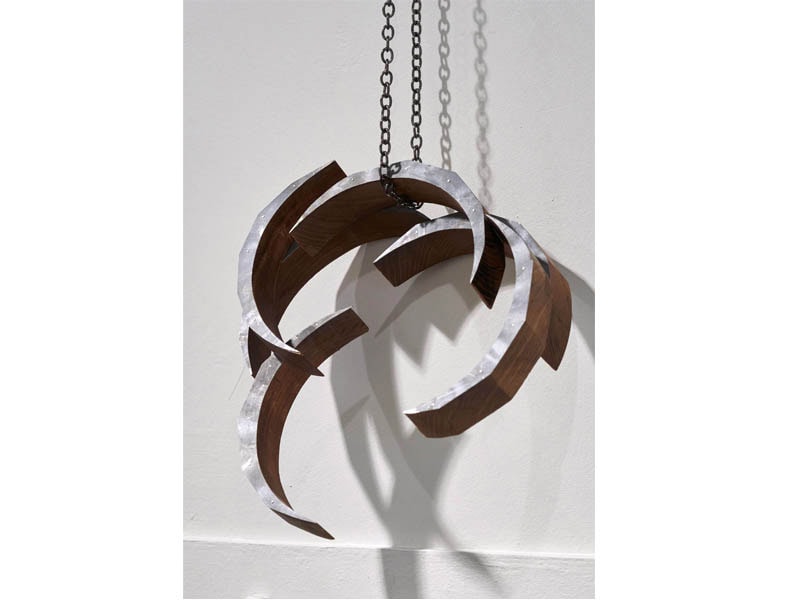
"I sometimes feel that contemporary jewelry is still expected to justify its presence within contemporary art," she observes. When she studied jewelry in a French fine art school, she frequently encountered the dismissive notion that the medium was somehow "less," superficial, or niche. While she views this outsider status as a strength that fosters fresh perspectives, it also underscores a lingering distance between the field and broader audiences.
To bridge that gap, some of her pieces, such as Panicroom Vector I, are intentionally more literal, acting as conceptual keys that invite viewers into the work. Winning recognition from the Young Artist Award confirms for Locquet that she is firmly on the right path.
Looking Forward
Looking ahead to the next five years, Locquet feels deeply satisfied with the evolution of her practice since her graduation. She has recently begun expanding her sculptural thinking into the surrounding architectural space, aiming to make objects and environments resonate in harmony—a development she plans to showcase in upcoming exhibitions. Alongside her studio practice, she hopes to secure further residencies, collaborate with fellow artists, and eventually move into research and teaching.
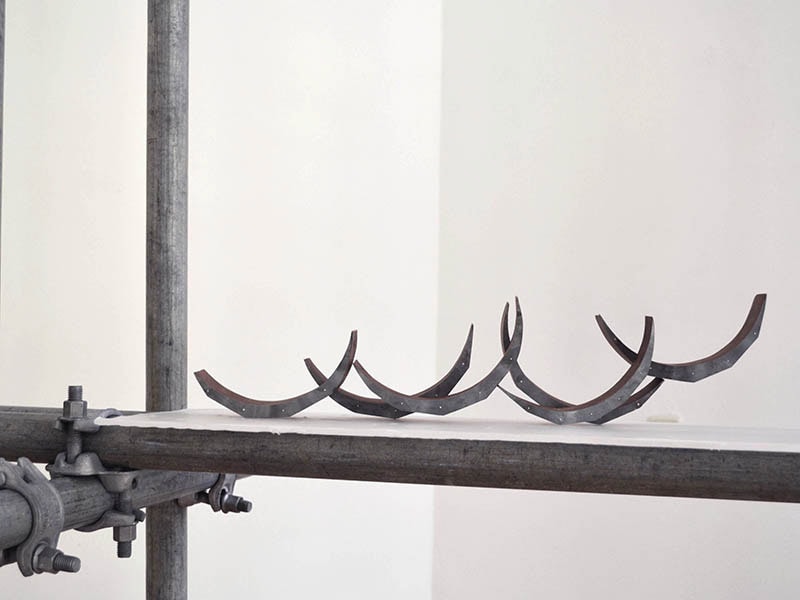
"It’s the best space to reinvent, to push forward the collective notion of body ornament, and the way we can still extend, deform, shape, and question the definition of jewelry," Locquet reflects. "Let’s see what happens in the future. I trust the process, will keep working, and want to thank everyone who supports my work. They have my endless gratitude."