The walls of Paris’s iconic Musée d’Orsay have plenty to say, and renowned American conceptual artist Jenny Holzer is finally giving them a powerful, unvarnished voice. Opening on October 20, 2026, a sweeping new exhibition titled J’ai Vu (I Saw) completely reimagines the grand former railway station, transforming the monumental Parisian landmark into a vast, breathing canvas of illuminated words, moving digital texts, and intricately engraved stone sculptures.
Developed in deep collaboration with the curatorial team at the Musée d’Orsay, the exhibition draws extensively from the rich written archives of the turbulent historical period represented within the museum’s permanent collections. By weaving together artistic correspondence, political commentaries, passionate literary manifestos, and forgotten historical accounts, Holzer bridges the gap between past and present. Rather than simply offering a nostalgic or academic revisiting of the nineteenth century, the artist forces historical voices into direct, urgent confrontation with contemporary anxieties, proving that many of humanity’s most pressing conflicts, struggles, and contradictions are far from resolved.
Monumental Light Projections Illuminate the Paris Skyline
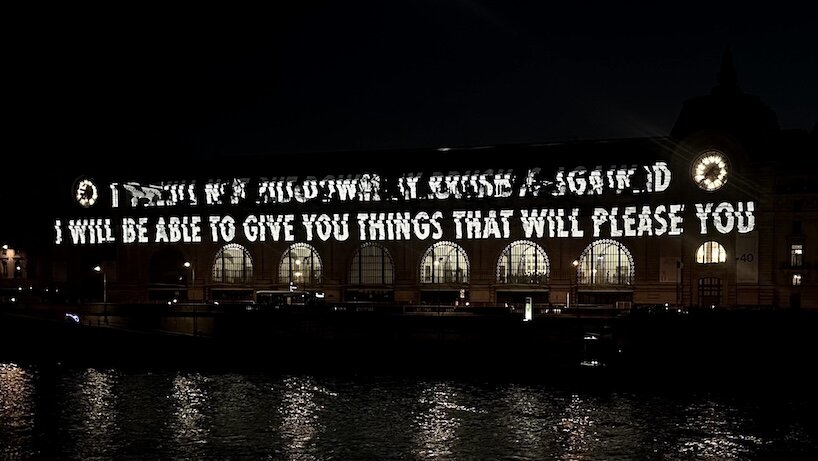
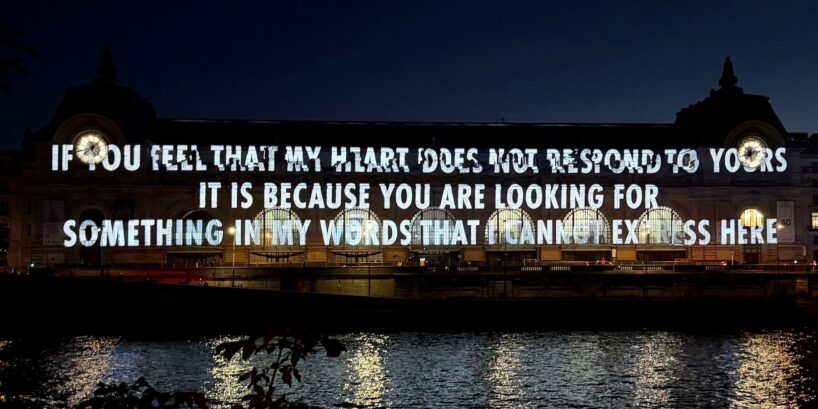
The sprawling public intervention begins well before visitors even step foot inside the museum doors. Across the building’s grand, historic facade facing the River Seine, Holzer presents ÉCLAIR, a breathtaking series of monumental light projections running from October 18 to October 22, between the evening hours of 7:00 PM and 11:00 PM.
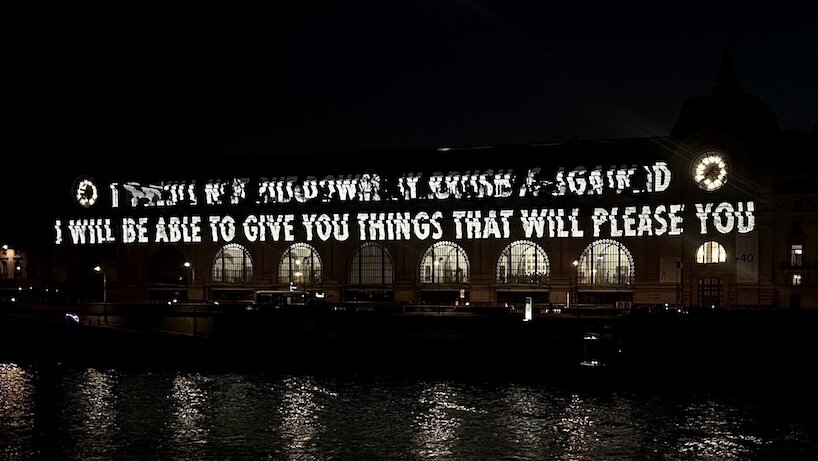
Drawing upon approximately 250 carefully curated excerpts authored by 34 distinct historical figures—including monumental literary and artistic titans such as Vincent van Gogh, Paul Cézanne, Gustave Flaubert, and Émile Zola—Holzer drapes the architectural stonework of the Seine-facing facade in glowing, luminous words. Passersby along the riverbanks can experience the projections freely as personal letters, sharp literary passages, and intense political reflections ripple across the monumental architecture. This temporary transformation turns one of Paris’s most recognizable cultural landmarks into an open-air public display of history in motion, inviting thousands of onlookers to absorb the written anxieties of past centuries against the backdrop of the modern Parisian night sky.
Dynamic LED Installations Reanimate the Former Railway Station
Upon entering the grand halls of the Musée d’Orsay, visitors are immediately greeted by a massive, site-specific LED installation designed by Holzer that snakes through four distinct galleries dedicated to history painting, naturalism, symbolism, and the realism of Gustave Courbet.
In these soaring spaces, vibrant streams of brightly colored text pulse and glide along the walls, injecting fierce historical voices into rooms traditionally dominated by static paintings and classical sculptures. The installation is meticulously calibrated to respond to the unique architecture of the building and the natural circulation of modern museum-goers. In doing so, the artwork cleverly recalls the structure’s original nineteenth-century identity as the bustling Gare d’Orsay. Once a bustling terminal designed for moving weary passengers from across France, the grand railway-turned-museum now finds itself transporting language, ideas, and urgent historical truths instead.
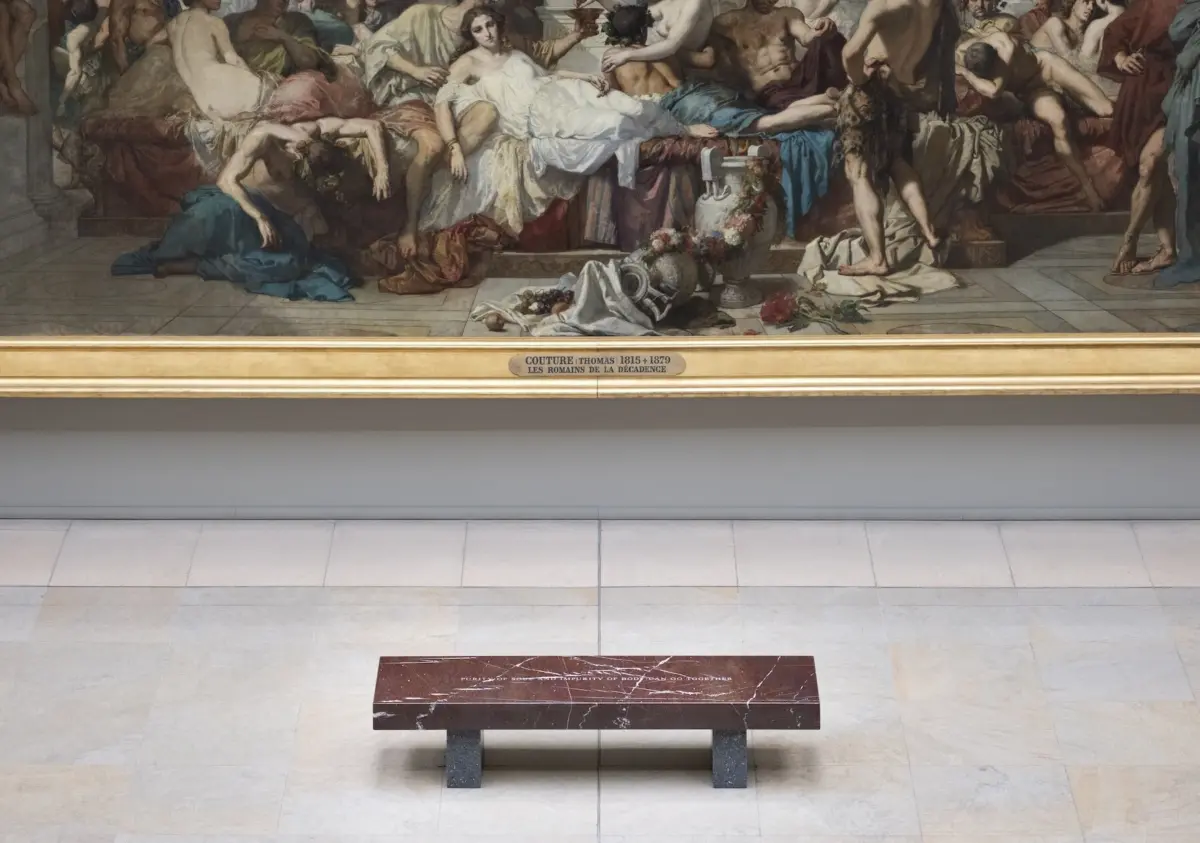
Complementing the luminous digital streams, Holzer introduces 19 custom stone sculptures distributed thoughtfully throughout the museum’s sunlit ground-floor galleries and open public spaces. Comprising 17 stone benches and two vertical columns crafted specifically for J’ai Vu, these works feature deeply engraved texts dating primarily from the critical period between 1848 and 1914. Holzer selected each variety of stone after rigorous research into its geological origin and physical character, establishing a rich material dialogue with the museum’s existing collection of classical sculptures and ornate stone pedestals. Unlike the fast-moving LED displays overhead, these permanent or semi-permanent stone inscriptions invite a much slower, more contemplative encounter with language, turning familiar architectural furniture into powerful objects that demand close, deliberate reading.
Confronting War, Secrecy, and Censorship Through Art
The exhibition shifts toward a distinctly political and somber register within the museum’s history painting galleries. Here, Holzer has orchestrated a striking new presentation centered unflinchingly on war, civil conflict, and state power. Historical paintings from the museum’s permanent collection are displayed in direct dialogue with Holzer’s own contemporary metallic paintings, crafted using precious applications of gold, platinum, and palladium leaf.
These reflective metallic surfaces directly reference recent and ongoing international conflicts. Based on declassified yet heavily redacted government and military documents, the paintings intentionally conceal substantial portions of their original texts beneath gleaming metallic layers. This leaves only isolated, haunting fragments visible to the viewer, raising urgent questions regarding government secrecy, institutional accountability, and the dangerous blurred boundaries between legitimate confidentiality and the deliberate concealment of wrongdoing. A separate, light-filled gallery overlooking the Seine extends this powerful presentation, allowing shifting natural daylight to continuously transform the reflective, metallic surfaces throughout the course of the day.
A Monumental Portrait of History in Flux
Altogether, J’ai Vu brings together an astonishing collection of more than 750 distinct texts sourced from 424 individual documents and 73 unique authors. This makes the ambitious undertaking arguably Jenny Holzer’s most extensive and comprehensive selection of written material ever assembled for a single institutional exhibition.
The thematic scope of the texts is remarkably vast, ranging from the trauma of the Franco-Prussian War and the bloody fracture of the Paris Commune to the complexities of European colonialism, early radical anarchism, burgeoning labor movements, military corruption, and the grinding everyday realities of Haussmann-era urban development in Paris. By bringing these competing, often contradictory perspectives into the exact same physical space, Holzer constructs a complex portrait of history that actively resists any singular, tidy interpretation.
Whether projected in blinding light across a historic stone facade, carved indelibly into heavy geological stone, or partially erased beneath sheets of precious metals, the words chosen by Holzer expose how chillingly close the anxieties, fears, and political struggles of the past truly resemble those of the modern era. Through this monumental intervention, Jenny Holzer reminds the public that history has never been particularly good at keeping quiet, and that the voices of the nineteenth century still have urgent instructions for the twenty-first.