






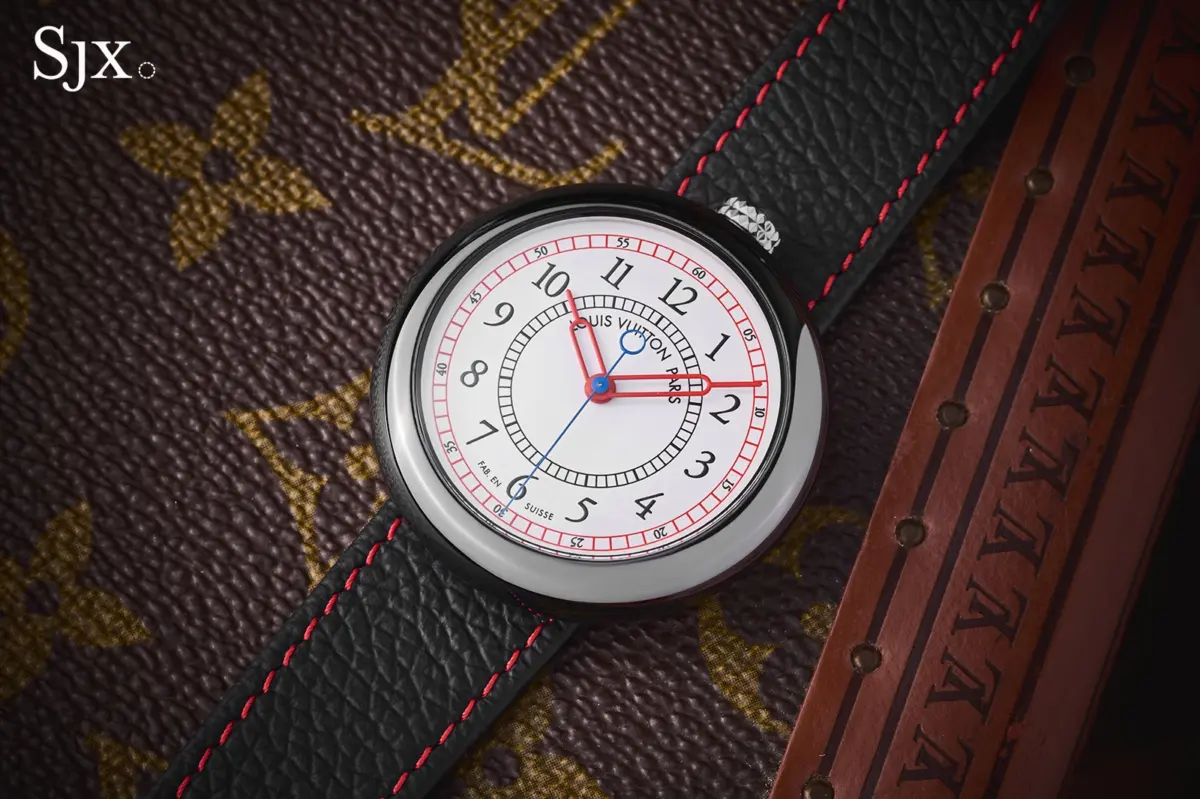
Louis Vuitton has officially introduced the second chapter of its ambitious 1980s watchmaking revival, unveiling the Monterey Ceramic. Following last year’s luxury-oriented debut modeled after the historical Montre LV I in 18k gold, this latest iteration draws inspiration from the archival Montre LV II. Styled closely after its celebrated predecessor, the new Monterey Ceramic adopts a simpler, more streamlined approach in its material execution. By shifting away from precious metals and opting for contemporary technical materials, the brand has managed to make this avant-garde design significantly more accessible, though it firmly remains in the luxury tier.
Instead of the solid 18k gold case seen on the inaugural model, the Monterey Ceramic features a high-tech ceramic case available in a glossy finish of either deep black or striking green. This vibrant or stealthy ceramic shell is paired with a contrasting steel case back, balancing modern material science with traditional horological architecture. On the dial side, the fired enamel of the gold predecessor is replaced by a clean, crisp lacquer dial—white for the black ceramic variant and matching green for its counterpart. Despite utilizing a more industrial production approach rather than handcrafted precious metals, the Monterey Ceramic proudly retains a proprietary, high-end mechanical movement crafted by La Fabrique du Temps (LFT), reinforcing Louis Vuitton’s dedication to serious industrial-haute horlogerie.

Initial Thoughts and Historical Context
The original Monterey—or more accurately, montre, the French word for watch—was born in 1988 as a distinctive, highly idiosyncratic, and surprisingly timeless design penned by renowned Italian architect and designer Gae Aulenti. At the time of its creation, it was never positioned as a ultra-exclusive high-end watch, relying instead on quartz movements and avant-garde industrial aesthetics. Today’s modern recreation, however, completely upends that positioning by transforming Aulenti’s quirky concept into a serious, high-horology mechanical timepiece.
While last year’s 18k gold Monterey carried a decidedly steep price tag that limited its audience to dedicated collectors, the new Monterey Ceramic dials back on the precious materials to reduce the retail price by roughly half. When paired with the sophisticated, Geneva-made proprietary calibre ticking away inside, this pricing strategy positions the Monterey as a surprisingly competitive offering against established traditional watchmakers.

Yet, the visual identity of the Monterey remains resolutely unconventional. The style was wonderfully unorthodox when Aulenti first sketched it out in the late 1980s, and it continues to challenge design norms today. The unusual case construction gives the watch a distinctly bulbous, architectural silhouette. Although the physical height of the case measures a modest 11 millimeters, it wears with a more prominent visual presence on the wrist. Rather than detracting from the experience, this pronounced volume is widely regarded as a core component of the watch’s unique charm.
The Monterey serves as an appealing and quirky testament to the rapid expansion and soaring quality of Louis Vuitton’s watchmaking division. Ever since Jean Arnault took the helm of the brand’s watchmaking initiatives, the house has enjoyed a steep and impressive upward trajectory, consistently bridging the gap between high-fashion prestige and genuine watchmaking credibility. While some purists might wish that Louis Vuitton had retained the artisanal fired enamel dial of the gold model while keeping the new, more approachable price point, the current iteration nevertheless stands as a compelling and artistic value proposition in the modern market.
An Offbeat Architectural Design

Gae Aulenti originally conceived both the Montre LV I and the Montre LV II, which served as the stylistic blueprints for the gold and ceramic iterations, respectively. While the previous year’s release leaned into the luxurious territory of the LV I, the new Monterey Ceramic follows the design language of the LV II and is produced as a regular production model rather than a strictly limited edition.
Maintaining identical proportions to its historical muse, the new Monterey Ceramic measures 37 millimeters wide and 11 millimeters high. While the 37 mm diameter matches the original 1980s reference, the case has been subtly built up in thickness. This minor adjustment in height successfully brings the proportions into better alignment with contemporary watch collecting conventions, preventing the piece from feeling too diminutive by modern standards.
Despite its compact diameter, the watch defies expectations on the wrist. It commands a surprising amount of visual real estate, a phenomenon driven largely by the bulbous architecture of the case and the unique structural integration of the strap. True to the historical design, the new Monterey utilizes a distinctive one-piece strap that slides seamlessly into a specialized slot running directly underneath the case. This unorthodox attachment method was a mandatory feature of Aulenti’s original blueprint, and its retention is a welcome nod to the integrity of the initial industrial design.

This clever strap integration instills the watch with an instrument-like feel, which is hardly surprising given Aulenti’s distinguished background in architecture and industrial design. The functional, no-nonsense ethos extends directly to the dial layout, which echoes the clean lines of the original while adapting to a simpler mechanical display.
Whereas the vintage original was a multi-functional quartz timepiece featuring both a date complication and an alarm function—resulting in a complex array of scales across the dial—the modern ceramic version focuses entirely on timekeeping purity. The multi-functional scales of the past have been condensed to accommodate a clean three-hand display. This layout significantly enhances everyday legibility while carefully preserving the visual spirit and minimalist aesthetic of Aulenti’s Montre II.
The dial is rendered in a high-quality, glossy lacquer, available in white for the black ceramic model or green for its colored sibling. While the lacquer finish is clean, well-executed, and entirely sufficient for a watch of this character, it lacks the microscopic depth and artisanal complexity of the fired enamel dial found on its more expensive gold predecessor. Above this lacquer backdrop sweep the skeleton syringe hands, which serve as an unmistakable signature design element directly inherited from the original Monterey family.

Mechanical Execution by La Fabrique du Temps
Tucked securely beneath the solid steel case back is the LFT MA01.02, an automatic movement that belongs to a proprietary calibre family developed entirely by La Fabrique du Temps. This movement engine powers many of Louis Vuitton’s most sophisticated contemporary timepieces, boasting a level of construction and mechanical integrity that easily compares to standard-setting workhorse movements crafted by historic Geneva-based manufactures.
Given the compact proportions and specific material constraints of the 37 mm ceramic case, the LFT MA01.02 is necessarily petite in physical dimensions. Consequently, it delivers a standard power reserve of 45 hours when fully wound. However, it compromises nothing in terms of execution, incorporating all the essential elements expected of modern industrial-haute horlogerie in both its structural architecture and its surface finishing. Among its finer technical highlights are a Geneva-style stud carrier and a modern free-sprung balance wheel, ensuring both chronometric stability and long-term reliability.

The movement finishing adheres firmly to Louis Vuitton’s distinctive house style, which leans toward a slightly unconventional aesthetic. Key hallmarks include clear rubies and frosted, recessed surfaces across the movement bridges. This contemporary industrial aesthetic complements the quirky personality of the Monterey collection exceptionally well, even if the intricacies of the decoration remain hidden from view behind the solid steel case back. Powering the automatic winding system is a 22-karat red gold oscillating weight featuring a finely engine-turned edge, providing a subtle touch of traditional luxury to an otherwise thoroughly modern movement.
Key facts and price
Louis Vuitton Monterey Ceramic
Ref. W0CR11 (black ceramic)
Ref. W0CR21 (green ceramic)

Diameter: 37 mm
Height: 11 mm
Material: Ceramic and steel
Crystal: Sapphire
Water resistance: 30 m
Movement: LFT MA01.02
Functions: Hours, minutes, sweep seconds
Winding: Automatic
Frequency: 28,800 beats per hour (4 Hz)
Power reserve: 45 hours
Strap: Calf leather strap with steel pin buckle

Limited edition: No
Availability: Only at Louis Vuitton boutiques
Price: €19,000 before taxes