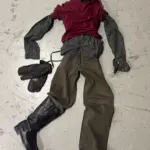




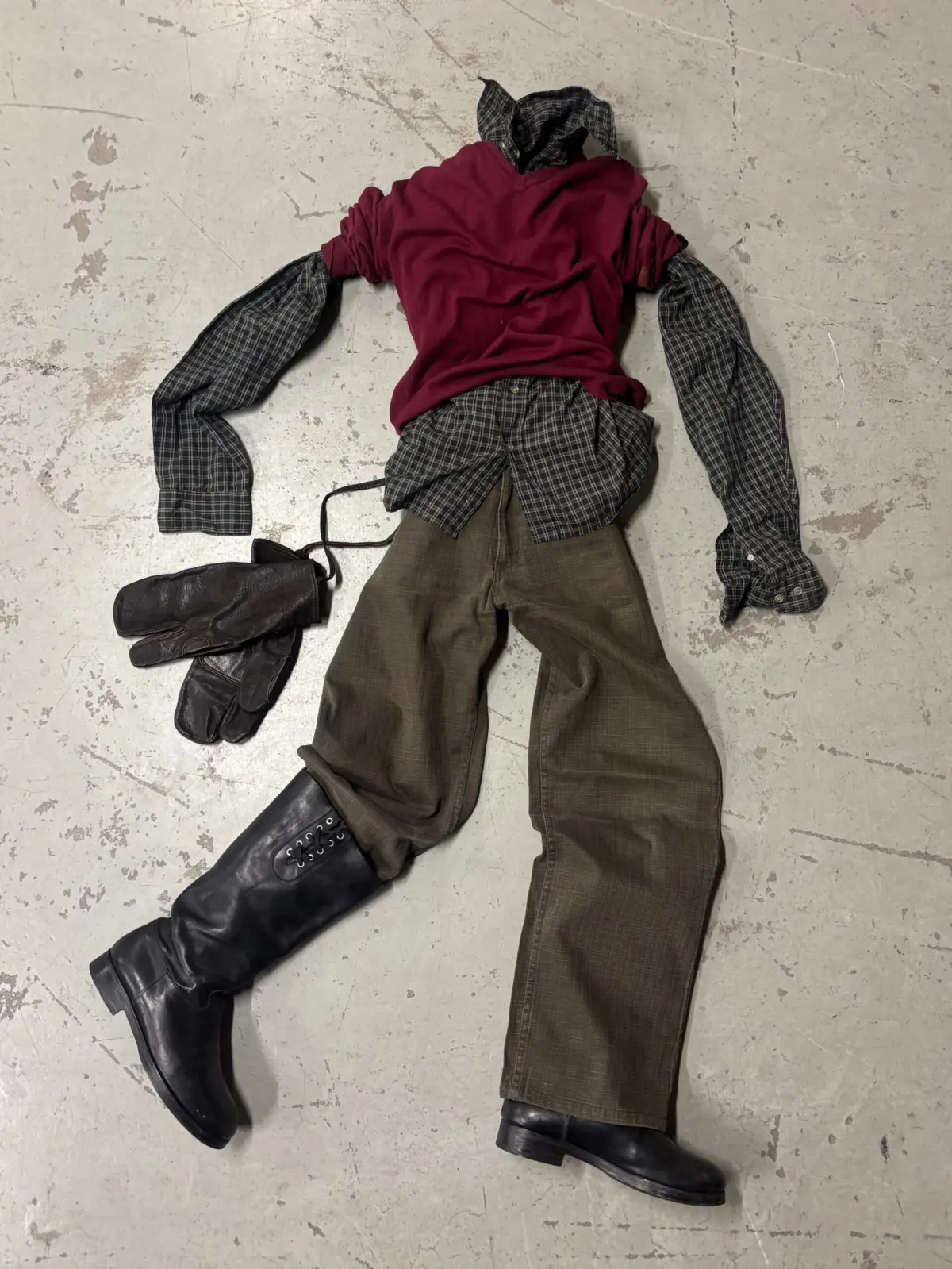
Do clothes make the man? It is an age-old question, but Portrait of the Absent, a striking new book of flat-lay photographs by Swedish artist Jack Jildevik, reframes the inquiry in an entirely unprecedented way. Over the course of a year, Jildevik crafted a series of bodiless self-portraits by meticulously arranging carefully curated ensembles on the concrete floor of a storage facility. The resulting images present a profound meditation on identity, memory, and the enduring power of garments stripped of the human form.
“I think it’s fascinating how much of someone’s identity can exist in the things they leave behind,” Jildevik reflects.

Coincidentally or not, the flat-lay aesthetic has begun quietly creeping into contemporary fashion photography just as modern pharmacological interventions like Ozempic have begun rapidly shrinking bodies across culture. Yet, this macro-trend had nothing to do with Jildevik adopting the format for a project that is, at its core, achingly personal. Instead, the format arose from a lifelong obsession with objects, materiality, and the unspoken narratives carried by vintage textiles and designer archives.
The book is published by Prince, a new publishing house spearheaded by Berlin-based art director Elsa Mueller, who collaborated closely with Jildevik on the project. Mueller speaks to the uncanny visual power of the flat-lay technique, noting how it plays a dual role of revelation and concealment.

“I find flat-lay fascinating because it can expose the essence of an object while simultaneously distorting its shape,” observed Mueller. “It reveals and conceals at the same time, making something ordinary feel strangely mysterious.”
Born and raised in Stockholm, Jildevik initially pursued a traditional path, earning a law degree in his native city before moving to Paris to study fashion business and communication at ESMOD. Following his studies, he gained valuable industry experience working with avant-garde labels like CMMN SWDN and Hodakova. However, an unexpected accident broke the linearity of his career, prompting a decisive pivot toward independent art.

Creativity, however, was nothing new to him. Jildevik describes himself as having been an overly nostalgic child, perpetually drawn to—and nearly obsessed with—old objects, forgotten materials, and the silent lives they carried. That foundational fascination has quietly underpinned every phase of his creative journey.
Within the pages of Portrait of the Absent, the artist himself exists as a ghostlike constant. The book derives much of its striking power from the way it deliberately resists the relentless centrality of the human body and the rampant narcissism that defines much of modern digital culture. Jildevik’s photographs function simultaneously as portraits of garments and portraits of the man who collected them. This philosophical stance—granting a piece of clothing the distinct status of a stand-alone object—runs entirely counter to the received wisdom of the fashion industry, which traditionally holds that a living body is required to complete a garment.

“Removing the body altogether and letting the things that would normally surround or cover it take its place is something that really interests me,” Jildevik explains. “I’ve spent over 15 years collecting clothes and objects, and they’ve all become part of my life in different ways. They carry memories, different periods of my life, and sometimes versions of myself that no longer exist.”
By taking these garments out of their original context, rearranging them into careful compositions on a storage facility floor, and photographing them as self-portraits, Jildevik achieves a paradoxical effect. The living person is physically absent from the frame, yet virtually everything that makes a portrait deeply personal remains intact.

Traditionally, the face serves as the focal point of any portrait, acting as the primary anchor for human recognition and emotion. Jildevik’s book challenges viewers to consider how clothing can communicate identity completely independently of the body, physical gestures, or facial expressions. Instead, identity is conveyed purely through arrangement, spatial orientation, and the quiet historical weight of the textiles themselves.
Reflecting on his lifelong relationship with physical objects, Jildevik points to a childhood steeped in second-hand culture. Growing up with parents who were avid flea market enthusiasts and vintage geeks, he caught the collecting bug at an extremely early age. Starting with small action figures and porcelain trinkets, his passions eventually evolved into an architectural appreciation for fashion history.

“I’ve always been obsessed with collecting. Ever since I was a kid, I’ve always cherished my things a lot—not expensive things, but finding things that only I have,” Jildevik says. “For me, it’s so much about the stories that these things carry. I can’t throw anything away because everything means so much to me.”
That collecting instinct naturally expanded into a deep, scholarly passion for fashion when he was just fifteen years old. His expansive wardrobe archive is largely built from flea market finds and vintage discoveries. His coveted designer pieces are predominantly sourced from elderly men across Italy and tucked-away Parisian flea markets. Operating never on a massive corporate budget, but rather through personal sacrifice and devotion, Jildevik has always viewed his collection as an emotional investment.

While he holds a deep reverence for independent design pioneers, his relationship with high fashion remains idiosyncratic. Martin Margiela was his first major designer love—a sentiment shared by many avant-garde aficionados, though Jildevik notes that before discovering the Belgian designer’s radical vision, his focus was simply on the raw utility and character of clothes.
The genesis of Portrait of the Absent emerged organically from youthful experimentation. Growing up, Jildevik frequently arranged outfits on the floor to visualize characters before going out, sometimes laying out three distinct personas at once. One day, he decided to photograph one of these arrangements. Struck by how cool the resulting image looked, the concept slowly expanded—first into a plan for a single month, and eventually evolving into a grueling, year-long artistic challenge.

For years, Jildevik collected garments, repairing them, altering them, and occasionally treating them as wearable armor. Often, pieces were so radical that he scarcely dared to wear them in public, yet putting them on allowed him to step outside his own skin and inhabit a character. Dealing with a lifetime of anxiety and overthinking, getting dressed functioned as a vital escape mechanism.
“Getting dressed has often been a way of escaping those feelings. Putting on my armor for the day, becoming whoever I wanted to be in that moment,” he admits.

However, the act of creating his 365-day photographic project altered his internal landscape. As he dared to fully embrace his artistic practice, a profound sense of freedom took root. While self-doubt remains a familiar companion, the urgent psychological need to hide behind a sartorial armor has faded. In a profound twist, the artist has effectively become one with his creations.
When asked what the book ultimately communicates about its creator, Jildevik points directly to an unwavering obsession with the object itself. By isolating the garments from the human form, the project forces viewers to see clothing in an entirely new light. Even though the 365 featured outfits vary wildly in composition and era—incorporating everything from vintage military gloves and utilitarian coats to archival pieces by Martin Margiela, Comme des Garçons, and Helmut Lang—a distinct authorial signature remains legible throughout.

“You can see some kind of obsession and appreciation of the object. [I think you] see clothes in a different, new kind of way,” Jildevik reflects. “When you remove the body, it’s just clothes. But I think just clothes can be so much more than just clothes. I really want to show appreciation of the garments and that I’m obsessed with them.”
Having successfully completed the massive year-long undertaking, Jildevik is already looking toward future creative horizons, contemplating new ways to expand upon the core concept—including the possibility of applying his bodiless portraiture technique to other individuals.

The philosophical question of whether fashion constitutes art is one Jildevik approaches with nuance. While legendary designers like Martin Margiela historically distanced fashion from high art, Jildevik views Margiela’s rigorous craftsmanship, structural design, and conceptual processes as undeniably artistic.
“For me, it’s art. But if I would get the question and have to say yes or no, I would say no, but it’s a no with a lot of buts and ifs. I don’t think fashion is art per se, but I think fashion can be art. And I think fashion is such a big word where it includes so much,” he notes.

This artistic exploration touches upon broader societal themes, including the universal human impulse to seek creativity through a childlike mindset. For Jildevik, childhood represents an unburdened space where absolute freedom reigned, unhindered by the pressure of correctness or professional validation.
“I think childhood is, for me, a place where everything was possible. I think maybe I am escaping through creativity. If I go back to my childhood, I can be free and I can do whatever, and it doesn’t matter. I don’t have to be right, I don’t have to be good, it can just be,” he reflects.

Yet, as people enter the adult world, clothing frequently shifts from a playground of pure imagination into a rigid social tool. Society relies heavily on garments to make immediate assumptions about status, profession, and cultural alignment. In places like Sweden, where traditional religious frameworks are largely absent and social reservedness prevails, clothing often serves as a subtle, silent marker of belonging. Whether it is schoolchildren uniformly wearing identical jeans and hoodies or office workers adopting corporate dress codes, attire provides a non-verbal signal of inclusion in an otherwise solitary society.
Jildevik also observes a broader cultural shift within the contemporary fashion and art industries, noting with frustration how corporate consolidation and multi-billion-dollar art valuations risk pulling these creative mediums away from their authentic roots. Art, in his view, is fundamentally meant to be cherished and shared in its rawest form, serving as a conduit for genuine human connection.

“Nothing makes me feel closer to another person than experiencing something they’ve created that I really connect with,” Jildevik says. “Sometimes I almost feel like I’m becoming one with them, like I’m being invited into their inner world and getting to share that space for a moment.”
The physical design of Portrait of the Absent mirrors these thematic concerns of trace, presence, and absence. Collaborating publisher and designer Elsa Mueller conceived a unique slipcase that echoes Jildevik’s physical working methods. The slipcase print was created by pressing an actual shirt directly onto an inked gel plate, leaving a physical imprint that was subsequently transferred onto paper. Though the physical shirt is gone, its exact trace remains.

Furthermore, Mueller designed the interior layout so that every single image occupies the exact same spatial position on the page, allowing readers to slowly perceive subtle, evolving transitions as they flip through. Eschewing a rigid narrative arc, the book features no definitive beginning or end, inviting readers to enter and exit the sequence at any point.
Through thirty-six hundred accumulated moments of arrangement, Jack Jildevik has successfully captured the essence of a life through the inanimate objects that accompany it. In doing so, Portrait of the Absent redefines the boundaries of self-portraiture, proving that a person can be vividly, hauntingly present even when they are entirely missing from the frame.