





The eternal tension of the modern metropolis lies in the ongoing clash between urban order and the unpredictable, visceral experience of wandering. For over a century, architects, philosophers, and planners have grappled with this fundamental dichotomy—a space where mechanical efficiency routinely gives way to mood, pure chance, and spontaneous discovery. Nowhere is this ideological battle more clearly defined than in the stark contrast between Le Corbusier’s highly calculated vision for Paris and the subversive, drift-oriented philosophies that emerged in response to it decades later.
Le Corbusier’s Plan Voisin Reorganizes Paris
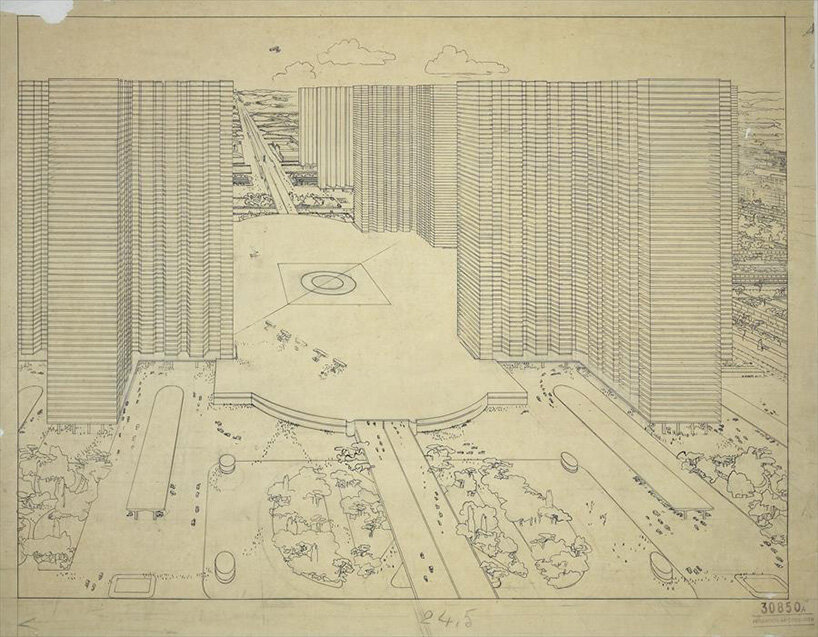
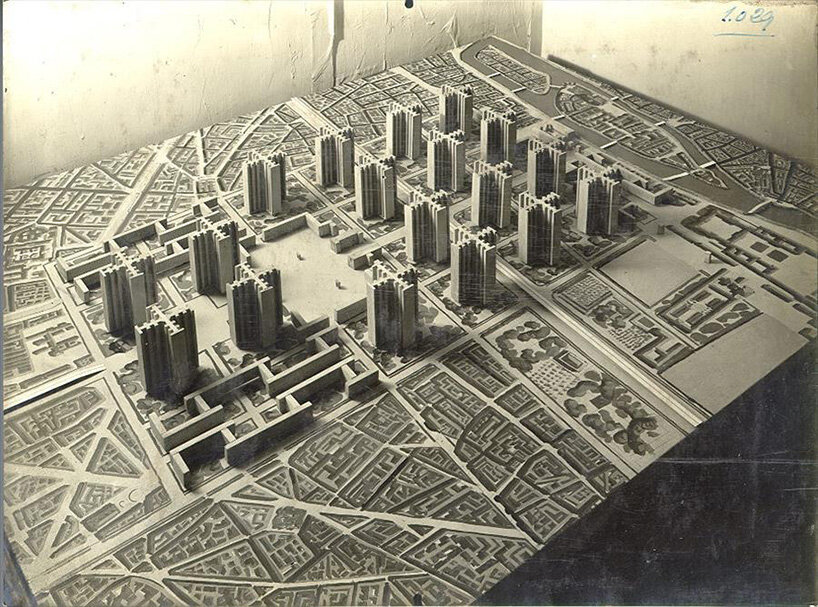
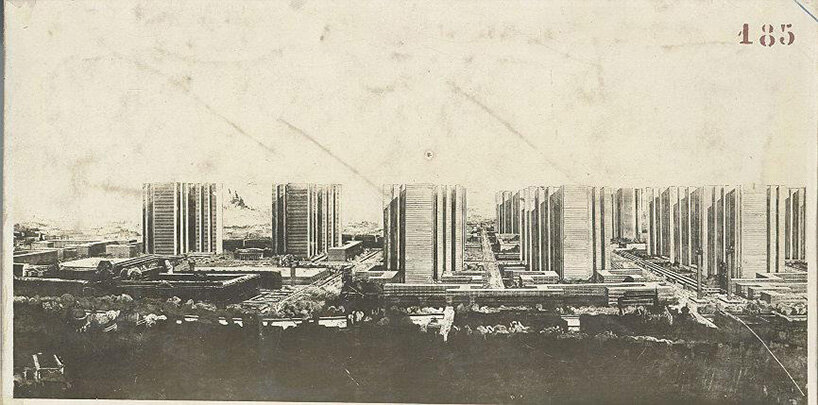
In 1925, Swiss-French architect Le Corbusier imagined Paris not as a sprawling, historically layered labyrinth, but as a highly ordered, rational urban system. His sweeping proposal, known as the Plan Voisin, sought to radically restructure a large, historic section of central Paris by replacing it with cruciform office towers, uniform residential blocks, wide open green spaces, and a rigorously organized, hierarchical road network.
The radical scheme was conceived primarily as a direct response to the deep-seated urban anxieties of the era: chronic overcrowding, severe traffic congestion, and poor sanitary conditions within the dense fabric of the city. However, it also advanced a much broader, uncompromising ideology of urban life. Under Le Corbusier’s vision, urban functions were strictly separated, human movement was systematically organized, and the city became entirely legible as a single, flawless, comprehensive system.
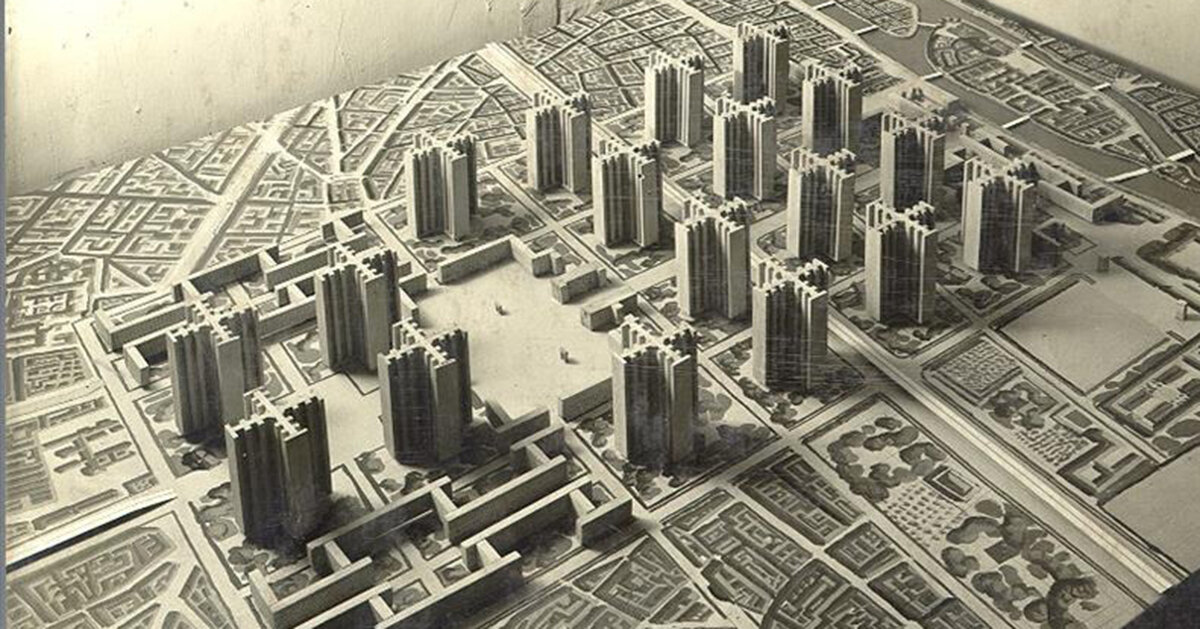
Had it been realized, the proposal would have demolished much of the existing urban fabric—particularly across the historic Marais district and its surrounding neighborhoods—while carefully preserving iconic monuments such as the Louvre, the Palais-Royal, and the Place Vendôme. Eighteen towering cruciform office blocks would have risen dramatically from an expansive, open landscape, with residential structures zoned completely apart from the primary business district.
Although the Plan Voisin was never built, its core principles permanently embedded themselves into the broader modernist approach to global urban planning. The absolute separation of urban functions, the vertical concentration of architecture to free up ground level, and the aggressive prioritization of vehicular and pedestrian circulation continued to shape architectural theory for decades. These ideals eventually manifested in projects like the Ville Radieuse (Radiant City) and the codified doctrines of the Athens Charter.
Then Chtcheglov Starts Somewhere Else
Almost three decades after Le Corbusier drafted his blueprint for hyper-efficient urbanism, French philosopher and writer Ivan Chtcheglov looked at the modern city and diagnosed a completely different societal ailment: boredom.
Writing in his seminal 1953 text, Formulary for a New Urbanism—published under the pseudonym Gilles Ivain—Chtcheglov issued a passionate call to arms for "new, changeable decors" capable of morphing alongside the desires and moods of the people inhabiting them. Chtcheglov was remarkably blunt in his critique of high modernist architecture, pulling no punches when evaluating Le Corbusier’s legacy. He famously described the Swiss architect’s high-rise paradigms as environments better suited for "factories and hospitals"—and, ultimately, prisons—before accusing him of systematically stripping away human "joy," "love, passion, and freedom."
In direct opposition to cities designed around the rigid geometries of the Plan Voisin, Chtcheglov imagined an architecture capable of actively altering human moods, generating vivid dreams, and fundamentally transforming how individuals experienced their immediate surroundings. He conceptualized visionary domestic spaces: houses that rotated continuously with the sun, sliding walls that allowed dense vegetation to creep indoors, and buildings whose outward appearance could shift on a whim according to the changing wishes of their inhabitants. Pushing this concept to an even grander scale, he proposed dividing an entire city entirely according to human emotion and psychological states, mapping out distinct zones such as a Bizarre Quarter, a Happy Quarter, a Noble and Tragic Quarter, and even a Sinister Quarter.
A City Built for Getting Lost
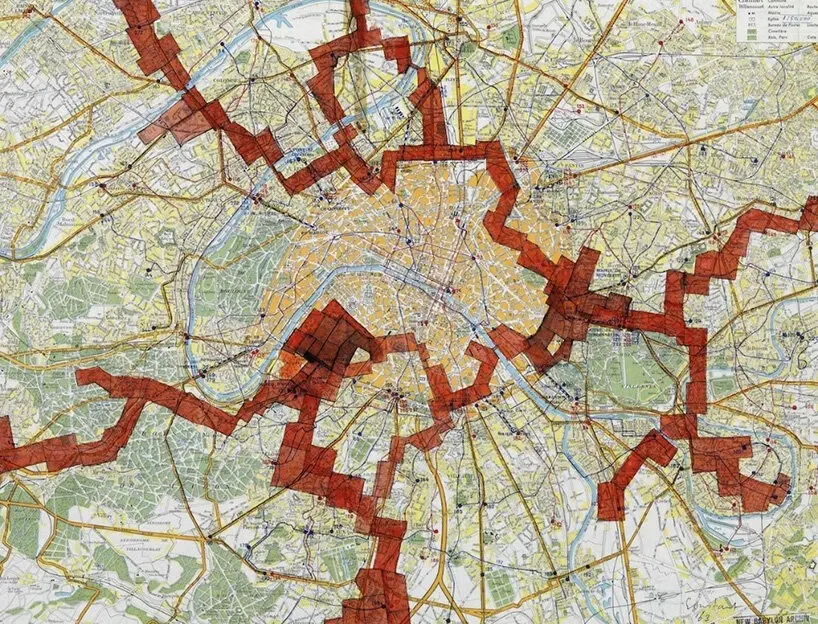
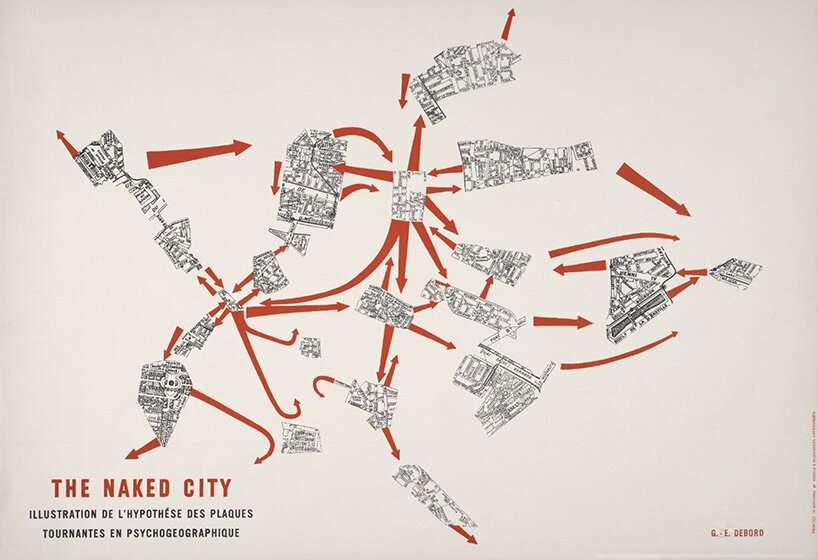
While Le Corbusier’s master plan began with the foundational premise that the city could, and should, be completely reorganized according to a rigid, rational structure, Chtcheglov was fascinated by the chaotic possibilities of what happens when the movement through a city is entirely unorganized.
The Situationist International movement later described this unscripted wandering through urban terrain as the dérive—a technique where individuals allowed the physical pull of streets, changing architectural styles, and shifting atmospheric conditions to dictate the trajectory of their journey. For Chtcheglov, a building or a street did not need to serve a singular, utilitarian purpose. Instead, it could actively disrupt the mood of a walk, pull a pedestrian off course in an unexpected direction, or make a deeply familiar part of the city suddenly feel strange and exotic.
For the drifting urbanite, arriving at a destination was only a minor part of the experience; the journey itself became the entire point. This philosophy of drifting runs directly counter to the modern logic of optimization and efficiency. The shortest route gets a traveler to their destination faster, but Chtcheglov was intensely interested in the hidden discoveries waiting down the long, winding detour.
"The main activity of the inhabitants will be CONTINUOUS DRIFTING," he wrote, envisioning urban landscapes that would shift dramatically from one hour to the next, producing what he termed "total disorientation." The ultimate objective was not to reach a terminal point efficiently, but to surrender to the unpredictable currents of the city.
Through this lens, even the most mundane, everyday street could transform into something entirely alien. A looming building might draw a wanderer inside, a sudden shift in atmospheric light could send them down an unmapped alleyway, or an unexpected pocket space could make an ordinary neighborhood feel utterly unfamiliar.
It is difficult to imagine any urban philosophy further removed from the ethos of the Plan Voisin. Le Corbusier’s city is meticulously drawn from an aerial perspective, with its functions, zoning, and circulation worked out long before a single foundation is poured. Chtcheglov’s city, by contrast, only truly comes alive when people let go of their maps and start wandering blindly through its streets.
The Value of Taking the Long Way
To be fair to the history of modernism, Plan Voisin was formulated as a direct response to very real, pressing urban crises. Paris was grappling with severe overcrowding and deplorable sanitary conditions, and progressive architects were desperately searching for ways to introduce vital sunlight, fresh air, and open green space back into the suffocating urban core.
Yet, a paradox remains: the more comprehensively those physical problems are solved through top-down planning, the more predetermined and sterile the city becomes. If every single building is assigned a permanent function, every thoroughfare is engineered for maximum throughput, and every human movement is accounted for in advance, there is drastically less physical and psychological room for the unplanned detours, informal gatherings, and spontaneous uses that make a city truly feel alive.
This loss of spontaneity is precisely what troubled Chtcheglov. He was drawn to qualitative elements that resist measurement, such as the elusive mood of a particular public square, the magnetic pull of a winding street, or the thrill of stumbling upon a forgotten courtyard by sheer accident. His vision went far beyond simply making urban environments more entertaining; his imagined city was explicitly structured around these complex psychological states. The proposed Sinister Quarter, for example, was designed to evoke genuine psychological unease without presenting actual physical danger, while other specialized rooms were dedicated entirely to dreaming, secrecy, and cultural exoticism.
Placing these two monumental visions side by side reveals a fascinating ideological paradox. Le Corbusier sought to engineer the city for absolute efficiency and hygienic order, while Chtcheglov demanded that people surrender to the drift and embrace the unpredictable. Chtcheglov’s city refused to force every square foot of space to serve a clear, measurable economic purpose—a radical, poetic notion when contrasted against the unyielding logic of modern urban convenience.
While the fastest route across town is undeniably useful, it is also thoroughly predictable. Chtcheglov’s philosophy champions the unexpected encounters born from taking a wrong turn, getting lost, or discovering a place that was never on the itinerary. While Plan Voisin left virtually no physical or conceptual room for such fortunate accidents, Chtcheglov made those accidents the very foundation of urban life.
This article is part of designboom’s SPECTATOR AND SPECTACLE chapter, exploring how wonder gets built, presented in partnership with SolidNature, and examining how mystery might return to a world that has measured most of it away. Discover more stories that turn onlookers into participants, alter perception, and disrupt the everyday.