



Decades after his tragic death, Dutch rock-and-roll icon Herman Brood has achieved a milestone that places him alongside the titans of Dutch art history. An acrylic painting by the charismatic musician, songwriter, and painter has officially been added to the Netherlands’ prestigious National Collection. This inclusion vaults Brood into an elite tier of cultural figures, sharing institutional space with legendary Dutch masters such as Rembrandt, Ferdinand Bol, Piet Mondriaan, and Karel Appel.
The decision, announced by the Cultural Heritage Agency of the Netherlands (RCE), marks a profound shift in how the nation views Brood’s legacy. While he was universally celebrated during his lifetime as the wild, charismatic frontman of bands like Wild Romance and the voice behind hits such as "Saturday Night" and "Never Be Clever," his visual art was often marginalized. With this official state recognition, the cultural establishment is formally acknowledging what his supporters have long maintained: Brood was not merely a rock star dabbling in paintbrushes, but a formidable 20th-century artist who made a substantial and lasting contribution to Dutch culture and history.
“We believe that Herman Brood should be given more prestige as an icon of the twentieth century as an artist,” stated a representative for the RCE, explaining the rationale behind acquiring the piece.
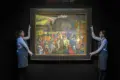
The artwork in question is an untitled, striking acrylic piece created with Brood’s signature unorthodox tools—his ever-present injection syringe and standard paint rollers. The composition features a vivid depiction of two men holding a pistol. For years, the painting hung quietly on the wall of a tax office in The Hague, a rather bureaucratic setting for a work born of chaotic rock-and-roll energy. Earlier this week, however, the painting was carefully removed from the government office and transferred to the RCE’s secure depot in Amersfoort. Upon its archival intake, the state officially christened the piece "rock-’n-roll on canvas."
As part of the 120,000-strong national collection, the painting will now be permanently preserved under optimal museum conditions. Furthermore, it will be made available for loan to museums across the country, ensuring that the public can experience Brood’s unique visual expression firsthand.
“A Junkie Who Painted”
For those who knew Brood intimately during his whirlwind life—which ended in July 2001 when he jumped from the Hilton Hotel in Amsterdam at the age of 54—the national recognition feels almost surreal. Rob Dupré, a close friend of the late musician who now dedicates his time to tracking down and authenticating genuine Brood artworks while exposing counterfeits, expressed sheer astonishment at the news. Speaking to the Dutch public broadcaster NOS, Dupré remarked that Brood would practically rise from the dead if he could witness the honor.
“In life, he was seen as a rock ’n’ roll singer who worked as an artist. Others called him a junkie who painted. As if everyone could do what he did. This news is like winning gold at the Olympics,” Dupré said, capturing the historical condescension Brood often faced from the fine art establishment during his lifetime.
The painting’s previous tenure in a government tax office is believed to have originated from a common arrangement in Brood’s unconventional financial life. According to Dupré, the artist frequently settled his debts with the state using his canvases rather than cash.
“He didn’t do receipts and that kind of civil matter,” Dupré explained. “He painted five paintings and then spent them on alcohol, drugs, and women. He wasn’t really businesslike.”
Dupré also highlighted the subtle, cynical wit embedded within the artwork now owned by the Dutch state. Noting the painting’s stark bureaucrat-like figures and the menacing firearm, Dupré drew a parallel to the universal dread of dealing with government bureaucracy. “Have you ever had an envelope from the Tax and Customs Administration? He deliberately painted those two people’s sweaters in exactly the same colour.” As for the gun brandished by the figures in the painting, Dupré offered a darkly humorous interpretation to the daily newspaper AD: “Everyone would want to have that in their hand when you get a tax assessment, right?”
A Great Honour for the Family
Herman Brood’s widow, Xandra Brood, shared her profound appreciation for the state’s posthumous tribute, noting how deeply her husband would have valued the gesture.
“He would have thought this was a great honour,” Xandra Brood told AD. She also offered a glimpse into his frantic, instinctive creative process, revealing a surprising physical detail about the artist: Brood was actually colour-blind. Because of this, she frequently had to step in to assist him with distinguishing and selecting hues while he worked. “He worked very fast and made several paintings one after the other,” she recalled.
While seeing his work enter the national archives is a historic victory, Xandra Brood noted that the acquisition stops just short of fulfilling her late husband’s ultimate artistic dream. Brood had long harbored a deep ambition to see his work hanging permanently on the walls of Amsterdam’s world-renowned Stedelijk Museum. She remains hopeful that the state’s official recognition—and the subsequent movement of the artwork through national museum loans—might eventually bring that final dream to fruition.
From a financial standpoint, the painting’s entry into the national collection has already altered its status. Previously, the untitled acrylic work carried an estimated market value between 13,000 and 15,000 euros. However, Dupré estimates that the piece’s value has likely surged by at least 50% following its induction into the national archive.
More importantly, Dupré emphasizes that the true value lies in the validation of Brood’s artistic identity. The inclusion of the work in the Rijks collection serves as official recognition of his craftsmanship, cementing his legacy not merely as a talented side-working rock star, but as a legitimate and enduring pillar of Dutch cultural heritage.