





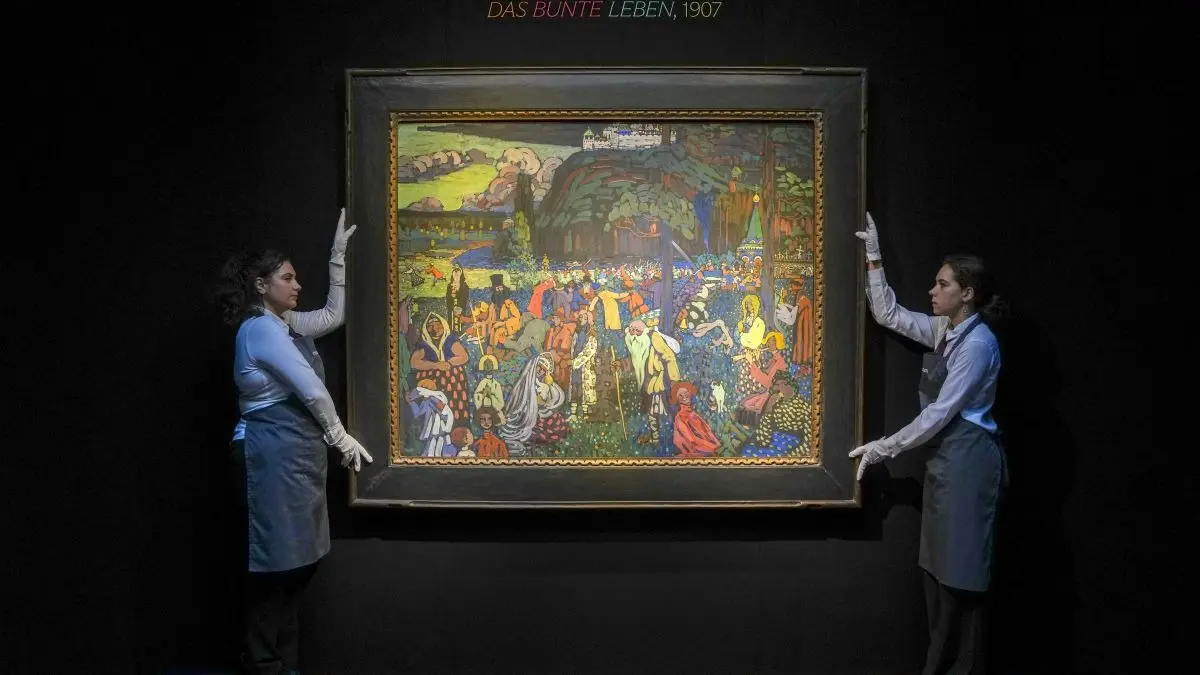
LONDON — A vibrant, historically significant masterpiece by Russian avant-garde artist Wassily Kandinsky, which was stolen from a prominent Jewish family in Amsterdam during the dark days of the Second World War, has fetched an impressive £27 million, equivalent to approximately €32 million, at a high-profile auction at Christie’s in London.
The striking oil painting, titled Das bunte Leben (translated as The Colourful Life), represents not only a pinnacle of early abstract art but also a poignant chapter in the ongoing, complex global reckoning with cultural property looted by the Nazi regime. The auction drew international attention from collectors, art historians, and restitution advocates alike, serving as a stark reminder of the long shadow cast by wartime persecution over Europe’s cultural heritage.
Wassily Kandinsky created Das bunte Leben in Paris in 1907, during a pivotal period in his artistic evolution when he was moving away from traditional representation toward the explosive use of color and form that would eventually pioneer modern abstraction. The canvas bursts with folkloric imagery, vibrant pigments, and intricate patterns reminiscent of Russian fairy tales and folk traditions.
Decades later, in 1927, the painting found its way into the esteemed collection of Emanuel and Hedwig Lewenstein. The couple were prominent figures in Amsterdam society, where Emanuel ran a successful sewing machine factory located on the bustling Dam Square. Alongside the Kandinsky masterpiece, the Lewensteins assembled a remarkable and diverse art collection that featured significant works by other celebrated artists of the era, including Jan Toorop, Jozef Israëls, and Jean Metzinger. Their collection reflected a refined cultural sensibility and deep engagement with the burgeoning modern art movements of early twentieth-century Europe.
However, the tranquility of the Lewenstein family’s life and the preservation of their collection were shattered following the German occupation of the Netherlands in May 1940. Under the brutal Nazi occupation, Jewish citizens faced systematic persecution, asset stripping, and eventual deportation. In the chaotic and coercive atmosphere of the early occupation, Das bunte Leben was auctioned under duress.
Historical research later revealed the mechanics of how the painting slipped away from its rightful owners. Shortly after the onset of the occupation, a museum employee, acting on behalf of an unidentified individual, had the valuable artwork taken to an auction house by courier. Subsequent investigations by art historians and prosecutors uncovered a wealth of documentation indicating that the painting had been unlawfully seized under the auspices of the Nazi regime, stripping the Lewenstein family of both their property and a vital piece of their cultural legacy.
Following its forced removal from the family’s collection, the painting was acquired by Sal Slijper, a well-known Jewish art collector who managed to survive the war years. Slijper’s family later parted with the work, transferring it to the Bayerische Landesbank. The bank subsequently placed the painting on permanent loan to the Lenbachhaus museum in Munich, where Das bunte Leben hung on public display for decades, admired by thousands of visitors who were largely unaware of the painting’s troubled provenance and dark wartime history.
The path toward justice and restitution was long and arduous, requiring meticulous archival research and legal persistence. In 2023, the German public prosecution department officially classified the painting as Nazi-looted art. Following this decisive legal and historical determination, the Bayerische Landesbank returned the painting to the legal heirs of Emanuel and Hedwig Lewenstein, finally rectifying a historic injustice more than three-quarters of a century after the canvas was torn from the family’s possession.
The successful restitution and subsequent sale of Das bunte Leben at Christie’s in London echoes a similar high-profile case involving the Lewenstein family heirs just a year prior. In 2023, the heirs successfully sold another masterwork by Kandinsky, titled Bild mit Häusern (Painting with Houses), which fetched more than €60 million at auction.
That particular restitution came after a grueling, years-long dispute with municipal authorities in Amsterdam. Bild mit Häusern had hung prominently in the city’s prestigious Stedelijk Museum until February 2022, when the Amsterdam city council finally agreed to return the painting to the family following recommendations from the Dutch Restitutions Committee. The dual recoveries and subsequent high-value sales underscore the immense financial and historical stakes involved in the ongoing global effort to identify, return, and restitute cultural artifacts stolen during the Holocaust.
The sale at Christie’s in London marks the latest chapter for Das bunte Leben, transitioning the painting from a symbol of wartime theft and decades of institutional obscurity into the private art market, where its complex history remains indelibly bound to the resilience of the Lewenstein family.