






Fifteen years after it first disrupted the horological world by blending contemporary mechanical daring with a reimagined nineteenth-century aesthetic, the MB&F Legacy Machine 1 is receiving a comprehensive, high-performance transformation. The newly unveiled MB&F LM1 EVO revitalizes the brand’s foundational Legacy Machine collection, shrinking its footprint slightly while introducing enhanced daily-wear capabilities, robust shock protection, increased water resistance, and a significantly revised, in-house-developed movement architecture.
In adopting the "EVO" suffix, the LM1 becomes the fifth major platform within the MB&F stable to receive this modern, sports-oriented treatment, following in the footsteps of the LM Split Escapement, LM 101, LM Perpetual, and the LM Sequential models. Mirroring the blueprint established by its predecessors, the LM1 EVO pairs a polished titanium or 18-karat rose gold case with a proprietary, wipe-clean rubber strap and the brand’s patented FlexRing shock absorber system. Designed to absorb and mitigate severe lateral and vertical impacts, the FlexRing underlines the watch’s transition from a delicate dress piece to a rugged daily companion.

Initial Thoughts and Evolution
Reflecting on the horological landscape of 2011, the original LM1 arrival came as a dramatic pivot for Maximilian Büsser and his team. Up to that point, MB&F had spent six years firmly establishing its avant-garde identity around the futuristic Horological Machine collection. The debut of the Legacy Machine served as a fascinating intellectual exercise, posing a hypothetical question: what kind of wristwatch might Max Büsser have designed had he been born a century earlier, surrounded by the golden age of classical pocket watchmaking?
That thought experiment birthed a distinct design language characterized by suspended balance wheels, arched bridges, and classical finishing executed through a thoroughly modern, independent lens. Over the decade and a half since, the collection has matured immensely. The new LM1 EVO retains the signature dual-time layout and the iconic centrally suspended balance wheel that hover above the dial plates, but every millimeter and component has been re-evaluated for contemporary lifestyles.

Sport-oriented timepieces traditionally trend toward oversized proportions, but horological tastes have evolved significantly since the early 2010s, when ultra-large watches dominated the market. Recognizing this shift, MB&F has crafted the LM1 EVO with a 42 mm case diameter, making it 2 mm smaller than its dressier predecessor. Despite its robust architecture—which includes twin screw-down crowns ensuring a dependable water resistance rating of 80 meters—the watch remains true to its high-end roots. Retailing in the six-figure territory, few owners will actively push the watch to the absolute limits of its rugged specifications. However, the introduction of a more casual aesthetic, a comfortable geometry, and an easy-to-clean rubber strap makes the LM1 EVO exceptionally well-suited to the everyday hazards and routine hassles of modern wear.
In the upper echelons of independent watchmaking, the LM1 EVO occupies a singular space where few competitors dare to tread. Priced at CHF 82,000 for the titanium iteration and CHF 102,000 for the limited 18-karat rose gold model, the watch positions itself directly alongside radical creations like the space-age Urwerk UR-150 Scorpion and De Bethune’s DB28GS, both of which similarly bridge the chasm between classical mechanical watchmaking and futuristic design.

Two Distinct Configurations
When it comes to aesthetics, the LM1 EVO launches in two distinct variations. The titanium model features a rhodium-plated dial plate, while the 18-karat rose gold version—produced as a strictly limited edition of 33 pieces—sports a striking green dial plate. Both models share identical physical dimensions, measuring 42 mm across and 16.8 mm thick. Though a thickness of nearly 17 mm sounds substantial on paper, Legacy Machines consistently wear much slimmer than their technical specifications suggest, largely because a vast majority of that height is taken up by a dramatically domed sapphire crystal that frames the mechanical theater beneath it.
The colorway chosen for the titanium iteration bears a remarkable, intentional resemblance to the legendary LM1 Longhorn prototype from 2009. Featuring a silver background contrasted against black sub-dials and vivid blue hands, the titanium model gives the familiar, symmetry-driven layout a sharper, unmistakably contemporary appearance that diverges cleanly from the white lacquer dials found on the original production LM1.

The historical roots of the Longhorn concept run deep. During the initial development phase of the LM1 in 2009, the design team grappled extensively with the precise positioning of the spring bar holes within the elongated lugs. While shorter "horns" ultimately won out for the commercial production run, the original Longhorn prototype resurfaced triumphantly for the LM1’s tenth anniversary in 2021, commanding a staggering price of over CHF 277,000 at a Phillips auction. Bringing this color palette back in the titanium EVO model closes a fascinating historical loop for the brand.
Meanwhile, the 18-karat rose gold variant delivers a warmer, more vibrant visual punch, pairing its rich green background with contrasting black sub-dials and matching rose gold hands. Both versions preserve the mesmerizing visual symmetry of the original piece, though they incorporate broader, luminous-filled hands and baton indices that better align with the EVO collection’s sporty mandate.

In a subtle yet noteworthy refinement shared with other recent MB&F releases, the hands benefit from sculpted, polished central bosses. This minor mechanical detail grants the hands a more substantial, three-dimensional depth, elevating their decorative finish closer to the uncompromising standards applied to the movement components visible through the case back.
Both configurations are secured to the wrist via an integrated rubber strap paired with a matching folding buckle. Crucially, the clasp incorporates a new push-button release mechanism that drastically simplifies the process of swapping straps. While the EVO series firmly keeps owners within MB&F’s proprietary strap ecosystem, the quick-release functionality introduces a welcome layer of convenience, allowing the buckle to be easily transferred from one strap to another without tools.

An EVO-lved Calibre
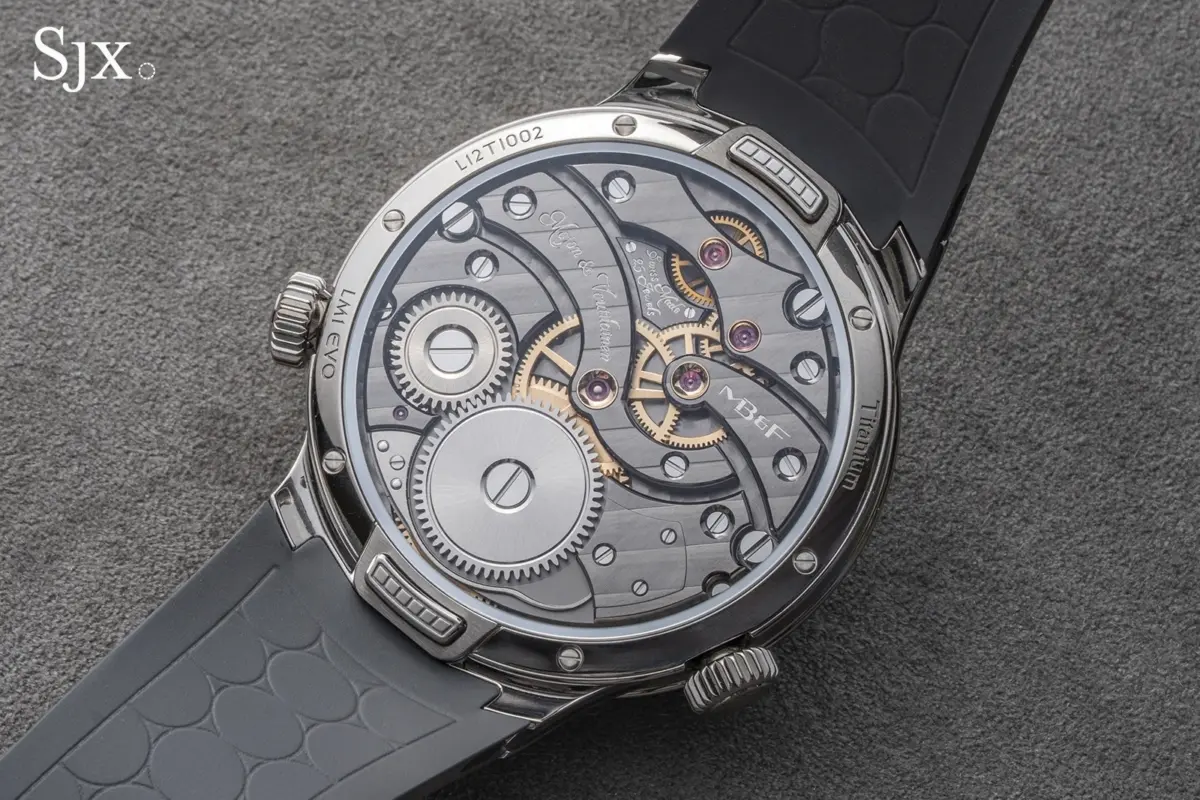
Beneath the sapphire display case back beats a thoroughly revised iteration of the original LM1 movement, which was initially engineered alongside Chronode founder Jean-François Mojon. Over the intervening fifteen years, subsequent development and refinement have been brought entirely in-house at MB&F, serving as a testament to the brand’s immense growth in technical capability.
The mechanical upgrades to the calibre are both functional and visual. Most notably, the movement introduces a revised power reserve indicator, a pair of opposed Straumann hairsprings, and a 33% boost to the power reserve, extending autonomy to a very practical 60 hours. The first two updates are proudly displayed on the dial side. The redesigned power reserve indicator replaces the original model’s more literal "up/down" script with a clean, highly legible gauge-like readout.

More significant from a chronometric standpoint is the integration of twin opposed hairsprings, which replace the sweeping single overcoil found in the original LM1. MB&F remains one of the exceptionally few high-end watchmakers utilizing this technically demanding yet performance-enhancing configuration, a geometry pioneered by H. Moser & Cie. and occasionally employed by historic houses like Audemars Piguet and independent masters like Laurent Ferrier.
Hand-finishing across the calibre continues to be executed by longtime brand partner Charles-Louis Rochat SA, strictly adhering to decorative specifications established by master watchmaker Kari Voutilainen. This pedigree accounts for the breathtaking traditional anglage, sharp interior angles, and meticulous polishing found throughout the movement. The dark-grey plating chosen for the EVO calibre represents a deliberate departure from the bright rhodium plating of the original LM1, though the mirror-polished gold chatons have thankfully been retained to provide gleaming pops of color against the dark backdrop.

Rounding out the movement updates are various internal refinements that MB&F has progressively rolled out across its entire collection, including a proprietary escape wheel featuring the brand’s signature axe logo subtly integrated into its spokes.
The MB&F LM1 EVO is available now through authorized retailers and MAD Galleries, priced at CHF 82,000 for the titanium model and CHF 102,000 for the 18-karat rose gold limited edition of 33 pieces, excluding local taxes.