






Initial thoughts
The brand name Wren originates as a portmanteau of Wrist Enthusiast, the popular online watch publication founded by Mr. Karger. When the brand debuted its first timepiece, the Diver One, it received a warm reception from collectors and critics alike for its capable specifications and clean tool-watch execution. For its sophomore effort, however, Wren has elected to take an entirely different path. In doing so, the brand has essentially taken a page out of the playbook of avant-garde independents like Berneron, releasing a follow-up model that stands almost diametrically opposed to its predecessor.

Despite this radical shift in aesthetics, the design team cleverly incorporated subtle nods to the brand’s origins. To bridge the visual gap between the heavy-duty tool aesthetic of the Diver One and the refined architecture of the Vessel, the new sports watch features a vibrant aqua blue seconds hand and a matching winding rotor. This splash of color pays direct homage to the dial colorway of the original diver, creating a cohesive thread running through the young manufacturer’s expanding catalog.
The architectural lines of the Vessel were brought to life by Max Resnick, a designer whose primary training lies in automotive styling. Having previously collaborated with several independent microbrands including Anoma and VPC, Mr. Resnick approached the project with a distinct perspective. The core vision called for an integrated-bracelet sports watch that deliberately avoided imitating the well-worn tropes of historical 1970s sports watch templates. Instead of channeling the ubiquitous codes popularized by Gerald Genta designs like the Audemars Piguet Royal Oak, the Vessel pursues a more futuristic, architectural geometry that shares a closer spiritual kinship with contemporary independent designs like the Alto Art series.

While the resulting angular composition is bold, it succeeds largely due to its restrained and wearable proportions. Yet, not every design choice has escaped debate among purists. The watch features an applied wordmark on the dial, a choice that some commentators argue slightly detracts from an otherwise ultra-clean and upscale presentation. Many enthusiasts might have preferred the brand’s avian logo—inspired by the bird of the same name—which currently finds a home exclusively on the crown.
Prototype models initially indicated a limited production run of just 100 pieces, but due to strong projected demand, final production versions of the Vessel will be numbered in series of 150 pieces per variant. Retailing at US$2,900 for the standard stainless steel variant, the watch includes a matching quick-release bracelet crafted from robust 904L stainless steel. At launch, collectors can choose between a classic steel sunray finish or an exotic meteorite dial, with the latter option carrying an incremental price adjustment of US$500.

The vitrine-like Vessel
In crafting the Vessel, Wren followed a path traveled by a growing number of contemporary brands, partnering with specialized manufacturing suppliers in Asia to bring its complex case and crystal architecture to life. The cushion-shaped case is meticulously constructed from corrosion-resistant 904L stainless steel. Although the elongated geometry of the crystal creates a distinctly rectangular visual impression on the wrist, the case itself measures a balanced 39 millimeters square. This clever geometry yields a remarkably short lug-to-lug distance, which, combined with a slim profile of just 10.6 millimeters, allows the watch to wear exceptionally low and comfortably on the wrist.
Curved and faceted sapphire crystals are certainly not unprecedented in the horological world, but the Vessel pushes this concept to a technical extreme by combining sweeping outer facets with precisely matching internal facets on the underside of the crystal. This sophisticated double-sided faceting plays a crucial optical role, helping to eliminate the severe visual distortion and awkward refraction that typically plague heavily shaped crystals at glancing viewing angles.

According to the brand, executing this delicate geometry proved to be an immense manufacturing challenge. The initial production runs suffered from such an exceptionally high failure rate that only five out of the very first one hundred prototype crystals were deemed usable. To overcome this hurdle, Wren ultimately partnered with a specialized manufacturer renowned for engineering full sapphire watch cases, a facility uniquely equipped to polish and shape the complex matching internal and external facets required by Mr. Resnick’s design.
The practice of sourcing advanced sapphire components from specialized overseas partners is increasingly common across the watch industry, allowing independent houses to achieve levels of finishing and complexity that would otherwise be cost-prohibitive at value-oriented price points. The gamble has undoubtedly paid off. On the wrist, the faceted crystal creates a striking, vitrine-like effect that immediately recalls the similarly ambitious, multi-faceted crystal architecture of the legendary TAG Heuer Monaco V4.

Despite its unconventional construction and heavy reliance on extensive sapphire geometry, the case maintains a robust water resistance rating of 70 meters. This specification is more than sufficient for everyday wear and light aquatic activities. Maintaining water resistance in a watch with such complex sealing requirements is an engineering feat; it would have been easy for the brand to default to a conservative 30-meter rating, making the 70-meter certification a welcome reassurance of everyday durability.
Attention to detail extends all the way down to the hardware of the integrated bracelet. The screws utilized for resizing and removing bracelet links are positioned discreetly on the underside of the links rather than entering through the traditional side profiles. This design choice grants the bracelet a cleaner, more seamless appearance on the wrist, though traditionalists note that standard side-pin systems remain exceptionally reliable and straightforward to service.

Common calibre
Powering the Vessel is a tried-and-tested mechanical engine: the automatic Sellita calendar-free caliber SW300-1. Widely utilized and universally respected throughout the watchmaking industry for its thin profile and reliable performance, this latest iteration of the movement delivers a healthy power reserve of 56 hours while maintaining a high beating frequency of 28,800 vibrations per hour, or 4 Hz. This robust power reserve adds modern convenience to an already dependable and easily serviceable architecture that watchmakers around the globe know intimately.
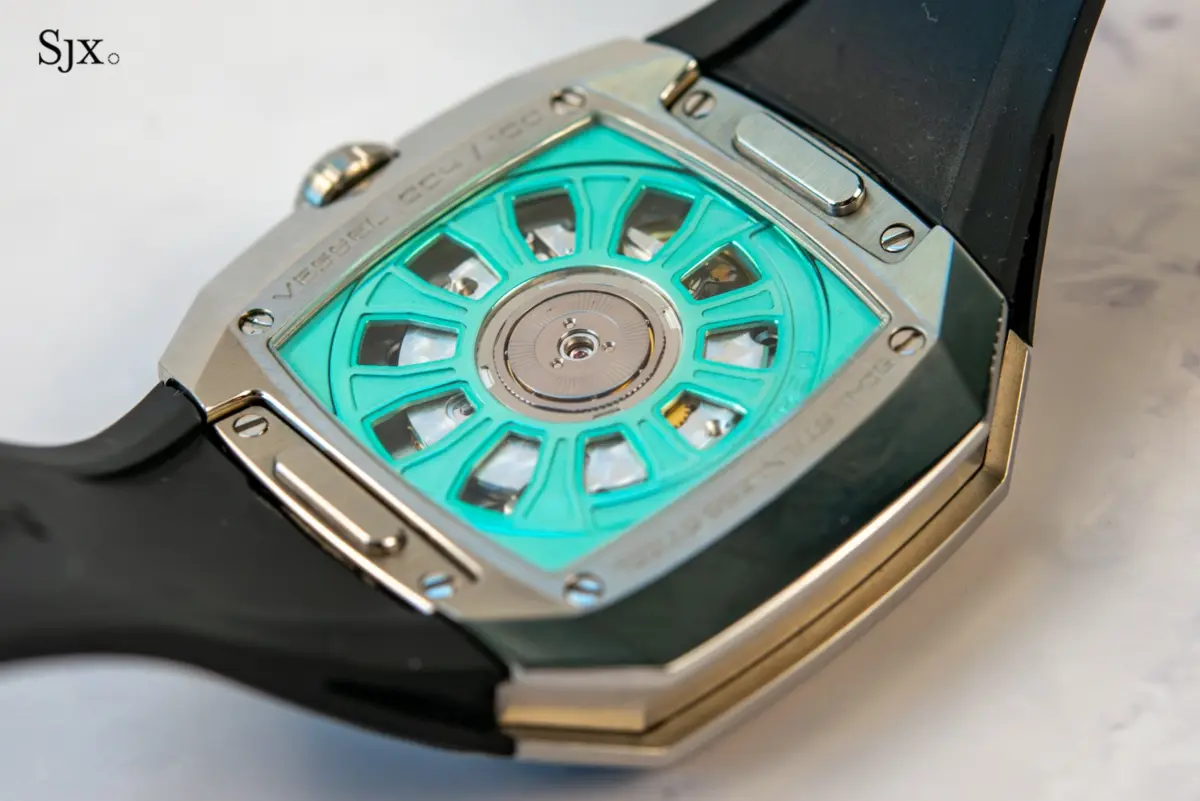
Rather than leaving the movement entirely standard behind a simple sapphire display back, however, Wren has introduced a distinct visual twist. Much of the mechanical layout is partially concealed beneath a custom 360-degree oscillating weight featuring asymmetrical weighting. This unconventional rotor design gives an otherwise familiar movement a bold, futuristic identity. Furthermore, the rotor is finished in the same vibrant aqua blue tone as the seconds hand, successfully carrying the signature colorway of the brand’s debut dive watch through to the exhibition case back of its newest creation.