





Anyone who has stepped onto a Dutch cycle path recently cannot fail to notice that the humble, traditional bicycle is no longer the sole occupant of the asphalt. A bustling, fast-paced, and seemingly never-ending stream of alternative road users has successfully claimed the territory. From e-bikes and fatbikes to scooters, snorfietsen, speed pedelecs, and specialized disability vehicles, the iconic Dutch fietspad has transformed into a high-stakes transport corridor. But as the variety of vehicles multiplies, the question on many commuters’ minds is what rules and regulations actually govern this chaotic new landscape.
For decades, the social contract of the Dutch cycle path was simple, predictable, and largely self-policed. Today, however, managing the dynamic mix of high-speed electric motors and traditional pedal power has become a daily challenge for urban planners, pedestrians, and cyclists alike. Understanding who is allowed where, at what speed, and under what legal classification requires a close look at the current state of Dutch traffic law.
The Rise of the Fatbike
Among the recent arrivals, the fatbike—distinguished by its characteristic thick tyres and frequently younger or heavier riders—has become wildly popular across the Netherlands. This surge in popularity is hardly surprising, given that current regulations exempt riders from needing a helmet, a driving licence, or third-party liability insurance. Officially classified under the law as a standard e-bike, the fatbike currently has no minimum age limit, though mounting political and public pressure has put measures afoot to make helmet-wearing compulsory for riders under the age of 18.
Officially, fatbikes are legally permitted to travel at speeds of up to 25 kilometers per hour. In reality, however, many of these vehicles are easily doctored to go much faster. This becomes painfully obvious to motorists when a fatbike whizzes past cars that are strictly keeping to the mandatory 30 kilometers per hour speed limit implemented in many Dutch city centers.
The Electric Bike Evolution
The standard electric bicycle—essentially the non-fatbike variant—is literally overtaking the traditional, person-powered bicycle across the country. This transition is driven in no small part by its immense popularity among older demographics, a group that is also unfortunately well-represented in annual traffic fatality statistics.
When it comes to the legal framework, the exact same rules of the road that apply to fatbikes apply to ordinary e-bikes: practically none. Riders do not need a licence, insurance, or a helmet, though a shifting cultural acceptance and safety consciousness mean that an increasing number of elderly riders can now be seen wearing helmets voluntarily.
Electric Cargo Bikes and the School Run
The electric cargo bike, often affectionately or critically dubbed the moedermobiel, deserves a separate mention due to the distinct behavioral patterns of its operators. Many cargo bike riders operate under the mistaken impression that everyone else on the path has to make way for their space-hogging vehicle simply because it happens to be carrying cute little toddlers.
A reliable place to observe this phenomenon in its natural habitat is outside virtually any primary school across the country at three o’clock in the afternoon. At these times, the convergence of oversized cargo bikes creates a veritable traffic jam entirely of their own making, testing the patience of pedestrians and standard cyclists alike.
Speed Pedelecs: The Legal Motorcycles
While speed pedelecs are technically electric bikes, they diverge significantly from normal e-bikes by being legally capable of reaching assisted speeds of up to 45 kilometers per hour. Because of this high velocity, the law views them as motorcycles, subjecting them to the corresponding regulatory framework. This means riders must carry a driving licence, hold appropriate insurance, and wear a mandatory helmet.
While speed pedelecs are permitted to use Dutch cycle paths, they are legally restricted to a maximum speed of 25 kilometers per hour when sharing space with traditional cyclists, shifting to the main road when they wish to unleash their full potential.
The Decline of the Snorfiets
The snorfiets, or low-speed moped, requires no pedalling from its operator and features a capped maximum speed limit of 25 kilometers per hour, making it a legal fixture on cycle paths. Although snorfietsen share the exact same speed limit as standard electric bikes, they are technically categorized as mopeds. Consequently, riders are required to wear a helmet, hold a valid driving licence, and maintain insurance.
The introduction of mandatory helmet laws for all types of mopeds several years ago effectively spelled the beginning of the end for the traditional snorfiets. Confronted with the prospect of wearing a helmet regardless, many commuters logically wondered why they shouldn’t just drive a proper motorbike—or switch to a trendier fatbike instead.
The Danger of the Scootmobiel
Perhaps the most statistically hazardous vehicle occupying the cycle path is the motorized wheelchair, commonly known as the scootmobiel. According to data from the national statistics agency CBS, the traffic death rate among mobility scooter riders is disproportionately high—surpassing that of motorbike riders by over six times and that of standard cyclists by more than twenty times.
Users of the scootmobiel are not required to pass any tests, demonstrate a knowledge of traffic rules, or hold a licence. They enjoy remarkable freedom of movement, permitted to travel virtually anywhere pedestrian and cycling infrastructure allows—including shopping centers, pavements, cycle paths, and ordinary roads—with the sole exception of motorways.
The Canta and the Micro Car Phenomenon
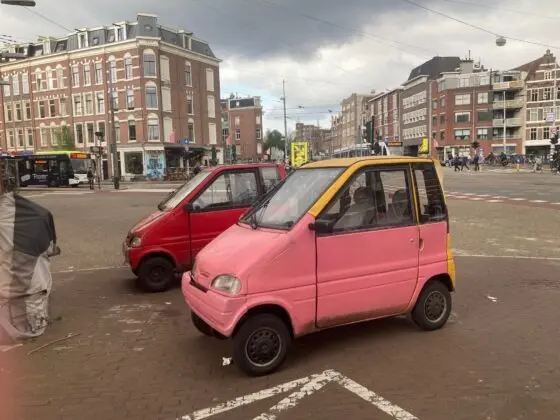
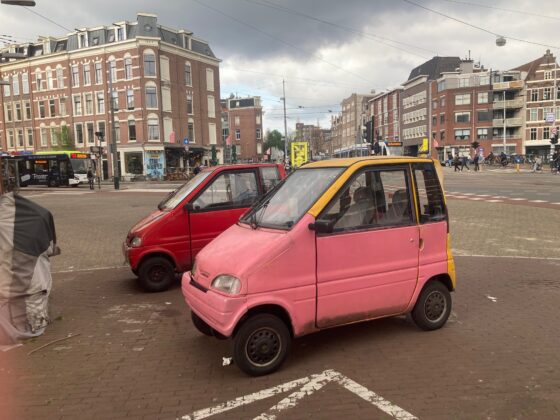
The Canta shares a visual similarity with the brommobiel, a small four-wheeled electric vehicle, but because it is legally classified as a mobility aid for people with disabilities, it shares the regulatory status of a scootmobiel.
The Canta is theoretically restricted to 30 kilometers per hour on the cycle path and 45 kilometers per hour on the road, but it is uniquely permitted to mount the pavement to navigate around obstacles or pedestrians at a crawl of six kilometers per hour. Furthermore, it can park virtually anywhere and does not require a registration number plate.
The minimum age to operate a Canta is 16, and operators must secure insurance, though a driving licence is not required. Its practical convenience eventually made it popular with young people looking for an alternative to cycling, spawning a wider commercial surge in fashionable micro cars.
Modern micro cars, such as the Birò and similar compact electric vehicles, are marketed as stylish urban runabouts, though their presence on narrow infrastructure is viewed by many as an annoyance. Officially, these micro cars are strictly banned from cycle paths, yet drivers frequently use them there anyway—particularly as a convenient escape route when trapped in urban traffic congestion.
Particularly popular among real estate agents and public relations professionals, these micro cars boast a maximum speed of 45 kilometers per hour. Operating one legally requires a specific brommobiel driving licence and a minimum age of 16.
Electric Scooters Join the Fleet
The step, or kick scooter, was historically viewed as a children’s plaything. However, following the widespread invention and commercialization of the electric version, e-scooters have steadily colonized urban environments across Europe. Officially approved electric scooters have been legally permitted on Dutch cycle paths, categorized officially under Dutch terminology as "light electric vehicles."
These e-scooters are capped at a maximum speed of 25 kilometers per hour, and riders must be at least 16 years old. Operators are required to hold third-party liability insurance, and the vehicles must display a clearly visible registration number plate on their base. Industry observers predict that the e-scooter will soon rival the fatbike in both sheer popularity and its proven capacity to provoke cycle-path rage, provided that helmet regulations remain non-compulsory for the foreseeable future.