






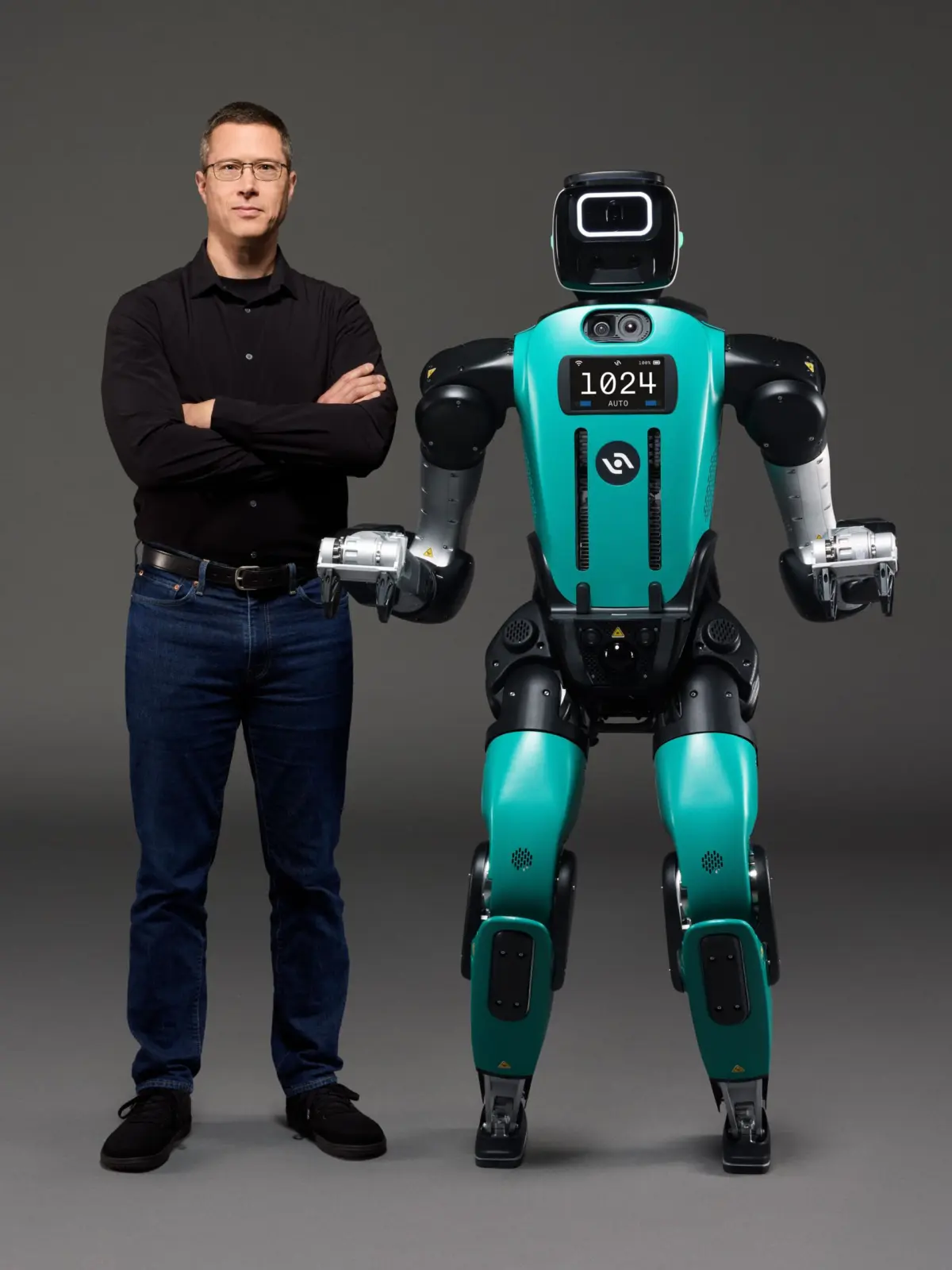
Agility Robotics, the pioneering company co-founded in 2015 out of the Dynamic Robotics Laboratory at Oregon State University, has officially launched its newest iteration of industrial automation: Digit 5. Engineered to be the first humanoid robot capable of safely and economically performing useful work at scale, Digit 5 represents a major milestone in the company’s decade-long quest to introduce tens of thousands of humanoid workers into the real-world labor market.
Designed specifically to address severe labor shortages in physically stressful or monotonous jobs, Digit 5 is built to lift 23-kilogram bins onto high shelves shift after shift. Equipped with a high-capacity battery that delivers 90 minutes of continuous operation on a rapid 9-minute charge, the robot is tailored to handle heavy warehouse tasks without burning out. However, bringing this machine to market required traversing a challenging path that forced its creators to make heavy compromises on aesthetics and fluid movement in favor of brutal, uncompromising functionality.
From ATRIAS to Digit: The Evolution of Bipedal Locomotion

The foundational vision behind Agility Robotics was never merely commercial; it began as an academic pursuit of motion mastery. When Jonathan Hurst started the Dynamic Robotics Laboratory at Oregon State University in 2008, his team drew upon decades of biomechanics research. They operated on a core theory: a simple "spring-mass" model—wherein a body is supported by spring-like legs—should theoretically be capable of reproducing every known walking and running gait observed in animals.
To test this theory, the lab built ATRIAS, an acronym for "Assume The Robot Is A Sphere," a tongue-in-cheek nod to the physical sciences’ penchant for simplifying complex systems. ATRIAS resembled a large microwave on stilts, designed exclusively to demonstrate the physics of human locomotion. Despite its lack of human features, the machine exhibited a remarkably natural, almost lifelike quality when settling into a walking gait.
Encouraged by this success, Hurst and his co-founders, Damion Shelton and Mikhail Jones, launched Agility Robotics to bridge the gap between a one-off academic concept and a commercially viable product. Fuelled by a mix of ambition and naivety, they bypassed conventional business planning—which typically dictates identifying a customer problem first—and instead trusted that their groundbreaking technology would ultimately find its purpose.
Their first commercial offering for the research community was Cassie, a dynamic bipedal robot capable of maintaining balance through active, fluid motion rather than rigid steps. Featuring ostrich-like legs engineered strictly for mechanical performance rather than biological mimicry, Cassie lacked a torso, arms, or head. Agility sold approximately 10 of these units to prestigious institutions including Harvard, Caltech, the University of Michigan, and UC Berkeley, effectively saturating the market for US $250,000 bipedal research platforms.

Cassie proved instrumental in shifting the legged-robot research frontier toward advanced control software. Rather than relying on traditional, rigid mathematical models, researchers pioneered reinforcement learning for bipedal locomotion. By training simulated robots through trial and error, neural networks were developed to control the physical machines. This breakthrough allowed Cassie to recover from stumbles on stairs, run a 5-kilometer route across the Oregon State campus, and even set a Guinness World Record for a 100-meter dash by a bipedal robot.
Yet, to make a robot genuinely useful for commercial applications, locomotion alone was insufficient; the machine required manipulation capabilities. After extensive experimentation with various configurations, Agility found that an upright torso aided balance, while two arms mounted near the top enabled the robot to lift heavy objects and arrest falls. This realization culminated in Digit 1, the company’s first mobile manipulation robot and a crucial stepping stone toward commercial utility.
Why Digit Began With Warehouse Bins
As Agility explored potential early applications for Digit, prospective industrial partners invariably asked two fundamental questions: Why legs, and why a humanoid form? For Hurst, these inquiries underscored a harsh commercial reality: solving an elegant scientific problem meant little if it failed to solve practical problems for paying customers.

After years of engagement with industry partners, the company identified a clear, viable starting point in warehouses and manufacturing facilities: moving storage bins. Bin handling represents a well-defined task requiring two arms to lift objects to elevated shelves, while legs provide the necessary balance and mobility to navigate narrow, confined spaces. Because such tasks vary widely across different deployments, they had largely resisted single-purpose automation, yet they offered a constrained enough environment for Digit to prove its economic value.
Beginning in 2019, Digit put its capabilities on display. Working alongside the Ford Motor Company, an early iteration of Digit demonstrated the ability to carry packages from autonomous delivery vehicles to front porches. Subsequent versions collaborated with a global package delivery company to sort and move cardboard boxes. Amazon later tested Digit 4 on bin-handling tasks, and the robot eventually achieved a historic milestone as the world’s first commercially deployed humanoid at logistics provider GXO, subsequently earning a spot on the cover of Time magazine in 2024.
Despite these commercial deployments, tensions quickly emerged between Hurst’s original academic vision and the practical demands of the market. Unlike patient university research laboratories, commercial customers lose money whenever their operations stall. Agility found itself dedicating immense resources to keeping early deployments operational, while simultaneously managing the myriad non-technical complexities of running a global hardware enterprise—ranging from supply chain logistics and fleet-management software to regulatory compliance, customer support, and continuous fundraising.
Turning Digit Into a Product

To successfully transition Digit from a research platform into a scalable commercial product, Agility had to undergo significant structural changes. Bringing in an experienced executive team meant relinquishing a degree of control, but the leadership swiftly implemented necessary, albeit painful, commercial adaptations.
The upcoming revision, originally designated as Digit 4 EVT (Engineering Validation and Test), was intended as a routine upgrade. However, the new leadership insisted that the machine required critical enhancements to meet stringent safety and regulatory standards. Consequently, Digit 4 EVT incorporated major system-wide updates over a compressed timeline, including larger batteries and protective housings. These modifications added substantial mass, visibly altering the robot’s appearance and capabilities.
For Hurst, watching these engineering compromises unfold was difficult. Elements that prioritized raw industrial utility often superseded his vision of a lithe, graceful machine. However, these real-world deployments yielded invaluable data regarding specific application requirements. By mapping out the first 10 use cases Digit needed to fulfill, Agility laid the groundwork for designing Digit 5 entirely from scratch.
Digit 5 marks the company’s definitive transition toward a general-purpose robotic product shaped by the realities of customer deployments and international regulatory frameworks. Compliance standards such as European CE certifications, North American UL electrical-safety requirements, and Federal Communications Commission limits for electromagnetic radiation became absolute mandates.

Among these requirements, safety emerged as the most critical barrier to scaling. During early commercial deployments, Digit 4 units were required to operate behind physical safety cages, entirely separated from human coworkers to satisfy insurance and regulatory mandates. While Hurst viewed these barriers as overly conservative given the robot’s inherent stability, proving safety is legally non-negotiable. Because restricting robots to cages severely limits their utility, designing Digit 5 to operate safely alongside people became a primary, two-year engineering focus.
Digit 5 relies on an integrated sensor array to detect nearby human coworkers and execute certifiably safe behaviors. When a person approaches, the robot is programmed to halt operations, set down its payload, sit flat on the floor, and cut power to its motors before human contact can occur. While this conservative protocol introduces considerable design complexity, mass, and power consumption, Agility regards it as the only viable near-term approach to verifiably reduce risk in shared workspaces.
Weighing over 120 kilograms, Digit 5 is by far the largest, heaviest, and strongest humanoid robot Agility has ever produced. It was engineered to meet the lifting limits recommended by the U.S. National Institute for Occupational Safety and Health for human workers, including repeatedly lifting 23-kilogram bins and reaching shelves 1.75 meters high. Furthermore, it is designed to execute these duties for up to 20 hours a day—an endurance level unattainable by humans.
Achieving this level of continuous performance demanded powerful motors capable of delicate force control, supported by a heavy-duty battery and a rapid autonomous charging dock. The charging system delivers 240 amperes at 48 volts, generating magnetic forces strong enough to make thick charging cables visibly twitch, while internal fans channel air through the torso to prevent the battery from overheating. Although the power and cooling systems occupy roughly 75 percent of the robot’s torso, they enable a 90-minute operational window followed by a 9-minute recharge.

These functional demands physically precluded the svelte, agile form Hurst originally imagined. The robot’s legs were reconfigured from the earlier ostrich-like stance to a traditional humanoid layout, ensuring the ankles and knees provide sufficient torque for deep squatting motions required when lifting objects from near the floor.
While these design choices mirror the outward form of other humanoids on the market, Agility emphasizes that its configuration was driven purely by functional engineering necessities rather than imitation.
What Comes After Digit 5
Agility Robotics views Digit 5 as the crucial inflection point for large-scale commercial deployment. While its immediate focus remains on bin handling, the company’s long-term roadmap encompasses a broad array of tasks, ranging from item picking, machine tending, and assembly preparation to active manufacturing work. Its modular design and interchangeable tool interfaces are built to accommodate gradual subsystem upgrades.

Although Digit 5 embodies compromises that distance it from Hurst’s initial aesthetic ideal, the development process refined the company’s understanding of what is truly required for a robot to achieve real-world impact. By proving its utility in demanding industrial environments, Digit 5 establishes a practical operational foundation. As Agility continues refining future iterations toward lighter, more graceful designs with enhanced dexterity, the company moves closer to realizing the broader promise of general-purpose humanoid robotics in everyday life.