







Roughly thirty minutes into Alejandro G. Iñárritu’s ambitious new film, Digger, a model tree unexpectedly topples over. In that exact moment, a section of what had convincingly appeared to be a rugged hillside swings open, and a giant figure steps forward to retrieve the prop. Behind him, an entire technical crew floods the frame, breaking the cinematic spell. Director Alejandro G. Iñárritu immediately starts shouting instructions, Tom Cruise drops his heavy Texas accent, and everything the audience has absorbed up to this point is abruptly revealed to be a technical rehearsal for the 25th-anniversary staging of a fictional play entitled Fossil Fools.
For the first half-hour of the film, Cruise stars as Curtis Markson, an actor portraying the ruthless oil baron Digger Rockwell. The play centers on a catastrophic global environmental disaster supposedly engineered by Rockwell, widely regarded as the most powerful man on Earth. Within the narrative of the play, Rockwell spearheads a massive Greenland drilling operation that triggers the catastrophic detachment of an enormous ice shelf. This drifting ice mass pushes relentlessly toward Europe, ultimately drowning the coastal regions of the world.
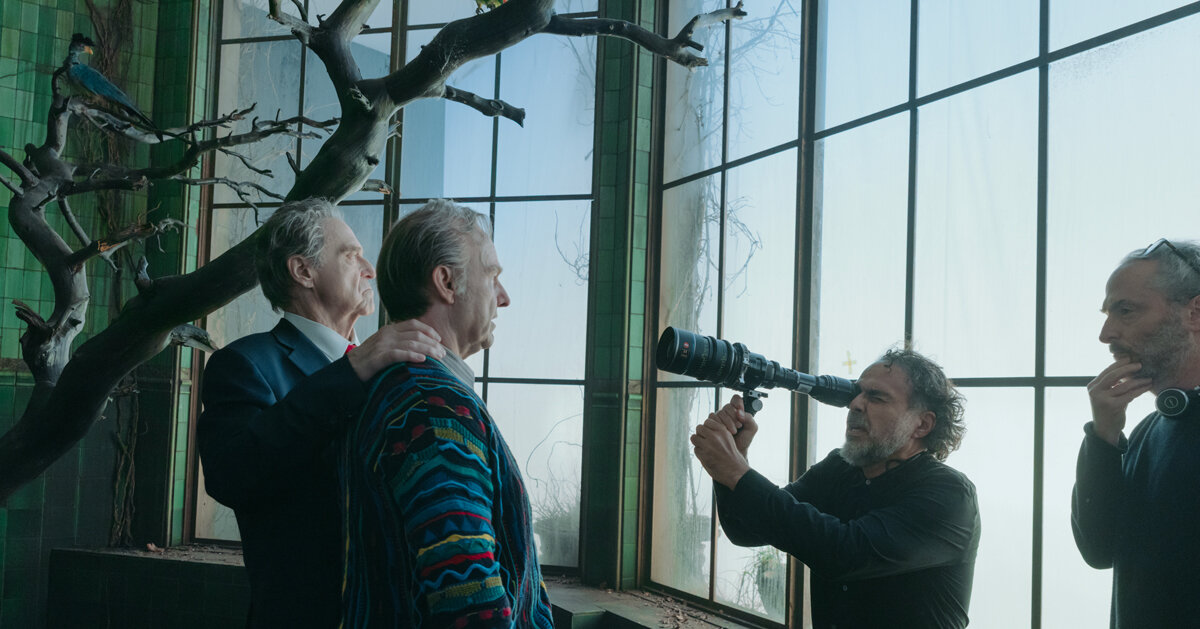
What appears at first to be a standard cinematic portrayal of corporate villainy quickly transforms into a brilliant structural game. The plot twist does not arrive via traditional expository dialogue; instead, it is delivered physically as a stagehand walks into the shot to manage a fallen prop. This introduction establishes the first of four distinct spatial positions that the film forces its audience to inhabit. Throughout the two-hour runtime, the narrative shifts through a secure mansion holding disaster at arm’s length, a theatrical play viewed by a seated audience, a play that is actually a historical reconstruction of real events, and finally, a reality with no physical distance remaining between the spectator and the catastrophe. The meticulous set designs serve not merely as structural decoration, but as a precise measuring instrument for the shifting distance between spectator and spectacle.
Set Design as a Narrative Instrument
The complex world of Digger was brought to life by acclaimed production designers Dennis Gassner and Richard Johnson. Gassner boasts an extraordinary career, having earned seven Academy Award nominations for Best Production Design and a win for Bugsy. His extensive filmography includes masterworks such as Barton Fink, Road to Perdition, Blade Runner 2049, and multiple entries in the Daniel Craig era of the James Bond franchise. However, the most relevant antecedent in Gassner’s catalog is The Truman Show, where he constructed an entire suburban town designed to function as a television set.

Digger subverts that dynamic entirely. In The Truman Show, the protagonist remains blissfully unaware that he is living inside a manufactured set, while the audience is let in on the secret from the opening minutes. Digger reverses this equation completely. Every actor on screen is acutely aware of their artificial surroundings from the very beginning, while the audience is deliberately left in the dark, experiencing the shock of the reveal alongside the unfolding technical chaos.
The initial world presented to the viewer is Digger Rockwell’s opulent, hyper-stylized mansion. Here, Rockwell wakes beside a bedroom window framing an idealized landscape reminiscent of a Hudson River School painting by Albert Bierstadt. Taxidermied alligators are pinned ominously to the ceiling, while full-body mirrors lined with antlers reflect his image into infinite regression. Every detail within this lavish estate reinforces the portrait of a monstrous man whose villainy feels safely cordoned off from ordinary existence. It mimics the oldest arrangement in cinema: a secluded villain in his lair, a distant environmental calamity unfolding in frozen isolation, and a sturdy fourth wall holding the horrifying spectacle at a comfortable distance.
Color Palettes, Props, and Visual Intentionality
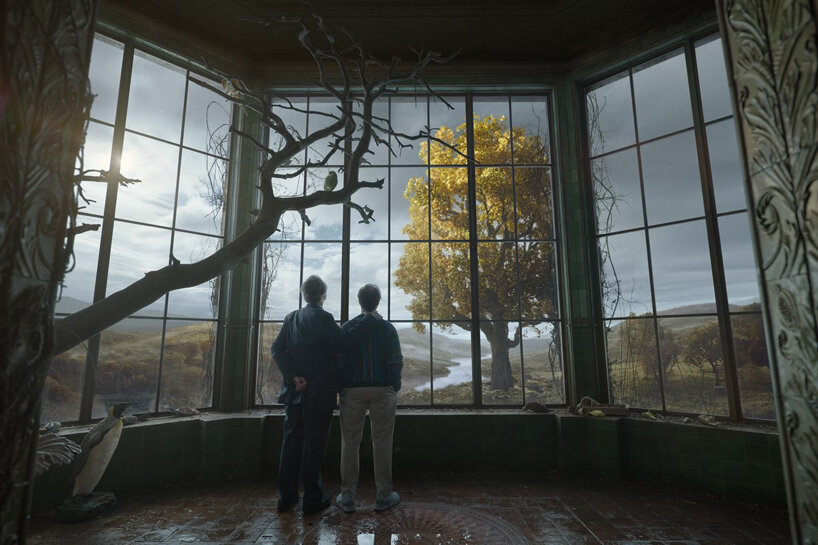
Once the artificial nature of the setting is exposed by the falling tree, the film retroactively reframes its earlier stylistic choices. The artifice of the first half-hour stops registering as a technical flaw and becomes an intentional artistic signature. Maggie, Digger’s aging, one-eyed cat, is clearly revealed to be a visibly stiff animatronic creation—a deliberate artistic choice in a blockbuster production with the financial resources to employ a real animal. Miniature props feature visible seams, and clouds and aircraft cross the simulated sky suspended on physical sticks. Nothing on screen is accidental.
The color palette reinforces this thematic argument. In interviews regarding the visual language of the film, Iñárritu has cited the Dutch master Johannes Vermeer and Danish painter Vilhelm Hammershøi for color reference, alongside Edward Hopper and Rembrandt for stark contrast. Hammershøi’s influence is unmistakable on screen, characterized by nearly empty grey interiors, sparse notes of color, and doorways that open perpetually onto further doorways.

Iñárritu describes this pervasive grey tone not merely as a mood setter, but as a functional instrument. As the narrative of Digger expands, the color visibly drains from the screen. The theatrical set looks increasingly washed out, while the backstage areas hum with industrial life. This stark visual contrast offers a physical sense of reassurance: grey represents the realm of fiction, while color signifies reality—a reality that initially appears stable and manageable.
The Evolution of the Stage and Reality
The third major reveal pulls the rug out from under the audience once again. Fossil Fools is not merely an avant-garde theatrical invention; Digger Rockwell was a genuinely historical figure, and the global environmental catastrophe actually occurred. The financial backer of the theatrical production turns out to be Rockwell’s own nephew, who is staging his family’s historical trauma for a paying audience. As this context shifts, the physical set design remains entirely unchanged, yet its underlying meaning is profoundly altered.

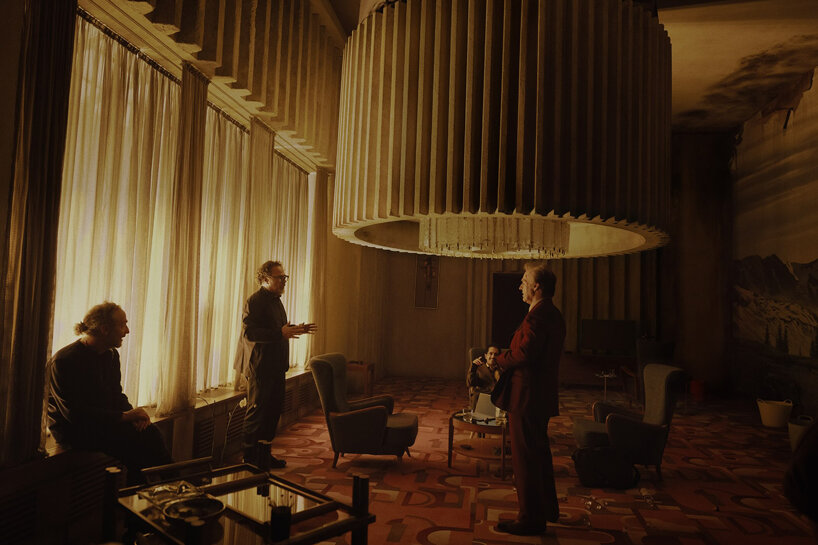
The grey-toned chamber where Digger confronts a tribunal of European politicians—with council members dressed in garments that nearly blend into the neutral walls—ceases to look like political caricature and begins to read as authentic historical testimony. Similarly, the visible seams on the miniature landscapes stop signaling a simple stage play and start functioning as a museum diorama, openly acknowledging itself as a model of a devastating historical reality.
This layered structure explains why the film required nearly a decade of development. During the extended writing and conceptualization process, the fictional elements Iñárritu originally dreamed up began materializing in the real world. Methane releases shifted from obscure scientific terminology to daily news headlines, and massive ice shelves began fracturing in the Arctic. As the director has noted in interviews, reality actively chased fiction and eventually surpassed it.

The Final Collapse of Fiction and Reality
The play within the film concludes with Digger diving from his drilling rig to his death. The fictional theater audience inside the story rises to their feet in rapturous applause, initiating a traditional curtain call. Suddenly, an automated intercom announces a Level 4 emergency. Without missing a beat, every person in the theater audience on screen reaches for a breathing mask and files out past theatrical debris and ruined machinery, stepping directly into the militarized, flooded street that the play had spent the entire evening depicting. As they exit, Melanie’s haunting 1970 song What Have They Done to My Song, Ma plays over the sequence.
The color seen backstage was never true reality; it was simply a slightly later stage of the exact same systemic collapse. The experience extends beyond the screen. Approximately ninety minutes into the actual cinematic credits, the Level 4 emergency announcement sounds once again—this time inside the real theater where the audience is sitting. Many viewers instinctively rise to leave upon hearing the familiar cue.
Stepping outside into the sunlight yields an initial wave of relief, quickly tempered by the unsettling realization of how thin the margin is between that ordinary afternoon and the devastated streets depicted in the film. This profound jolt is delivered entirely through sound design and meticulous spatial architecture, proving why the film’s production design is just as vital as its script. As Iñárritu noted when discussing the bleak outlook of his work, this is a disaster movie where the ultimate disaster is humanity itself, suggesting that true hope lies in gathering in the same room and collectively recognizing where we stand within the narrative. Through four carefully constructed sets and four distinct layers of physical distance, the film ultimately brings everyone into the same shared reality.
Project details for Digger include direction by Alejandro G. Iñárritu, a star-studded cast featuring Tom Cruise, Riz Ahmed, John Goodman, Sandra Hüller, Michael Stuhlbarg, Jesse Plemons, and Sophie Wilde, and a screenplay co-written by Iñárritu, Alexander Dinelaris, Nicolás Giacobone, and Sabina Berman based on a story by Berman, Iñárritu, and Jez Butterworth. Production design was led by Dennis Gassner and Richard Johnson, with costume design by Jacqueline West, cinematography by Emmanuel Lubezki, and original music composed by Cosmo Sheldrake. The 128-minute feature was released by Warner Bros. Pictures in October 2026.