






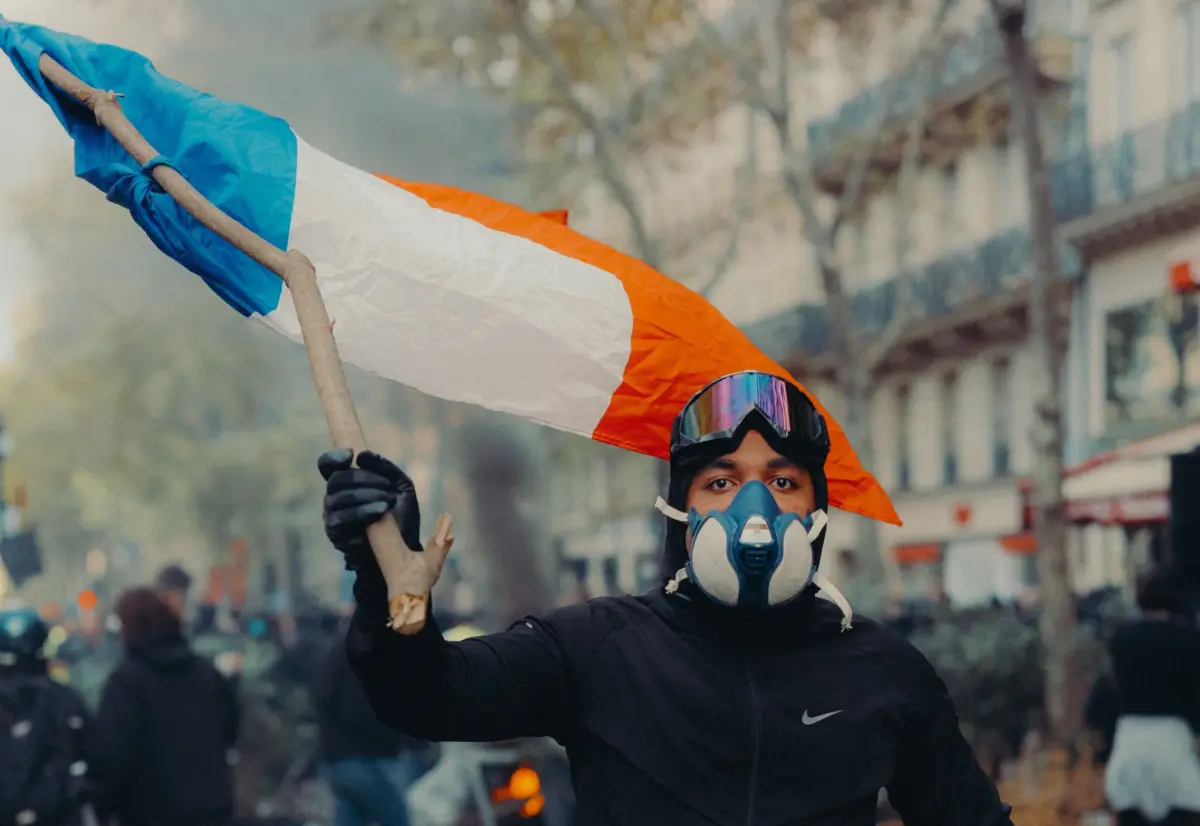
A cross-border mobilization against mounting economic hardship across Western Europe underwent a sudden and destructive transformation on October 17, 2026, as what began as peaceful, student-led assemblies in France and Italy erupted into widespread street violence, coordinated vandalism, and intense confrontations with law enforcement. The upheaval, fueled by deep-seated public anger over widening income inequality, the soaring cost of living, and persistent reductions in essential public services, swept through major metropolitan hubs, leaving hundreds of people injured and resulting in mass arrests across both nations.
The escalation marked a stark departure from the civic demonstrations that had initially brought thousands of high school and university students into public squares. For weeks, the younger demographic had served as the public face of an escalating social movement, rallying peacefully to challenge governmental austerity and the erosion of standard-of-living protections. By Saturday, however, the character of the mobilization fractured. Peaceful assemblies were overtaken by intense waves of property destruction and looting, transforming city centers into scenes of burning infrastructure, shattered storefronts, and heavily fortified police perimeters.
In France, the unrest struck both national and regional administrative capitals with unprecedented severity. What had been organized marches converged into chaos in Paris, while regional centers experienced severe physical destruction aimed directly at institutional symbols. The most catastrophic incident unfolded in Limoges, where the historic city hall was set ablaze and burned to the ground. In Lyon, demonstrators targeted the municipal tourist office, leaving the facility heavily damaged. Further south, unrest intensified in Marseille, where crowds stormed the city hall, while in Bordeaux, demonstrators carried out an aggressive attack against the official residence of the regional prefect.
The scope of the destruction across French cities signaled an alarming shift in tactics, with historic municipal landmarks and central state offices bearing the direct brunt of public hostility. Municipalities that had rarely seen confrontations of this magnitude were suddenly grappling with charred civic landmarks and ransacked commercial districts. The destruction of the Limoges city hall, an administrative and architectural anchor for the regional community, stood out as an indelible emblem of the day’s escalation, transforming a debate over social spending into an acute institutional crisis.
Concurrently, major cities across northern Italy saw parallel eruptions of unrest. In Milan, Turin, and Bologna, student demonstrations addressing identical economic pressures rapidly devolved into coordinated street disturbances, property damage, and looting. The simultaneous flare-up underscored the transnational reach of the movement’s underlying grievances. Across both countries, high school and college students had initially gathered to voice a collective sense of vulnerability, decrying an economic landscape defined by escalating consumer prices, stagnant entry-level wages, and the shrinking footprint of vital public services, from educational infrastructure to regional transit networks.
By the time the initial street battles subsided, the human and material toll had mounted significantly. Hundreds of individuals, including demonstrators and members of internal security forces, sustained injuries during the clashes, with municipal hospitals reporting a surge in admissions for smoke inhalation, lacerations, and blunt trauma. Police authorities in both France and Italy detained large numbers of people in connection with the unrest, initiating sweeping investigations into organized looting networks and the deliberate arson of administrative buildings.
Addressing the nation in a televised broadcast on Sunday evening, French President Emmanuel Macron condemned the violence in the most uncompromising terms, directly confronting the targeting of public buildings and the disruption of the constitutional order. Looking visibly stern as he delivered his remarks, Macron addressed the public sense of shock that accompanied the destruction of communal and regional monuments.
“Those who destroyed property must pay, those who looted must reimburse, and those who sought to bring down the Republic will be held accountable,” the French president declared during the address.
Macron focused on the symbolic gravity of the targets chosen by the rioters, expressing profound disbelief at the domestic origin of the attacks and rejecting any political or economic justification for the violence that unfolded.
“Watching these images, we all asked ourselves: What are they thinking? How can French people do this to France?” Macron said. “Why burn down the Limoges city hall, the tourist office in Lyon, storm the Marseille city hall, or attack the prefect’s residence in Bordeaux? How could they have gone this far? Nothing justifies it, nothing explains it. Nothing excuses it.”
The president’s speech established a decisive legal and financial posture on the part of the executive branch. By emphasizing that perpetrators would be required to pay for the destruction and reimburse businesses and municipalities for looted goods, the administration sought to draw a firm line between lawful assembly and acts of targeted destruction. Furthermore, by characterizing assaults on state institutions as attempts to undermine the Republic itself, Macron signaled that judicial authorities would pursue severe punitive measures against those identified as participating in the burning of municipal halls and assaults on state representatives.
The severity of the unrest also drew sharp attention to the broader structural issues that had initially gathered students together. High school and university student organizations had spent months warning that younger generations were disproportionately bearing the burden of economic contraction. With everyday necessities becoming increasingly unaffordable and budgetary cutbacks eating into the accessibility of public services, student unions had argued that young citizens were being priced out of stable futures.
Yet the sudden shift toward violence has significantly complicated the political landscape. While the initial daytime marches focused on systemic inequities, the evening’s looting and arson alienated community leaders and shifted the focus of national discourse away from economic policy and toward public safety and property protection. In Italian urban hubs such as Milan, Turin, and Bologna, where municipal leaders also confronted shattered storefronts and extensive cleaning efforts, municipal authorities faced similar challenges in balancing the enforcement of civic order against unresolved grievances concerning the rising cost of living.
Throughout Paris, the turbulent descent into violence was recorded in real time by photojournalist Odieux Boby, who found himself at the epicenter of the day’s unfolding events. Boby, widely recognized for his visual coverage of high-profile cultural gatherings including his Cannes Film Festival chronicle Croisette 3000, as well as extensive reporting on protests and fast-moving political developments, had simply been heading to work when he encountered the gathering procession moving through the capital.
Carrying his Leica camera, Boby was swept directly into the crowd as the demonstration abruptly shifted from an organized student march into an unpredictable street conflict. Rather than retreating from the escalating standoff, he remained embedded along the moving fault lines between demonstrators, looters, and advancing lines of riot police.
The exclusive images captured by Boby, shared directly with Vanity Fair, document the sudden dissolution of peaceful assembly into chaotic confrontations. His photographs depict the visceral progression of the event: the initial ranks of student marchers carrying placards condemning the erosion of public services, the subsequent arrival of masked agitators moving through commercial thoroughfares, the shattered display windows of ransacked retail locations, and the defensive deployments of security units amid swirling tear gas and burning debris.
Boby’s visual dispatch captures the atmosphere that gripped Paris, reflecting the immediate human reality behind the government’s formal statements. His frames alternate between the frantic movement of looters fleeing through broken storefronts and the stark stillness of emergency crews attempting to contain fires against the backdrop of historic Parisian architecture.
As municipal cleanup operations begin in Paris, Limoges, Lyon, Marseille, Bordeaux, Milan, Turin, and Bologna, authorities on both sides of the Alps are assessing the total financial cost of the devastation. With municipal headquarters charred and civic buildings breached, national governments face the dual challenge of pursuing legal accountability for property destruction while addressing the pervasive socio-economic frustrations that initially brought the movement into the streets.