





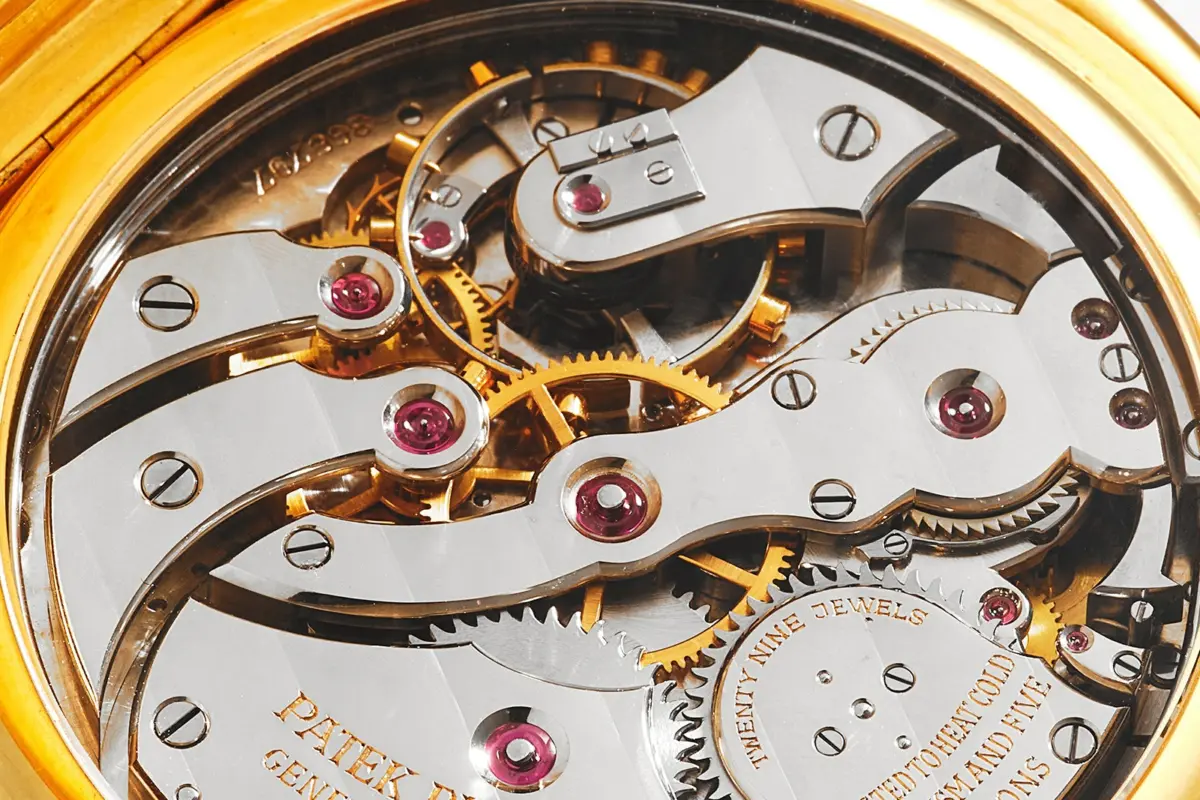
In exactly a week, Sotheby’s Hong Kong will stage Important Watches, an impressive, two-day auction that includes a remarkable selection of outstanding pocket watches from Switzerland and Great Britain. The upcoming sale features exceptional timepieces by master horologists such as Patek Philippe and Charles Frodsham, with the majority of the latter crafted by the renowned London-based manufacturer Nicole Nielsen.
While the modern watch market is overwhelmingly dominated by wristwatches, a select group of collectors understands that pocket watches still offer phenomenal value. Often serving as the most intellectually fascinating lots in major auction catalogues for movement nerds and horological historians alike, these pocket watches exemplify the pinnacle of mechanical ingenuity. Three specific pieces stand out from an already elite herd built by the finest workshops of London and Geneva: a modern grand complication, one of the first-ever flying tourbillon watches, and a minute-repeating pocket chronometer.

Lot 2293 – Patek Philippe ref. 942/2 “Grande Complication”
Representing a relatively recent example of a historical Patek Philippe genre, this grand complication pocket watch dates back to a tradition that spans well over a century. Common watch complications generally fall into three distinct families: chiming, timing, and calendars. Chiming watches include repeaters in all their resolutions, clock watches, alarms, and hour strikers. Chronographs, rattrapantes, dédoublantes, and independent seconds functions make up the timing complications. Calendar complications encompass standard calendars, moon phases, times of sunrise and sunset, and the equation of time.
A triple-complicated watch successfully combines complications from all three of these families. For Patek Philippe, this traditionally meant a minute-repeating base movement paired with an instantaneous perpetual calendar and a split-seconds chronograph, though frequently without a minute totalizer. Historically, Patek Philippe defined a grand complication as a triple complication augmented by a clockwatch featuring grande et petite sonnerie striking, essentially functioning as a pocket-sized grandfather clock.
The firm constructed approximately a dozen grand-complicated watches between the 1890s and the 1960s. Some of these historical masterpieces included special flourishes such as hour counters, secondary date hands, power reserve indicators, and even a rare iteration featuring lightning seconds. Patek Philippe completed its final historical grand-complicated watch in 1965, a sleek, American-style timepiece utilizing an ébauche produced by Henri Daniel Piguet.

However, the genre would return less than two decades later as Patek Philippe successfully navigated the severe stagflation and technological upheaval of the 1970s, transitioning into an era of post-modern watchmaking. While quartz watches comprised more than a third of the brand’s output during that decade and the sporty Nautilus collection was cultivated, the brand recognized a prime opportunity to revive one of its greatest historical strengths: complicated watchmaking.
During the 1980s, Patek Philippe watchmakers reverse-engineered the Victorin Piguet movement of a recently repurchased timepiece—watch no. 138’144, which had originally been sold to an American client in 1908. In 1982, the brand launched the reference 920, a near-exact replica of the 1908 original, right down to the bimetallic compensation balance, though the dial text was modified from English to French. Patek Philippe’s Geneva workshops built 15 of these cloned movements, designated the caliber 20GC, over a ten-year span. All of them bore the prestigious Poinçon de Genève (Geneva Seal), a certification that the brand’s historical complicated pocket watches generally lacked.
The specific specimen in Sotheby’s upcoming sale is one of those watches, manufactured in 1993 but not sold until 2012. Sotheby’s lot essay provides extensive documentation on the piece, with the additional detail that Patek Philippe upgraded the caliber 20GC’s instantaneous perpetual calendar halfway through production. This enhancement added leap year and 24-hour indications, alongside the ability to adjust the month independently—all features present in this exact model.

With an estimated price of HK$3.5 to 7 million (approximately US$450,000 to $900,000), the reference 942/2 represents a compelling value buy by the lofty standards of Patek Philippe wristwatches. It reflects the broader value proposition of pocket watches, delivering significantly more watch for the money than any comparably priced wristwatch on the market. While other historical marques manufactured similar complications that might command lower prices today, this lot is a genuine Patek Philippe, accompanied by its original solid-gold display stand, with the added assurance of ongoing serviceability.
Lot 2294 – Patek Philippe ref. 961 Minute Repeating Chronometer
Despite their widespread popularity in contemporary wristwatches, tourbillon regulators were historically uncommon in Swiss pocket watches. While traditional English makers frequently combined timekeeping-oriented features—such as revolving escapements, chronometer escapements, and chain-and-fusee drive systems—with high complications, Swiss watchmakers were historically hesitant to merge these elements.
The Swiss attitude toward tourbillons eventually evolved alongside consumer willingness to pay for the feature. Today, minute-repeating tourbillon wristwatches are produced with relative frequency. Complicated chronometers, however, remain an exceptionally rare breed. During the 1980s, Patek Philippe developed complicated tourbillons, including a minute-repeating pocket chronometer movement equipped with a spring-detent escapement and a free-sprung compensation balance featuring a helical hairspring. An example of this rare engineering is included in the current sale.

Measuring 21 lignes in diameter, or approximately 47.3 mm, the caliber 21RMD remains Patek Philippe’s third-largest modern movement ever produced, surpassed in size only by the monumental Calibre 89 and the Star Caliber 2000. It stands as the sole modern Patek Philippe movement to utilize an escapement other than the traditional Swiss lever, though the brand has invested years into developing alternative technologies like silicon oscillators.
Slightly more common is the even more complex perpetual calendar variant, the caliber 21RMDQ, which powers this specific watch. That calendar incorporates the same feature set found in the previously discussed grand complication, combining the instantaneous calendar change of Patek Philippe watches from a century ago with the user-friendly adjustment system of the reference 3940 wristwatch.
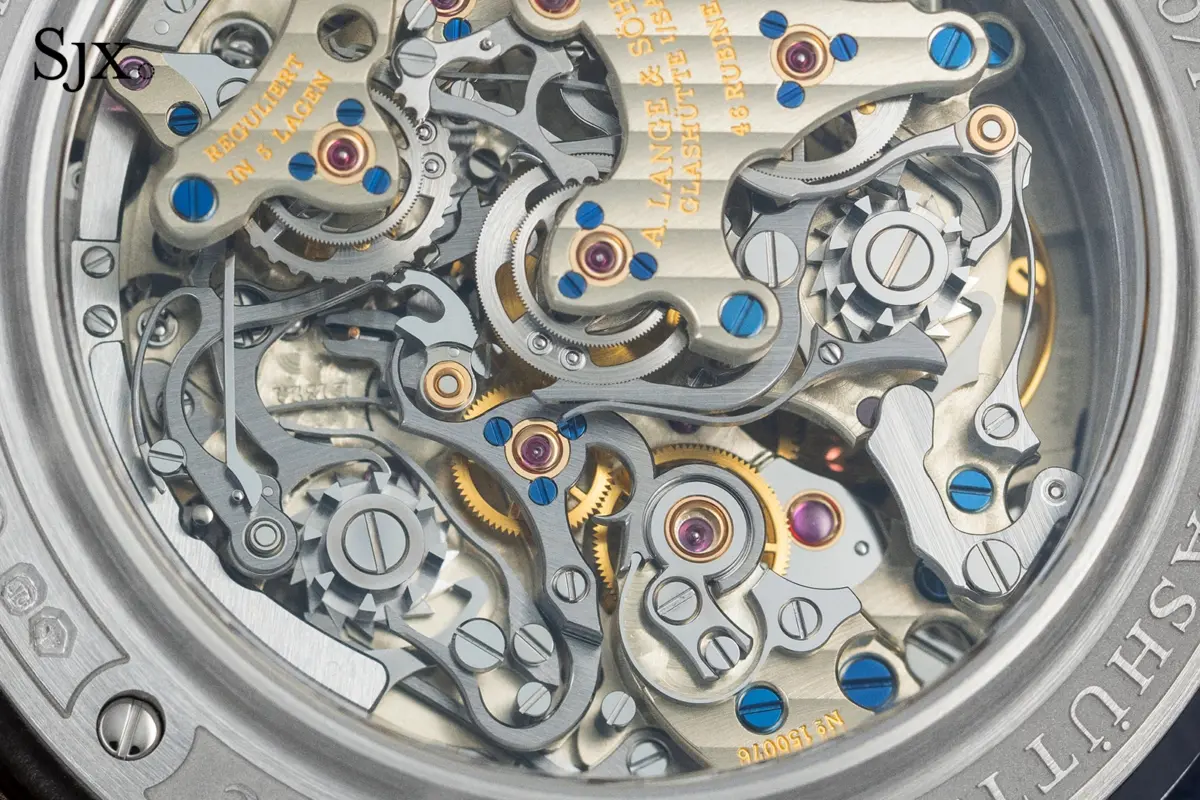
The full-bridge movement is visually stunning, featuring elegantly contoured bridges finished with thick, decadent anglage more characteristic of a high-end contemporary independent watchmaker than a major Swiss manufacturer from the 1990s. The solid-gold escape wheel warrants close inspection, and the hand-engraved movement text and Calatrava cross demonstrate the immense labor and master craftsmanship invested in adjusting the watch before it left Geneva.

Produced and sold in 1990, this reference 961 is one of only two known specimens of the model to ever appear publicly at auction, establishing it as one of the rarest modern pocket watch references created by Patek Philippe. It carries an estimated pre-sale price of HK$1.6 to 3.2 million, or approximately US$200,000 to $400,000.
Lot 845 / 844 – Patek Philippe Minute Repeating Pocket Watch with Linear Perpetual Calendar
As perhaps the most celebrated member of Patek Philippe’s "moderne" pocket watch series tailored to the American market, the reference series combines an in-line American-style perpetual calendar with a minute-repeating movement housed inside a mid-century modern case, topped by a sleek silvered-gold dial.
American collectors historically favored clean dials and aperture-based displays, a preference clearly demonstrated in custom watches created for prominent industrialists like James Ward Packard and Henry Graves Jr. This aesthetic eventually culminated in the "moderne" design language, producing some of the most visually balanced pocket watches ever conceived.

The 2021 introduction of Patek Philippe’s reference 5236 in-line perpetual calendar renewed global interest in the display format, with industry commentary frequently using the terms "in-line" and "American" interchangeably. However, what specifically defines the American layout is the month-date-day arrangement, whereas European brands favored a day-date-month order for their linear displays. The workshops of Victorin Piguet produced American in-line calendars for Patek Philippe while simultaneously supplying European in-line calendars to competitors like Breguet.
Sold originally during the 1960s, this timepiece utilizes a movement dating back decades earlier, evidenced by the movement number 197’909. Henri Daniel Piguet’s workshop in Le Chenit—the successor to Victorin Piguet—continued to manufacture repeater movements to supplement finite stocks of new-old-stock components.
The movement exhibits exceptional finishing and functional reliability. Its generous 17-ligne sizing, roughly 38 mm, provides an acoustic and mechanical advantage that benefits both sound resonance and overall reliability, two areas that historically challenged neo-vintage repeating wristwatches. With an attractive pre-sale estimate ranging from HK$480,000 to 800,000 (US$61,000 to $122,000), it presents a compelling entry point into high-complication Patek Philippe pocket watches.

Lot 2427 – Charles Frodsham Split-Seconds Chronograph with Six-Minute Flying Tourbillon by Nicole Nielsen
Ancient Greek writers claimed that the mute swan sings its most beautiful song immediately before its death. In a similar vein, English watchmakers produced some of their finest, most sophisticated timepieces during the waning days of traditional fine watchmaking in the British Isles.
Many of these masterworks were engineered by Nicole Nielsen, London’s premier fine watch manufacturer around the turn of the 20th century. Despite its technical preeminence, the company name remains relatively obscure today because Nicole Nielsen primarily produced movements and watches behind the scenes for other prestigious brands, most notably Charles Frodsham and the two Dent companies.
Originally founded in Le Solliat, Vallée de Joux, in 1837 as Nicole & Capt, the firm later expanded operations to London and incorporated as Nicole, Nielsen & Co. after Danish watchmaker Sophus Emil Nielsen joined as a partner around 1870. The Swiss-English enterprise leveraged its Helvetic connections for chiming and astronomical complications, while its London workshop specialized in ultra-precise chronometry, combining the best of both horological worlds. The famously meticulous master watchmaker George Daniels praised Nicole Nielsen’s tourbillons as being virtually impossible to improve upon, while the heavy, robust cases and Willis-made enamel dials matched that high standard of quality.

This specific lot combines three major horological inventions: the chronograph, the rattrapante (split-seconds) mechanism, and the flying tourbillon. Adolphe Nicole was responsible for the first two innovations, detailing the heart-cam and hammer reset mechanism in an 1844 British patent (patent 10’348) that also incorporated keyless winding and setting systems for fusee watches.
The flying tourbillon arrived later, patented in 1904 by Robert Benson North. North acquired a majority stake in Nicole Nielsen & Co. in 1888, assumed operational control in 1898, and eventually served as director and chairman of Charles Frodsham & Co. beginning in 1922.
North’s flying tourbillons are frequently mistaken for karrusels—an easier-to-manufacture and more energy-efficient indirectly driven revolving escapement that typically completes one rotation every 34 or 52.5 minutes. Mechanically, however, this piece functions as a true tourbillon, operating at a slower cadence by taking six minutes to complete a full revolution. True to English chronometer tradition, it features a free-sprung balance, an overcoil balance spring, and a low-friction diamond endstone.

Estimated at HK$160,000 to 320,000 (US$20,400 to $40,800), this lot represents a remarkable opportunity for collectors, given the rising global interest in rare, complicated pocket watches.
Preview and Auction Information
The auction will take place at Sotheby’s Maison in Hong Kong, located at Landmark Chater, 8 Connaught Road Central, Central.
The public preview exhibition is open daily from September 11 to 17, running from 11:00 am to 7:00 pm local time.

The live auction sessions are scheduled as follows:
- September 18: Session 1 (Lots 2201–2323) begins at 11:00 am; Session 2 (Lots 2324–2457) begins at 3:00 pm.
- September 19: Session 3 (Lots 2458–2612) begins at 11:00 am.
All listed times are local Hong Kong time (GMT+8). The complete auction catalogue is available on Sothebys.com.