




Paint trends are usually declared well before most of us ever pick up a brush. Brands announce colors of the year, forecasters identify emerging palettes, and designers make their own predictions about what is coming next. But what happens when you look not at what people say they like or eventually buy, but at the colors they consider along the way?
That is the premise behind the first Samplize American Paint Color Report, which analyzes millions of samples ordered in the United States during the first six months of 2024, 2025, and 2026. The data spans major industry names including Benjamin Moore, Farrow & Ball, and Sherwin-Williams, allowing Samplize to see which colors homeowners consider side by side before making a final decision on their interior design projects.
Makenna Lutz, partnerships lead at Samplize, explains that analyzing this sampling stage reveals three distinct things: the full shortlist a person actually weighed, which colors get tested against each other, and how that shortlist spans multiple brands rather than sticking to a single manufacturer.
Across those millions of samples, one major shift stands out above the rest. Warm colors grew nearly three times faster than cool colors over the three-year period analyzed in the report and now account for an overwhelming 69.4% of everything tested on Samplize, up from 64.3% two years earlier. Furthermore, half of all American shortlists now contain no cool colors at all, compared with 43% at the very beginning of the study.
It would be easy for industry observers and casual design enthusiasts to interpret this data as simply another swing toward pale beige and cream, reminiscent of past neutral revivals. However, the comprehensive data gathered by Samplize suggests something much more nuanced is happening in American homes.
The genuine surprise was in the split by depth, Lutz notes. Industry experts expected the warming trend to show up primarily as lightening—but it did not. Warm tones actually outgrew cool tones at every single depth level, and the deepest warm tones grew the fastest of all, expanding roughly six times faster than deep cool tones.
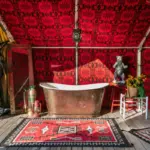
At one end of the spectrum are blush-toned plasters and warm creams that create soft, enveloping spaces. Examples include Farrow & Ball’s Setting Plaster, Benjamin Moore’s Proposal, and Sherwin-Williams’ Malted Milk. At the other end of the design spectrum is Benjamin Moore’s Classic Burgundy, which stands as one of the darkest colors included in the study and yet grew at a remarkably comparable pace. This indicates that homeowners have not necessarily lost their appetite for dark, dramatic interiors; rather, the temperature of that drama is fundamentally changing.
Brown shades reinforce that overarching shift, growing faster than any other color family tracked in the report. Brown now appears in 13.4% of shortlists, a noticeable increase from 9.2%. However, the specific colors driving that growth are not saturated chocolate or vibrant terracotta tones that might dominate seasonal runway trends. Instead, choices like Sherwin-Williams’ Warm Stone and Urbane Bronze, Farrow & Ball’s London Clay, and Benjamin Moore’s Smokey Taupe point toward muted greiges, warm grays, and stone-like shades rather than conventional, heavy browns.
Green, meanwhile, appears to be settling comfortably into the permanent American palette. After rising sharply in previous years and then holding steady at that higher level, green now appears in 34.6% of shortlists. The shades being evaluated range widely from soft sage and muted moss to deeper botanical greens that bring a sense of the outdoors inside.
The underlying consumer behavior also suggests that temperature may matter far more to decorators than individual color families. Two-thirds of shortlists contain colors from only one temperature group; half are entirely warm, while only about a third mix warm and cool shades together during the testing phase.
There are also clear signs that the warming palette may be getting more colorful overall. Pink and red are currently the fastest-growing color families from smaller starting points, while the warm-and-deep classification emerged as the fastest-growing combination of temperature and depth across the entire dataset.
That does not automatically make burgundy the next universal beige, nor does three years of sample data fully predict what American walls will look like several years down the line. But the shift is clearly not simply toward lighter, quieter neutrals. From soft plaster pinks to weathered browns and deep reds, Americans are exploring warmth across the entire spectrum.