






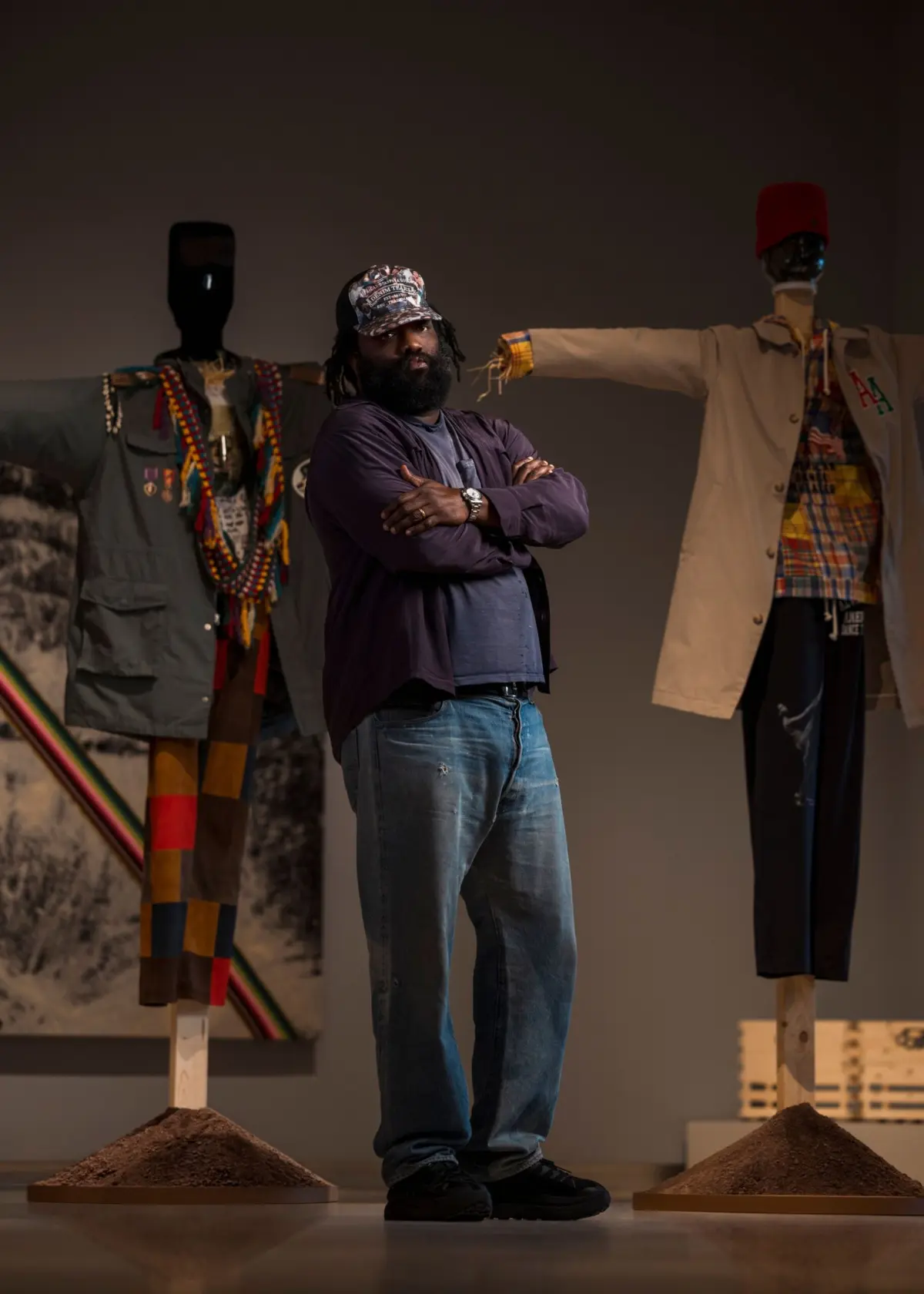
Even before Tremaine Emory established his own globally recognized label, Denim Tears, his footprint across the contemporary fashion landscape loomed remarkably large. Operating behind the scenes and in collaborative spaces, Emory lent his visionary eye to a diverse array of popular and influential brands—including Stüssy, Marc Jacobs, and Yeezy—playing a critical role in shaping their visual identities and cultural resonance. Since the launch of Denim Tears, his collaborative portfolio has only expanded, bridging luxury houses, heritage brands, and contemporary art icons. He has partnered with major names such as Dior, Levi’s, and Ugg, alongside high-profile creative collaborations with visionary artist David Hammons and the late, legendary designer Virgil Abloh. Furthermore, Emory’s industry leadership was cemented during his tenure as the creative director at pioneering streetwear brand Supreme, a high-profile role he held for a short time before his departure captured widespread media attention.
Throughout his multifaceted career, Emory has consistently infused his work with rigorous explorations of race, politics, and historical memory. The launch of Denim Tears in 2019 was itself a profound historical statement, arriving precisely 400 years after the first known enslaved Africans arrived in North America. The brand’s evocative name carries layers of heavy historical meaning, centering directly on cotton—the foundational textile around which the economy of American slavery was constructed—as well as the immense pain, suffering, and systemic exploitation endured by Black people forced to harvest it. By weaving these heavy historical narratives into wearable garments, Emory transformed everyday clothing into powerful artifacts of remembrance and critique.
This week, the Savannah College of Art and Design (SCAD) Museum of Art officially opened “Denim Tears From the Pool of Black Genius,” marking the very first solo museum exhibition and comprehensive retrospective dedicated to Emory and his rich, multidisciplinary creative practice. Rather than presenting his fashion designs in isolation, the exhibition thoughtfully places Emory’s pieces alongside works by some of the visionary artists who have profoundly inspired him throughout his career. Among these artistic influences are luminaries such as Arthur Jafa, Hank Willis Thomas, and David Hammons. This careful curation underscores the extraordinary breadth of Emory’s intellectual and artistic references, while reinforcing the reality that his fashion output was never created in a vacuum; rather, it was always deliberately designed to be in active, provocative conversation with culture at large.
Through the medium of graphic T-shirts, heavily embellished jeans, rugged workwear-style jackets, and a wide array of other garments and accessories, Emory continually nods to history and collective cultural memory. His approach redefines how garments function within society. Or, as a curatorial release from the museum aptly notes, “his work transforms important historical references into contemporary objects and experiences,” while simultaneously working to “create educational pathways between Black history and the history of clothing.” By challenging established hierarchies within the fashion industry and actively encouraging critical dialogue among viewers and wearers alike, Emory successfully positions fashion not merely as commercial product, but as both a sophisticated form of conceptual art and an essential tool for reflection and education.
As visitors and scholars alike explore the depths of the retrospective, Emory and the SCAD Museum of Art have shared exclusive images from the exhibition to provide a glimpse into the thoughtfully curated spaces. For those eager to experience the retrospective firsthand, “Denim Tears From the Pool of Black Genius” remains on view at the SCAD Museum of Art through January 11, 2027, offering an extended opportunity for audiences to engage with the profound intersections of fashion, history, and contemporary Black genius that Emory has championed throughout his career.