




Recent auction results at Sotheby’s Hong Kong have once again highlighted contemporary market fascination with independent watchmaking and special, limited editions of series-produced timepieces. Yet, when viewed against the backdrop of horological history, this modern obsession tells only part of the story. A striking contrast is found in the Sandberg Collection, an extraordinary assembly gathered by the late Baron Michael Sandberg, former chairman of the Hong Kong and Shanghai Banking Corporation (HSBC). This historic collection paints a vivid picture of a completely different era of watch collecting—a golden age when elaborately decorated pocket watches, mechanical singing birds, and exotic automata reigned supreme in the auction room.

Before it was entirely dispersed at an Antiquorum auction in 2001, the Sandberg Collection ranked among the most ambitious private assemblies of horological art formed during the latter half of the 20th century. Comprising more than 400 timepieces, the collection reflected a sustained, deeply intellectual engagement with both the mechanical and symbolic dimensions of historic watchmaking. Spanning centuries and vast geographical boundaries—from Geneva enamels and French musical complications to English automata, alongside Islamic, Chinese, and regional European adaptations—the holdings built a remarkably coherent whole. Instead of building around a single school, era, or brand, Sandberg assembled a collection that participated in a larger, global conversation: dialogue between European and Oriental markets, between religious and secular symbolism, and between raw mechanical utility and peerless ornamentation.

Lord Sandberg’s long and distinguished residence in Hong Kong undoubtedly shaped both his access and his unique global perspective. Chinese-market watches, enamelled automata crafted specifically for export, and timepieces informed by Islamic or South Asian design suggest a collecting philosophy deeply grounded in cultural plurality. Far from being mere token inclusions, these rare objects formed central threads in a broader exploration of how timekeeping evolved in response to international trade, diplomatic relations, shifting religious codes, and diverse regional tastes.

The Man and the Collector
Born in Singapore in 1927 and educated in Britain, Michael Graham Ruddock Sandberg belonged to a generation uniquely shaped by the final phase of British imperial influence and the concurrent rise of new global centres of power. His early formative years in one of the Empire’s key commercial crossroads introduced him to a world defined by cultural overlap, where the boundaries between East and West were experienced daily through trade, administration, and interpersonal life. This early exposure to complex cultural negotiation profoundly influenced both his illustrious professional career and his later, highly distinctive approach to horological collecting.

After a brief period of service in the Royal Air Force during the closing stages of the Second World War, Sandberg joined the Hong Kong and Shanghai Banking Corporation in 1948. His steady, methodical rise through the corporate ranks was built upon technical skill, deep cultural fluency, and strategic patience. When he was appointed Chairman in 1977, Hong Kong was standing directly on the precipice of profound political change. His steady leadership through delicate negotiations with China regarding the colony’s future demanded immense measured judgment and diplomatic tact. His eventual elevation to the peerage in 1997 coincided precisely with Hong Kong’s historic return to Chinese sovereignty, formally recognizing his vital role in managing that complex geopolitical transition.

The Collection
Lord Sandberg left behind no formal memoirs, extensive interviews, or published curatorial mission statements. What remains for historians and connoisseurs is the collection itself: 423 remarkable objects gathered over decades of dedicated pursuit and catalogued comprehensively before their sale in 2001. The detailed, richly illustrated auction catalogue produced by horological expert Terence Camerer Cuss allows the true contours of a sophisticated collector’s approach to emerge from that frozen moment in time.

Spanning more than four centuries of human ingenuity, though centred primarily on the 17th through 19th centuries, the collection heavily highlights exceptional Swiss and French workmanship. Master houses such as Piguet & Capt, Breguet, Bovet, and Rochat feature prominently alongside English automata, Chinese-market exports, and pieces meticulously adapted to Islamic and Indian cultural codes. Recurring motifs—including complex musical mechanisms, intimate erotic scenes, animated automaton figures, and unusual escapements—point to specific, curated intellectual interests rather than mere curiosities or random accumulations.

Ultimately, his collecting practice reflects an insistence on watches as profound cultural artefacts—objects that speak far beyond their internal mechanics. He deliberately sought pieces that revealed ingenious technical solutions alongside shifting historical meanings, acquiring timepieces that communicated through allegory, religious devotion, public display, or satirical commentary.

Origins and Early Forms (c. 1580–1700)
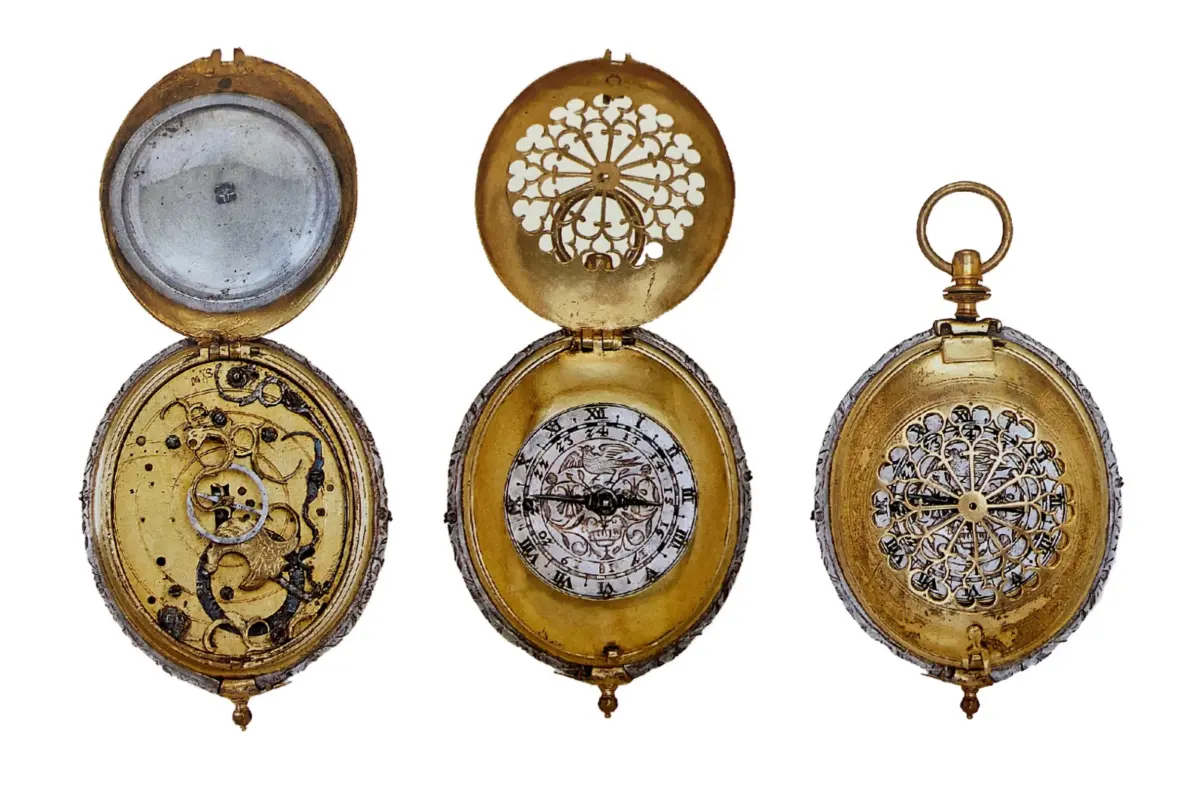
The earliest segment of the Sandberg Collection reflects a foundational era when horology was still taking shape as an experimental discipline rather than an established science of absolute precision. The collector sought rare instances where form, function, and symbolic meaning briefly aligned. Lot 67 anchors this group with an oval striking watch attributed to M.S., possibly Martin Schmidt of Prague, circa 1580. Its three-body “fermée” case in silver and gilt metal, featuring hinged covers, presents the watch as a sacred, protected object. Inside, the brass full plate carries a fusee with chain, a five-wheel iron train, verge escapement, and an iron striking mechanism sounding on a shallow bell, functioning almost as a miniature clock imbued with ceremonial gravitas.

In direct contrast, Lot 207 represents a more modest Central or Eastern European tradition from the late sixteenth century. Bearing only the maker’s mark “H,” it trades courtly decorative abundance for durability and folk-inspired ornament. Meanwhile, Lot 214, a Geneva-made pendant watch by Jacob Molly circa 1650, signals a shift toward symbolic refinement through “ronde bosse” enamel and a white enamel dial ring. Completing this early group is Lot 232, a gold-cased watch by Nicollas Vallin of London circa 1595, engraved with allegorical figures of Peace and Justice and featuring memento mori dial imagery—a cherub resting on a skull beside an hourglass—transforming the daily consultation of time into a meditation on mortality.

Enlightenment and Enamel (c. 1760–1805)
At the very heart of the Sandberg Collection lies a profound fascination with the Enlightenment’s conception of the watch as both a scientific instrument and a vessel for allegory, sentiment, and miniature painting. The most refined examples emerged from Geneva’s leading enamel ateliers, working in close collaboration with movement makers from the Vallée de Joux.

Lot 26, an unsigned Geneva lantern watch from circa 1780, exemplifies this period by utilizing three separate dials for multiple time zones, giving mechanical form to the metaphor of time as illumination. International scope is further demonstrated by Lot 30, an ambitious astronomical watch by Tavernier à Paris circa 1765, featuring double dials, a perpetual calendar, moon phases, and a four-digit year indicator extending all the way to 9999.

Mechanised Wonder – Automata and Musical Mastery (c. 1780–1825)
The Sandberg Collection reaches one of its most extraordinary peaks in its group of automata and musical watches. Conceived not merely as timekeeping instruments but as miniature mechanical theatres, these pieces blurred the line between machinery and performance.

Lot 6, attributed to William Staples of London, spans an imposing 84.7 mm and integrates three independent trains: a repeating mechanism, a musical movement, and an erotic automaton concealed beneath a rotating disc. Similarly, Lot 47, known as “The Amphora” and attributed to Piguet & Capt with enamelwork by the Richter workshop, conceals a musical automaton activated by touch, depicting a boy urging a dog to jump and a girl strumming a guitar. The genre is pushed to its absolute theatrical limits in Lots 405 and 406, flintlock-form automaton pistols attributed to Moulinié, Bautte & Cie of Geneva, which combine timekeeping, perfume dispersion, and exquisite scarlet flinqué enamel.

Cultural Markets and Technical Dialogue (c. 1825–1860)
As European horology expanded its reach, the watch evolved into an active medium of cultural negotiation. In Sandberg’s collection, this global turn is visible in pieces made specifically for Chinese, Islamic, and Indian markets.

Lot 104, a quarter-repeating watch by George Prior of London circa 1785 made for the Islamic market, features multi-coloured gold, Turkish numerals, and a chatelaine adorned with turquoise-set panels. Likewise, Lot 291 by Ilbery of London circa 1815 combines Imperial blue enamel over engine-turning with diamond-set floral wreaths for the Chinese market, satisfying a distinct regional desire for animation, dynamism, and high precision.

Industrial Refinement and High Complication (c. 1860–1900)
During the final decades of the 19th century, horology shifted decisively from theatricality toward uncompromising industrial precision. While Sandberg’s primary focus remained on earlier periods, his selections from this era reveal a collector still deeply appreciative of high mechanical achievement when paired with restraint.

Lot 182, Breguet à Paris No. 125—with a movement completed in 1785 but sold in 1797 and later owned by the Duc de Coigny—exemplifies Breguet’s ideal of mechanical elegance through a Stogden-type minute repeater mechanism. Furthermore, Lot 129, a rare Breguet Etablissement Mixte from circa 1820, features an eight-day going “wandering hour” display, where revolving hour numerals traverse a fixed minute arc centuries before modern digital concepts took hold.

Objects of Mechanical Wonder: Pistols, Birds, and Boxes
Beyond pure horology, Lord Sandberg’s collection encompassed an exceptional group of adjacent mechanical objects, including singing bird boxes, musical automata, and theatrical snuff boxes. Lot 100, known as “A Lapis Organ,” features a gold, enamel, and lapis lazuli musical box shaped like a pipe organ with a concealed watch, playing La marche du Roi Louis XIII. Meanwhile, Lot 197, “Vertumnus and Pomona” by Frères Rochat circa 1815, presents a singing bird automaton box in translucent Imperial blue enamel where the articulated bird opens its beak, flaps its wings, and turns dynamically.

Ultimately, Lord Sandberg’s collection stands not as a mere accumulation of luxury goods, but as a masterclass in discerning connoisseurship. Spanning nearly four centuries of human ingenuity, these remarkable timepieces preserve the rich, intersecting histories of invention, global exchange, and changing cultural tastes.