





Marta Costa Reis, Mónica Gaspar, and Patrícia Domingues, eds., Madrugada: A joalharia e a política da Esperança (Daybreak: Jewellery and the Politics of Hope)
Lisbon: PIN – Portuguese Association of Contemporary Jewellery and CML/MUDE Museu do Design, 2025. (Published in Portuguese/English)
As the 3rd Lisbon Contemporary Jewellery Biennial, organized by the PIN – Portuguese Association for Contemporary Jewellery, prepares to launch its week-long run from September 19 to 27, 2026, the global design community continues to reflect on the conceptual foundations that paved the way for this year’s theme, Coexistences. Derived directly from the concluding section of the 2024 biennial’s landmark exhibition, Madrugada: A joalharia e a política da Esperança (Daybreak: Jewellery and the Politics of Hope), these ongoing conversations find a permanent home in the exhibition’s newly released bilingual catalog. Reviewing the publication allows critics, makers, and enthusiasts alike to trace the powerful political ideas that sparked the contemporary jewelry movement’s recent evolution.
"Madrugada," a evocative Portuguese term denoting "daybreak," served as the conceptual title for the flagship exhibition of Lisbon’s second contemporary jewelry biennial. Presented in collaboration with MUDE – Museu do Design, the essential institution for Portuguese contemporary jewelry, the exhibition temporarily transformed the vacant historic Calheta Palace. Marking the 50th anniversary of Portugal’s transformative 1974 Carnation Revolution, curators Marta Costa Reis, Mónica Gaspar, and Patrícia Domingues brought together a compelling selection of political pieces. Ranging from quiet meditations to intense indictments, the works displayed a collective determination to inspire hope in a fractured world.
A Curatorial Framework Rooted in Crisis and Resilience
The exhibition united works by 90 jewelers hailing from 34 countries, addressing a vast spectrum of contemporary injustices. The featured pieces confronted pressing global issues, including systemic violence against migrants, destructive and exclusionary beauty standards, and the alarming deterioration of queer rights worldwide. The underlying definition of "hope" referenced in the project’s subtitle departs from naive optimism or paralyzing pessimism. Instead, it champions an active resilience—the kind of enduring hope that confronts uncertainty head-on, keeping the hands free and ready for meaningful labor. The curators specifically sought out jewelry that managed to carry both immediate, palpable rage and this steadying sense of purpose.
Primarily for the Initiated: Navigating the Exhibition Space
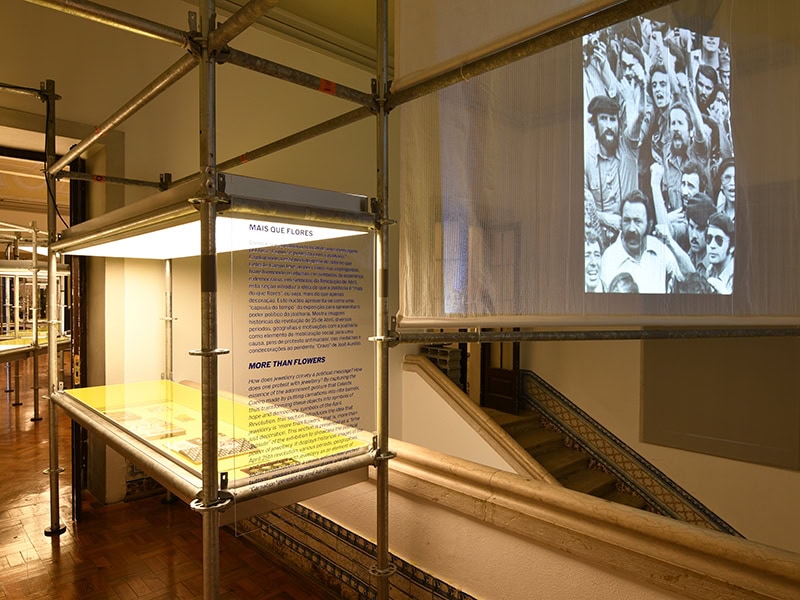
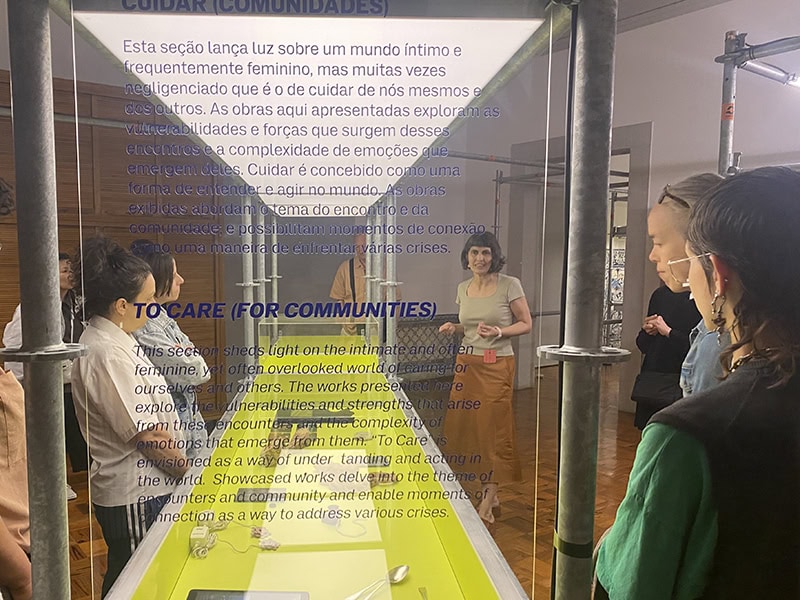
A traditional review of a jewelry exhibition would typically offer an extensive breakdown of the physical objects on view, but Madrugada presented a unique challenge in this regard. The curatorial team chose to accompany the works with the sparest possible information within the gallery spaces, providing little beyond basic factual data such as the maker’s name, title, and materials.
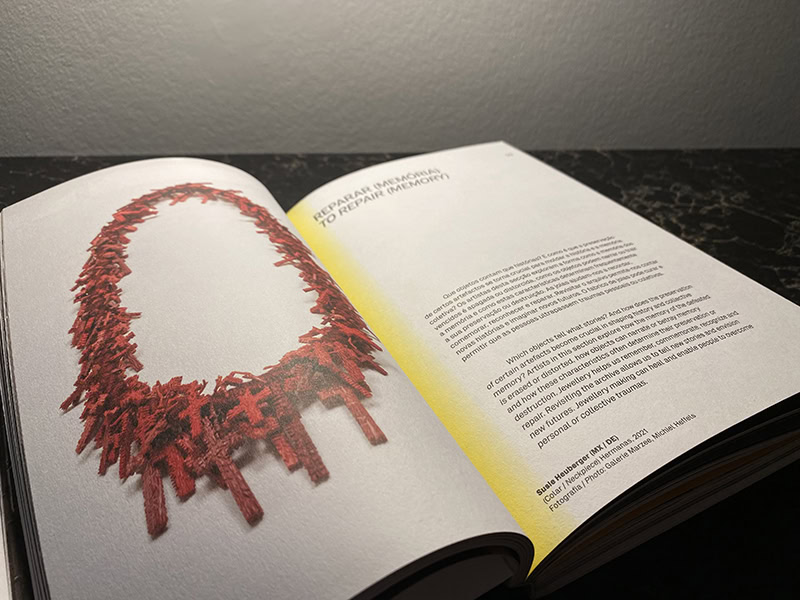
Navigating the exhibition with the curators and participating artists provided vital context that transformed the viewing experience. For instance, artist Nanna Melland explained the underlying concept of a swarm shaping her striking aluminum planes, while Johanna Zellmer’s passport-themed work took on profound personal resonance when paired with her migration narrative. Similarly, Susie Heuberger revealed that the striking pinkish-red crosses in her neckpiece Hermanas were created to commemorate Mexican women killed in ongoing conflicts.
Encountering familiar pieces offered moments of recognition, such as Ana Escobar Saavedra’s maternity ward baby identification band meticulously replicated in stone—a poignant reminder that society begins constructing our individual identities from the moment of birth. However, many works introduced fresh perspectives. By actively challenging their own institutional blind spots, the curators curated a diverse roster of young and underrepresented voices, highlighting how emerging generations react to contemporary socio-political crises.
To structure this massive undertaking, the curators organized the works into eight thematic categories reflecting hopeful actions: "To protest (voices)," "To empower (tools)," "To repair (memory)," "To care (for communities)," "To acknowledge (materialities)," "To transit (boundaries)," "To become oneself," and "To reimagine (coexistences)." Each section was introduced by a thoughtful mini-essay. While these texts were occasionally difficult to decipher on the transparent display panels scattered throughout the cavernous rooms of the Calheta Palace, they are easily savored and studied within the pages of the catalog.
A Practice of Curatorial Care
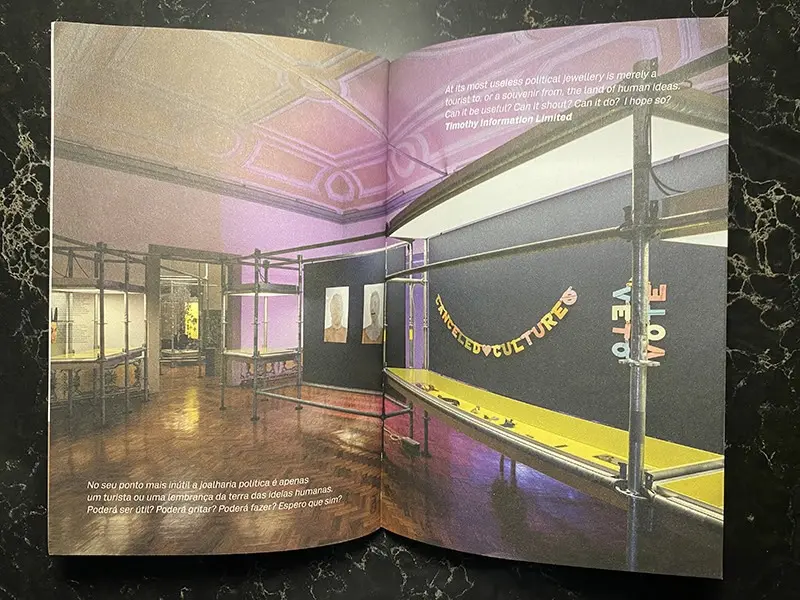
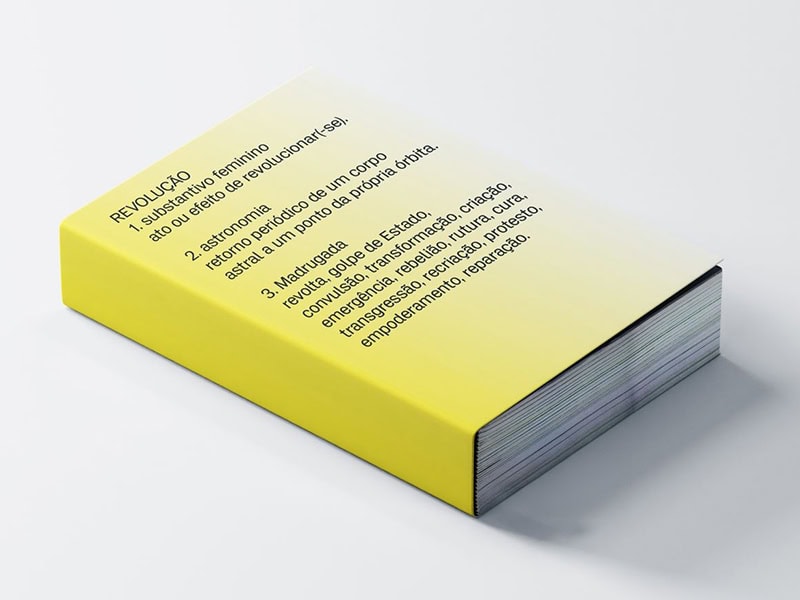
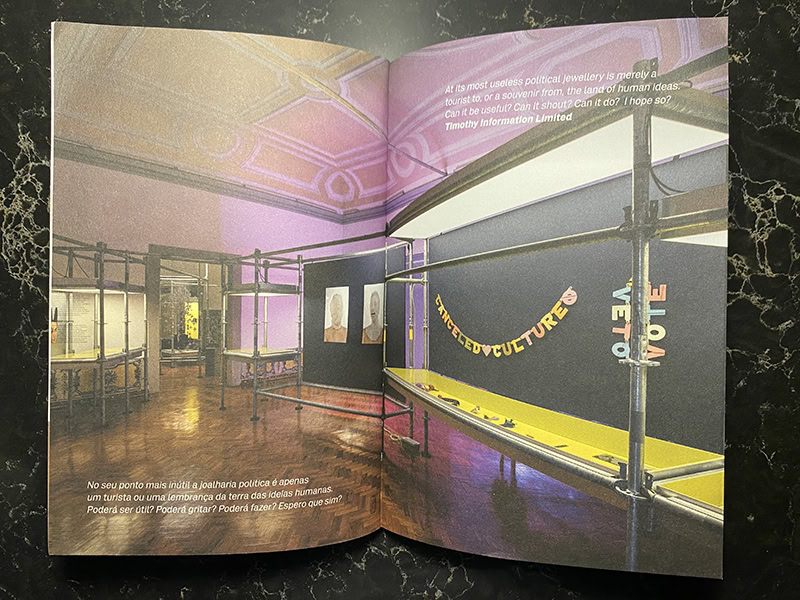
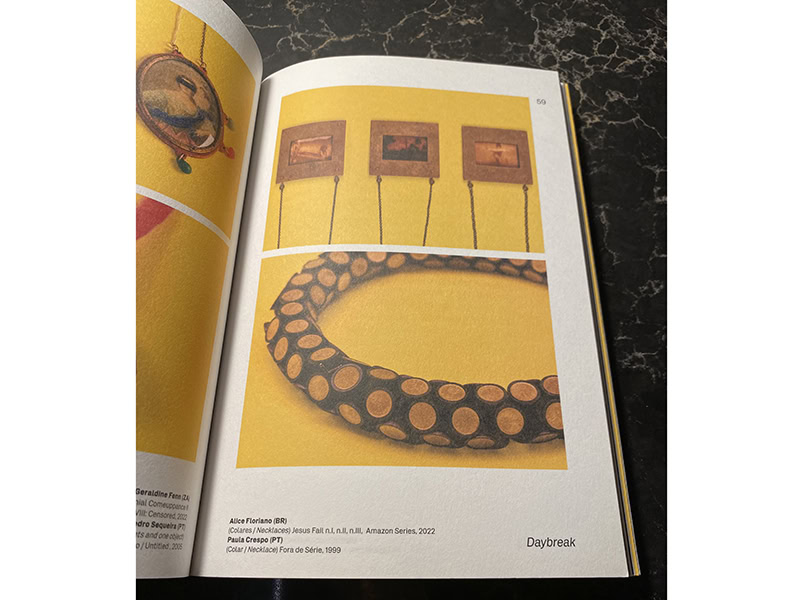
The catalog itself—unmistakably bound with a striking yellow cover—acts as a vital instrument for tending to the exhibition’s afterlife. Nearly all the interior photography was captured in situ, documenting how the temporary exhibition scaffolding snaked dynamically through the tall, ornate rooms and narrow passageways of the palace. Close-up photographs of the works resting inside glass display cases even capture the atmospheric haze of the dominant yellow partition walls.
This deliberate approach reflects the curators’ broader philosophy regarding the lifespan of an exhibition long after the loaned works are returned to their makers. During their presentation at the AJF talk during Schmuck 2025, Gaspar and Domingues emphasized that the publication functions as a tangible practice of "care," ensuring that the conceptual sparks generated by the project remain active in public discourse.
In an interview conducted by art critic Elena Karpilova featured within the book, the curators explain their deliberate choice to avoid providing a comprehensive 200-page explanatory manual inside the galleries. Instead, they opted for a restrained deployment of QR codes, hoping that visitors "would get curious and self-initiate acts of micro-research." While this calculated editorial decision risked leaving certain complex works obscure to the casual visitor, it placed agency squarely back onto the audience.
Avoiding Labels and Confronting Discomfort
The catalog maintains a rigorous approach by carefully listing the materials and dimensions of each piece, while proving slightly more generous than the exhibition by including selected artist quotes and contextual background. For instance, the inclusion of Auli Laitinen’s Nobel Bow—a two-meter-long silk chiffon and oxidized silver neckpiece worn by Inger Wästberg at the annual meeting of the Swedish Academy—serves as a potent symbol of institutional resistance. Wästberg famously wore the piece in solidarity with the secretary of the Swedish Academy, who was pushed out by male colleagues to preemptively avoid #MeToo-related embarrassments. Wearing such an accessory demands genuine courage, particularly in a global political climate where authorities increasingly criminalize "subversive" adornments, ranging from explicit political pins down to contemporary watermelon brooches worn in solidarity with Palestine.

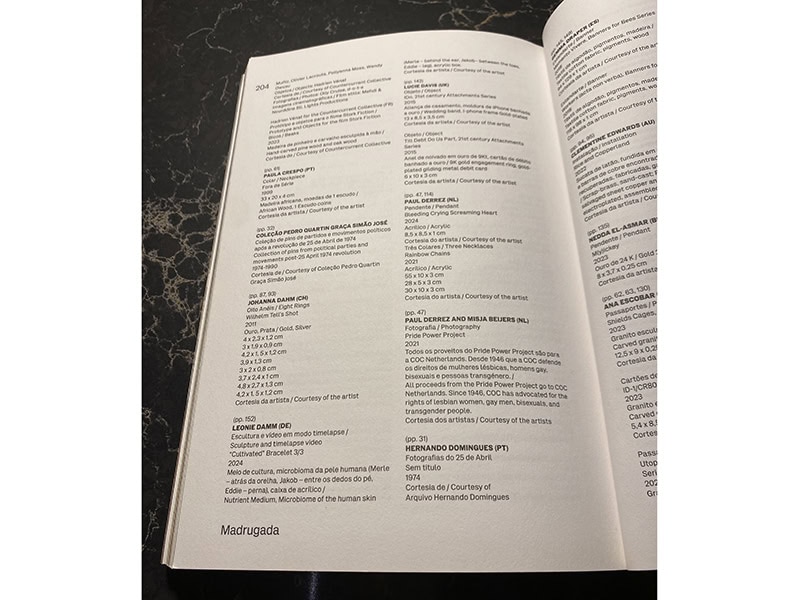
Similarly, encountering Paula Crespo’s necklace Fora de Série within the "To repair (memory)" section prompts immediate questions about its materials. A glance at the back of the catalog reveals the listing: "African Wood, 1 Escudo coins." The material combination silently alludes to the complex history of timber extraction and economic exploitation within former Portuguese colonies. Operating without the comforting crutch of explanatory wall labels forces viewers into a state of productive unease. This tension raises essential questions: Is this deliberate withholding a form of curatorial gatekeeping, or is it an offering of freedom—the freedom to finally look at art with unmediated eyes?
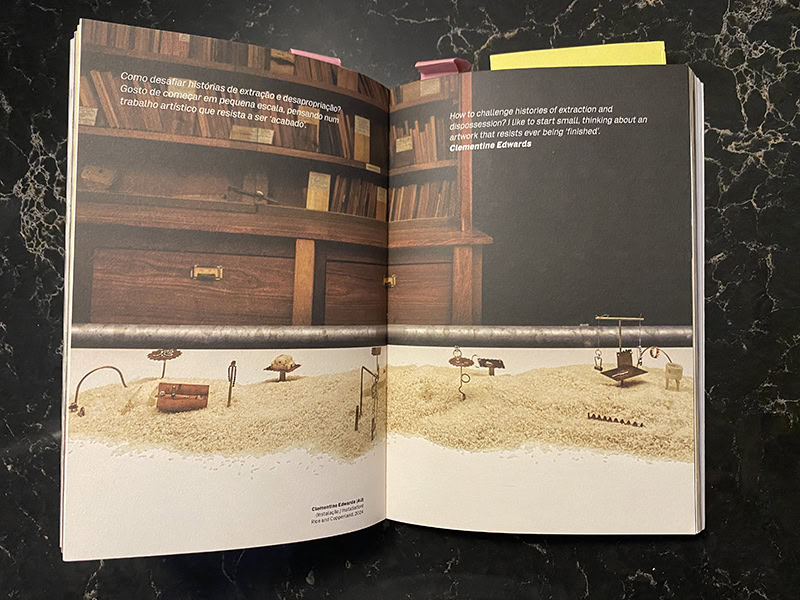
Other works demand similar active decoding. Clementine Edwards’s sprawling installation Rice and Copperland utilizes miniature elements, scrap brass, and salvaged copper to address histories of extraction and dispossession. As Edwards notes in a catalog quote absent from the physical exhibition, "How to challenge histories of extraction and dispossession? I like to start small, thinking about an artwork that resists ever being finished." Likewise, Conversation Piece’s pendant Black Box, which resembles a high-tech ammonite constructed from jet, ferrite, and seashell, gains profound thematic depth when understood through the lens of technological obsolescence, overconsumption, and conflict minerals.
Jewelry as an Instrument of Protest
The catalog bypasses tired debates over whether jewelry is a suitable medium for political protest or radical hope, firmly asserting that it already is. Historical pieces like José Aurélio’s 1974 medal bearing the phrase Arte é Revolução é Arte underscore the inherent revolutionary potential of creative practice. Midway through the publication, a quote by Timothy Information Limited captures this inquiry: "At its most useless, political jewellery is merely a tourist to, or a souvenir from, the land of human ideas. Can it be useful? Can it shout? Can it do? I hope so."
The featured works answer this call through various methodologies. Some sound alarms about ecological collapse and social decay, while others sketch utopian futures of interspecies coexistence, as seen in the Countercurrent Collective’s film Stork Fiction. As Patrícia Domingues notes, even dystopia can function as a productive methodology—one that unflinchingly acknowledges a complex reality while carving out space to imagine alternatives. Other contributions demonstrate active resistance in real-time, such as the Makers Move collective (Gitte Nygaard and Josephine Winther), who invited passers-by on the streets of Lisbon to manually shape wire into physical manifestations of "freedom."
The inclusion of diverse mediums—ranging from Helen Britton’s raw ink-and-acrylic painting on paper, Shame Australia Shame, to digital videos, phone filters, and large-scale installations—pleasantly disrupts the traditional cadence of standardized brooches, bracelets, and pendants. Unambiguous textual works, such as Auli Laitinen’s readymade name tags reading "I am human," challenge viewers to reconsider how language functions within the wearable arts.
Ultimately, Madrugada and its accompanying publication do not provide easy answers. Instead, they map out the myriad ways political jewelry can "do" the work of acknowledging materialities, traversing boundaries, and empowering wearers. By candidly addressing the dilemmas inherent in mounting a politically charged exhibition, the project highlights the complex role of language and context within contemporary adornment. As the 3rd Lisbon Contemporary Jewellery Biennial opens its doors under the banner of Coexistences, the Madrugada catalog stands as a rich, enduring addition to the archive of contemporary design literature—leaving many to hope that a similarly rigorous publication will follow for the current biennial.
The Madrugada exhibition was originally on view from June 28 to September 22, 2024, at the Calheta Palace, curated by Marta Costa Reis, Patrícia Domingues, and Mónica Gaspar, with catalog interviews conducted by art critic Elena Karpilova.