





When Franco Moschino famously declared that fashion was too serious a business not to be laughed at, he was not merely looking to entertain; he was engineering a systematic dismantling of the industry’s deepest vanities from the inside out. During the 1980s, at the absolute height of conspicuous consumption and rigid luxury, Moschino turned garments into a running, razor-sharp commentary. He sent models down runways in Chanel-like suits boldly embroidered with the words “This is a Waist of Money,” designed little black dresses carrying their own literal price tags, replaced standard buttons with tiny windmills, crafted skirts out of neckties, and accessorized with handbags proclaiming, “This Is Not an It Bag.”
His jokes, however, were rarely gratuitous. They served as a sophisticated semantic wit, a jeu de mots translated into wearable slogans that never dipped into pretension. Moschino did not want to lecture his audience; he wanted to expose fashion’s absurdities by exaggerating them until they became impossible to ignore. Crucially, his irreverence was always firmly grounded in meticulous technique. Moschino could brilliantly parody haute couture because he understood precisely how it worked, effortlessly translating trompe-l’œil and pop cultural references into astute critiques while delivering chic, highly wearable collections.
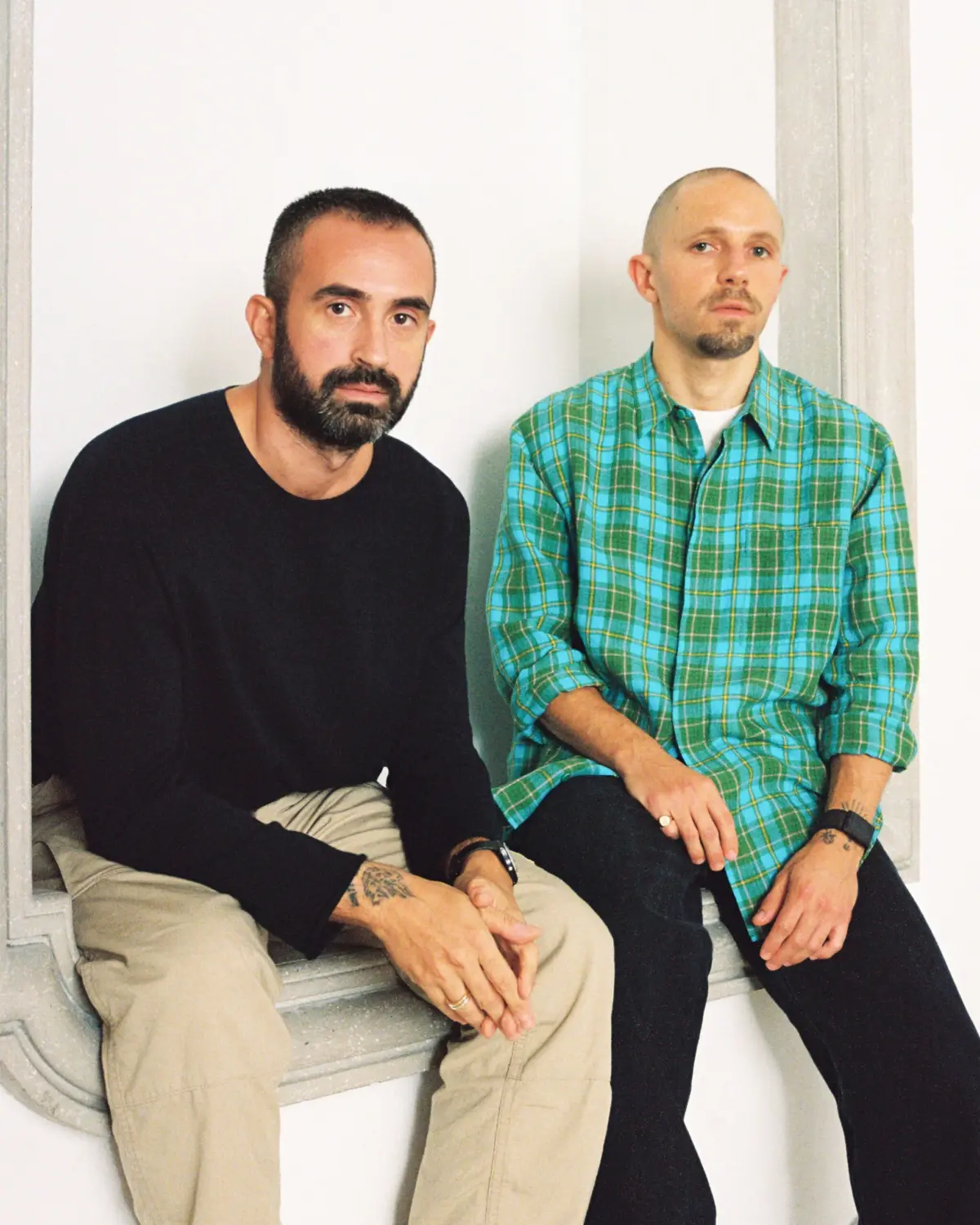
It is this intellectual lineage of Franco Moschino—rather than simply the man of the ubiquitous smiley face, the sardonic T-shirt, and the deliberately outrageous accessory—that Simone Rizzo and Loris Messina have been deeply considering since stepping into the creative direction of the historic house. Taking over the reins last June following in the footsteps of Rossella Jardini, Jeremy Scott, and Adrian Appiolaza, the former Sunnei designers have approached their new role with a deliberate sense of caution. Barely two months into their tenure, their immediate instinct was not to make noise, but to listen.
During a preview at the brand’s headquarters, where the designers consistently prefer to speak in unison, they outlined their foundational philosophy. “We are meticulously studying why Moschino made sense,” they explained. “But we don’t want to replicate it. We want to understand it in order to create the Moschino of the future.”
It is a deceptively simple distinction, yet one fraught with creative challenges. For a fashion house whose visual vocabulary has become so universally recognizable that its own jokes can easily harden into cliché, the constant temptation is to treat the corporate archive as a mere dressing-up box: pick a slogan, throw in a windmill, and call it Moschino. Rizzo and Messina have resolutely chosen the opposite path. They have closely examined the clothes, studied their structural architecture, and “metabolized” what they found within the historical archives. Their objective is explicitly not reproduction. “We don’t want to reproduce anything he did literally,” they note. “The only thing we are carrying forward is his spirit and his way of thinking.”
That revelation cuts straight to the core of their new appointment. While Franco’s signature humor has been endlessly imitated across the decades, his underlying methodology has been considerably less so. Rizzo and Messina are profoundly interested in the machinery operating beneath the joke itself. “For us it is fundamental that irony is in the concept,” they elaborate. “If irony is in the product, it becomes ornament.”
This philosophical difference matters immensely, and it is precisely where their own rich history with their independent label, Sunnei, comes into play. For twelve years, Rizzo and Messina built a brand completely outside the traditional parameters of the established fashion system, subsequently spending a significant portion of their tenure dismantling its conventional rules from within. Their avant-garde runway presentations included conceptual milestones such as audio voice-overs broadcasting what models were actually thinking while walking, audiences voting in real-time on what they saw, and even crowdsurfing incorporated directly into the performance. Their shows were never merely static presentations of garments; they were active experiments in how fashion and its public could collectively behave.
Now, as both designers approach the age of 40, they describe themselves with characteristic self-deprecation as two serious rompipalle—two serious pains in the neck. The expression, however, is far less frivolous than it sounds on the surface. Their foundational punk instinct has not disappeared; rather, it has simply acquired a sharper perspective, backed by significantly greater industrial resources.
“We have always been spaccapalle, not really simpatico,” they admit candidly. “We were born outside the system and became anti-system, even though now we are inside it up to our necks.” After spending years driving their own modest fashion workhorse, they suddenly find themselves behind the wheel of a high-performance racing machine. “At Sunnei we were used to driving a Fiat 500,” they joke. “Now we are driving a Maserati.”
That humorous analogy carries a deep appreciation for what the vast industrial machinery of a historic Italian fashion house can actually make possible. They openly praise the exceptionally high level of manufacturing capabilities at parent company Aeffe, which grants them the rare opportunity to build a wardrobe where conceptual intelligence is consistently matched by an exacting standard of execution.
They describe their newly imagined Moschino wearer as an “aristocrat on Mars”—someone possessing the ultimate freedom to dress precisely as they please, who intuitively knows how to choose, and who rightly expects a superior level of quality. The phrase perfectly encapsulates the delicate balance they are striving to achieve: sophistication without solemnity, and fantasy without sloppiness. “We want Moschino to speak the language of luxury,” they remark. “The thought behind Moschino has to be connected to an impeccable product.”
This perspective is precisely where their reading of Franco becomes uniquely fascinating. They are far less interested in the tired caricature of Moschino as fashion’s perpetual enfant terrible than they are in viewing the founder as a serious thinker. “There is this narrative that he was irreverent. Yes, he was irreverent, but he was also extremely intelligent. He was a philosopher, a person of thought. He was a painter. He was more sarcastic than ironic.”
They characterize Moschino as a potential “cultural amplifier,” a dynamic incubator of ideas capable of fluidly moving between the worlds of fashion and broader cultural expressions. The house founder fundamentally understood that a single garment could operate on multiple levels simultaneously: immediately legible as a striking visual image, yet considerably more complex and layered as an underlying idea.
Restoring that layered quality is a primary goal for the new directors. “Moschino is a brand as powerful as Coca-Cola,” they note, drawing a striking comparison. “It is a widespread platform of meaning.” It is an unexpected analogy, yet a deeply apt one, as both names have long since escaped the physical confines of their origins to function as cultural shorthands, carrying rich meanings far beyond the commercial products themselves.
Consequently, the physical archive is not being treated as a static catalogue of items to be blindly reproduced. Instead, it is operating as a creative laboratory. The physical archive itself is currently dispersed between Milan and Cattolica, and the designers are actively strategizing on how to bring it more fully into the heart of the house. Having examined the garments firsthand, they admit to being deeply moved by the sheer quality of the tailoring and construction. While certain archival ideas have naturally served as springboards for new directions, the famous windmills, smiley faces, and slogans will not be dragged out as nostalgic props.
The future visual identity of Moschino may ultimately be quieter, but it promises to be considerably noisier on an intellectual level. They speak passionately about stripping away the banal versions of Moschino humor that have accumulated over decades and replacing them with a more sophisticated semantic language. Furthermore, they are firmly determined to continue the performative approach that has always characterized their creative practice—not as a superficial merchandising device or a cheap attention-grabbing trick, but as their most natural and authentic form of expression.
For their debut runway show, the duo is taking an unusual step in a contemporary fashion system where external stylists have become almost as integral to authorship as the designers themselves: they are working entirely without one. “The ideas are clear,” they state, expressing absolute trust in the team they have assembled at Moschino to translate their vision without introducing an intermediary layer of interpretation. “It is like a form of magic, a form of alchemy that we produce between ourselves,” they say of their collaborative creative process. “It is an expressive urgency that is difficult to explain.” They intend for the runway show to put a fully formed thought on stage, rather than simply decorate one. In other words, the clothes are not mere illustrations of a concept; rather, “they are where the concept happens.”
That same sense of urgency explains why they harbor little interest in competing directly with contemporary fashion culture on its own hyper-accelerated terms. If anything, they appear purposefully intent on stepping sideways from it entirely. Fashion, they argue, has entered an era of deafening “cacophony,” characterized by an excess of competing voices, an overabundance of digital content, and an increasingly aggressive fixation on constant provocation. Within such a crowded and noisy environment, they believe that the genuinely radical gesture might actually be something unexpectedly old-fashioned: pure beauty.
“Today there is nothing more irreverent than the serenity of beauty,” they assert. “Knowing how to stand, a certain posture.” It is a sentiment that reads almost like a manifesto for the new era of Moschino—not because they intend to render the house overly polite, but because they are genuinely interested in the quiet confidence that stems from no longer needing to shout to be heard. “We don’t want to have to climb over ourselves to find formulas to be cool. We will go straight ahead, concentrating on creating something beautiful.”
Their recent year-long hiatus away from the relentless fashion cycle may have contributed significantly to that newfound confidence. After twelve uninterrupted years steering Sunnei, they deliberately chose to step back and disconnect from the industry entirely. They traveled, exercised, walked outdoors, and spent quality time with friends, describing the break as an extraordinary privilege. “We’ve come back as fresh as two little flowers,” they joke. Yet the sabbatical offered something far more pragmatic than mere physical rest: it provided vital distance. They returned to work with a markedly clearer idea of what they wanted to achieve, alongside an equally sharp suspicion of what they decidedly did not. While they remain deeply fascinated by digital culture, after years of operating in a hyper-digital space, they now believe the medium has reached a point of absolute exhaustion.
Their answer to this digital fatigue is not to abandon technology entirely, but to significantly reduce its volume. Moschino, they explain, will become an exercise in “grounding”—shifting the focus away from constant digital broadcasting and back into the physical world of actual human encounters. They want to reconnect the house with people through what they term “happenings,” prioritizing real experiences and physical exchanges over the endless production of transient content. “We don’t want to waste energy creating something that will last for zero seconds of attention,” they state. “We want to create something that lasts much longer.”
This conviction will directly dictate the format of their upcoming runway presentation. Their inaugural Moschino show will not be livestreamed across social media platforms. For designers who originally came of age by experimenting with digital tools, the decision is a deliberately provocative stance. Yet their argument remains rooted in recalibration rather than rebellion. The ongoing conversation on social media, they point out, is fundamentally distinct from actual consumption, and mere visibility does not automatically equate to human connection. “There is a digital bulimia that, frankly, is excessive,” they remark. “There has to be a way of breaking free from this addiction to being there at all costs.”
It is arguably the most authentically Franco Moschino concept in the entire conversation—not because it mimics his visual output, but because it applies his core instinct directly to the realities of the present moment. Moschino once looked at the fashion system surrounding him and questioned why everyone blindly behaved as though its established rules were immutable. Rizzo and Messina are now looking at a contemporary fashion ecosystem saturated with immediacy, endless commentary, and digital saturation, and asking whether those rules still hold any valid meaning. Despite their deep affection for the label’s founder, they harbor no illusions that the 1980s or 1990s can somehow be artificially resurrected. The world has changed; fashion has changed; and they have changed, too.
“The purpose is not to attack, or aggression or rage,” they conclude. “It is to share the privilege of doing this work, to create beauty, express a thought, exchange.” That perspective offers perhaps the most intriguing lens through which to view the arrival of two former industry outsiders at the helm of Moschino. They are not positioning themselves as literal heirs to Franco’s collection of jokes. Instead, they are striving to represent his core freedom—the fundamental freedom to look closely at fashion and independently decide which codes are genuinely worth keeping.
After all, the original Moschino trick was never simply the joke itself. It was knowing precisely where and how to place it. “There’s no creativity without chaos,” was one of Franco Moschino’s guiding principles. Yet his chaos was never careless: beneath the surface-level provocation lay an almost obsessive command of craft and linguistic precision. Disciplined chaos, perhaps. Rizzo and Messina appear to understand that vital attitude instinctively. Now, they simply have to show the industry just how much trouble they can cause.