






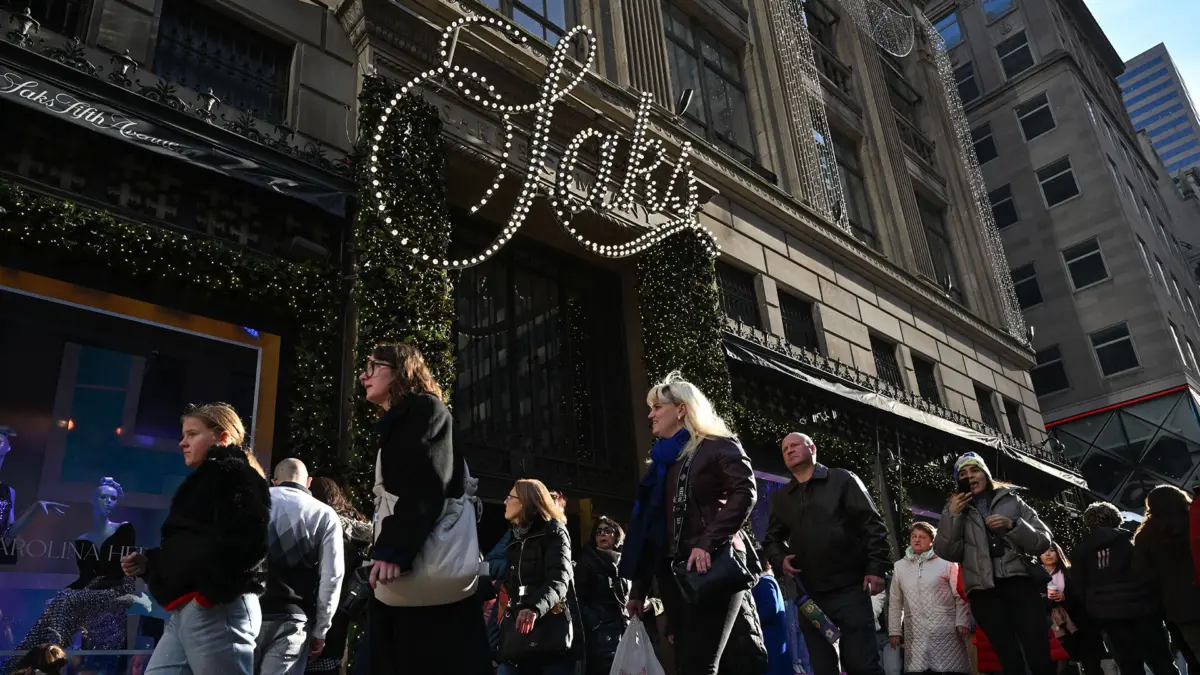
Long before shopping was governed by online algorithms, targeted ads, and automated recommendations, it had Saks Fifth Avenue. For several generations of discerning luxury buyers, the storied department store served as the ultimate arbiter of elegance, glamour, and impeccably good taste.
"Saks is New York," Donatella Versace once declared inside its glittering Midtown flagship, capturing a sentiment that extended far beyond Manhattan. For decades, its sumptuous stores across the country functioned as cultural destinations in their own right, places where acquiring a luxury good felt like an event rather than a transaction.
From Armani to Zegna, Saks carried rack upon rack of enticing indulgences that defined high-end American consumer culture. Shoppers could peruse Oscar de la Renta evening gowns and snakeskin Gucci loafers, inspect Montblanc fountain pens and sample Dior eaux de toilettes, or browse precisely tailored Ralph Lauren suits and matching Burberry trench coats for both adults and children. The aisles were stacked with quilted Chanel 2.55 handbags, polished Louis Vuitton briefcases, and, under its own prestigious house label, beautifully crafted pearl necklaces, buttery calfskin gloves, and extra-soft cashmere pullovers and cardigans.
"Saks was the reliable destination where you knew you could find whatever you wanted," says Julia Stedman, a New York-based brand-strategy consultant who works with fashion and technology and shopped at the emporium for decades. "Every luxury brand was there."
Footwear was a particular strongpoint, especially from covetable labels like Manolo Blahnik, Roger Vivier, Jimmy Choo, and Christian Louboutin. At the imposing Manhattan flagship—a Midtown magnet for locals and tourists alike since it opened its doors in 1924—the massive eighth-floor designer-shoe department earned a distinct cultural milestone that no other store in the country could claim. In 2007, the United States Postal Service formally granted the floor its very own ZIP code: 10022-SHOE.
"It was a great shoe department to begin with," Stedman recalls. "And then they expanded it… Literally, you could find anything and everything you could ever imagine and ever want. And it was always packed and bustling."
In the 2008 film The Women, Annette Bening’s character offered a simpler, widely accepted cultural verdict: "Nobody. Hates. Saks." At the time, it would have been hard to find anyone in the fashion world to disagree.
Over the past few years, however, the company’s prestige took a severe beating. Deep financial and managerial problems, many directly tied to the complex 2024 acquisition of Neiman Marcus, culminated in Saks Global filing for Chapter 11 bankruptcy protection in January with a staggering $3.4 billion in debt. Following an extensive financial restructuring, the firm announced in June that it had officially emerged from bankruptcy court oversight. Operating with a significantly reduced footprint of stores, the rebranded parent firm is now known as Exemplar Luxury Group. Whether Saks can fully recover its former stature—and win back the enduring affection of luxury shoppers—remains an open question across the retail industry.

In the wake of the corporate merger, the daily shopping experience had already visibly deteriorated. Customers increasingly found their once-beloved flagship and regional stores stocked with sporadic, often sparse assortments across their favorite merchandise categories.
"People just felt that it wasn’t the same Saks that they used to shop at," says Anita Berger, a former senior salesperson at the Saks Fifth Avenue location in St. Louis, Missouri, which had cultivated a fiercely loyal local clientele for more than half a century.
To be fair, traditional department stores have been under immense structural pressure for years. Consumers increasingly shift their purchasing habits to online platforms, buying directly from brand websites, major e-commerce giants like Amazon, or resale destinations like The RealReal. Instead of spending leisurely afternoons browsing racks of clothing and receiving personalized advice from trusted, long-tenured sales associates, modern shoppers frequently find their style inspiration through social media algorithms. Furthermore, formal suits and men’s ties no longer anchor everyday wardrobes the way they once did, a shift that accelerated dramatically in the wake of the COVID-19 pandemic. Many retail analysts now argue that the classic grand-department-store model—featuring floor after cavernous floor packed densely with inventory—may simply be outdated.
"What you have is literally this transition and shift in the paradigm," says Marshal Cohen, chief retail adviser at Circana, a firm that tracks consumer-buying patterns. "The model needs to adjust."
As Bain & Company noted in a comprehensive 2024 report examining the state of American department stores, "Many U.S. shoppers are now indifferent or averse to the format."
Even before Saks Fifth Avenue’s ambitious purchase of Neiman Marcus in December 2024, warning signs were flashing as familiar buyers and experienced sales associates began turning over at an unsettling rate.
"You could kind of smell that something was going on, just because everything was getting a little difficult," says Daniel Wingate, founder and creative director of Wingate, a collection of sophisticated designer women’s apparel that was regularly sold at trunk shows inside various Saks Fifth Avenue locations. "The people in the stores were in and out and changing, unhappy." He adds, "Then, the rumor started that they were trying to buy Neimans."
That rumor proved to be true, and the multi-billion-dollar acquisition saddled Saks Global with a crushing debt load that soon made it difficult to pay suppliers for incoming product. Eventually, many fashion and beauty brands felt they had no choice in good conscience but to halt shipments entirely.

"Every one of my clients was saying, ‘God, the stores look so bad—there’s no inventory,’" explains Gary Wassner, CEO of Hilldun, a financing firm that guarantees payments for roughly 180 fashion and beauty brands carried across Saks Global’s stores, including prominent names like Rick Owens, Golden Goose, Ulla Johnson, Isabel Marant, and Victoria Beckham.
"The consumer was well aware walking into any Saks Fifth Avenue that the inventory was depleted," he adds. "It was quite noticeable, particularly as the days wore on."
"My floor looked so bad," Berger echoes. "Customers would come in and say, ‘Are you closing? This looks like Saks Off 5th.’ There was nothing new and exciting because they couldn’t get anything—they owed money to everybody."
The inventory shortages extended to its sister stores as well. "We never had a full size run of dresses," recalls Babatunde Fakuade, who worked for nearly a year as a salesperson at Neiman Marcus Lenox Square in Atlanta. "We would get size 2, 12, 8. It’s like, ‘Where are the other sizes?’ We didn’t get a delivery of full size runs of dresses for months at a time."
The St. Louis store where Berger spent nearly a decade ultimately closed its doors in May, though she had already departed the previous September.
"How they were treating us, how they were not paying, how the store looked—I just started to feel like, ‘I need to get out,’" she says.
"It made more financial sense, literally, to leave the organization without a job secured," Fakuade notes. He ultimately left Neiman Marcus to focus full-time on a career as a retail business consultant.
The cash-flow issues, however, significantly predated the Neiman Marcus acquisition. When Saks Global was formed, it brought together Saks Fifth Avenue, Neiman Marcus stores, Bergdorf Goodman, Horchow, and the discount chains Saks Off 5th and Last Call. However, Saks entered the deal already carrying a heavy debt burden, much of it linked to its 2013 purchase by Hudson’s Bay Company, a historic Canadian retailer with corporate roots dating all the way back to 1670.

Certain early corporate maneuvers raised eyebrows among financial analysts. The iconic Fifth Avenue flagship building was mortgaged in 2014 for approximately $1.2 billion, creating the burden of hefty monthly debt service payments. In 2016, the company purchased off-price retailer Gilt Groupe for $250 million, ostensibly to bolster Saks Off 5th, only to sell it again a couple of years later for an undisclosed price widely rumored to be far lower than the purchase tag. Subsequent investments added even more recurring financial obligations to a company facing tightening cash reserves.
"There were a lot of prior Hudson’s Bay issues—leases and bonds—that Saks, through succession, became obligated on," explains Lorenzo Marinuzzi, a partner at the law firm Morrison Foerster, which represents Saks Global’s unsecured creditors, including luxury powerhouses Chanel and LVMH.
Hudson’s Bay Company’s historical financial baggage did little to soothe jittery vendors who were waiting anxiously to be paid for delivered goods. As Marinuzzi points out, "When you’re telling your vendors that you don’t have money to pay them for goods they’ve sold or shipped or consigned or delivered to your stores, yet you’re paying off this Hudson’s Bay debt, it rubs people the wrong way."
Hudson’s Bay Company ultimately filed for bankruptcy and wound up closing all of its remaining retail operations.
As Saks Global began to unravel operationally, many industry observers pointed their fingers directly at Richard Baker, who served as Hudson’s Bay Company’s governor, executive chairman, and CEO, and subsequently became the executive chairman of Saks Global. Baker’s primary professional background is in real estate, and critics frequently argued that his approach to managing retail department stores prioritized property acquisition and high-stakes dealmaking over the traditional craft of merchandising fine apparel and luxury eveningwear. Baker previously acquired Lord & Taylor in 2006 using extensive debt financing, later selling its flagship building to WeWork in 2017 and its retail operations to Le Tote in 2019, which led to the complete closure of brick-and-mortar stores in 2020.
This strategic shift was frequently reflected in Saks Global’s own corporate messaging. A press release issued in July 2024 to announce the planned Neiman Marcus purchase described the newly formed entity explicitly as "a combination of world-class luxury retail and real-estate assets." Upon finalizing the transaction, Baker stated that the overarching plan was "to redefine the luxury shopping experience" through, among other things, "a portfolio of prime real estate."
"There’s a lot of head-scratching about the way Richard Baker handled himself and ran the company, his background—maybe it wasn’t the right background for this kind of retailer," Marinuzzi says. "When people thought about the decisions that were being made and how the company was being operated, they didn’t really trust management, and they didn’t really trust Richard Baker."
When the multi-brand transaction was initially announced, Baker told The New York Times that "when selling luxury products, you need beautiful stores and salespeople customers trust." Yet by the time Saks Global ultimately filed for Chapter 11 bankruptcy protection, many of those very stores featured thinly stocked sales floors and demoralized, disgruntled employees.

Baker officially departed from Saks Global in January. Today, his public focus has returned primarily to real estate, highlighted by regular posts on his personal Instagram account, where his bio describes him simply as "Behind $Billions in Real Estate." When contacted for an interview for this story, Baker provided a concise response: "No comment on Saks at this time." Exemplar Luxury Group also declined repeated requests to make current executives available for comment.
When Saks Global formally filed for bankruptcy protection, the financial sums owed to some of the world’s most powerful luxury conglomerates were staggering. According to court documents filed in January 2026, the retailer owed more than $136 million to Chanel; roughly $60 million to Kering, the parent company of Gucci, Saint Laurent, and Bottega Veneta; about $30 million to Richemont, which owns Cartier, Montblanc, and Chloé; and nearly $16 million to the Estée Lauder Companies, whose portfolio includes La Mer, Jo Malone London, Le Labo, and Tom Ford.
While those losses are undeniably vast, global luxury giants possess a substantial financial cushion due to their own standalone retail boutiques, multi-brand counters, and immense international reach. For smaller independent brands, however, delayed or missing payments can prove far more crippling.
"As a small business, you have limited bandwidth," says a senior executive at a small, critically acclaimed beauty brand formerly carried at Neiman Marcus. "Finances are not just endless."
Her brand has still not received the six-figure sum it is owed for inventory shipped to the retailer, despite filing formal legal paperwork seeking to recover at least a portion of the balance. Deprived of that expected income, the brand’s small management team was forced to halt contracts with several essential freelancers. One key manager ultimately left for another job, and the company is now forced to slowly rebuild its retail network and customer base through alternative vendors.
She is one of several sources who spoke on the condition of anonymity within an interconnected industry where professional reputations are paramount. Many former Saks Global staffers approached for this report noted that they had signed strict nondisclosure agreements or were currently involved in active litigation regarding unpaid compensation, leading them to decline public comment.
Independent beauty and fashion labels made significant internal sacrifices to keep operating without the cash flow they had budgeted for.
"You have to keep going," explains an executive at another beauty label owed more than a quarter of a million dollars by Saks Global. "So you’re looking at your people, you’re looking at your programs. You might be cutting advertising or awareness programs. You may be cutting marketing plans, launches, photo shoots, company parties. It’s going to be rolled all the way across, because for small businesses to lose money like that is very serious. It seriously affects your bottom line."

For a prominent women’s fashion brand adored by celebrities and carried extensively at Saks, the fallout included canceling a major runway show and forfeiting the substantial deposit paid on the event space, according to a marketing executive familiar with the situation.
A senior executive at another lauded fashion label states that missing payments severely compromised the company’s ability to pay for essential raw materials like fabric and buttons, ongoing production costs, internal staff, and external contractors such as public relations agencies and consultants. The financial strain ultimately forced the company to lay off 20 percent of its workforce to survive what he describes as "this cash vacuum."
The experience, he adds, "will probably stall our business five years in terms of its growth trajectory."
His brand is owed several hundred thousand dollars and has received only one full payment for collections spanning across 2024 and 2025. On certain invoices, he reports receiving mere pennies on the dollar, estimating that the company will ultimately recover roughly 20 percent of its total outstanding debt.
The operational breakdown typically began with delayed payments, which eventually snowballed into a complete breakdown in corporate communication.
"We continuously situated ourselves reaching out for payment and updates, and they went ghost mode on us," he says. "They didn’t respond to us for months."
Compounding the frustration, appeals for payment were frequently routed to corporate representatives located in Bengaluru, India, where Saks Global had centralized various administrative functions including finance, human resources, merchandising, analytics, and marketing.
"It felt like people who really were not connected to who we were," he says. "I’m like, ‘Who are we talking to?’" In one correspondence, he notes, the brand’s own name was misspelled.

"You’re trying to explain to India how you work," adds Daniel Wingate, the designer who sold his collections via Saks trunk shows. "In the end, it felt like that was a stunt to just delay your payments."
Wingate ultimately utilized a collection agency to recover a portion of the money he was owed, though he acknowledges he still carries "six figures of open invoices that haven’t been paid."
Predictably, independent brands faced significantly greater hurdles securing payments than marquee name brands. According to a source familiar with Saks Global’s vendor payment history, many of the world-renowned luxury houses carried across Saks, Neimans, and Bergdorf Goodman successfully recovered at least half of what they were owed.
Certain prominent designer brands were paid in full, or close to it, though those specific terms were heavily guarded to prevent competing brands from demanding comparable treatment. Brands operating on strict concession or consignment models generally recovered close to their full outstanding balances. Representatives for Chanel, Kering, LVMH, and the Estée Lauder Companies declined or did not respond to requests for comment regarding the recovery of their Saks-related debt.
Meanwhile, designers represented by Hilldun were owed more than $66 million by Saks Global, though slightly under half of that exposure involved shipments that Hilldun had not formally guaranteed. Wassner confirms that his financing firm has paid its client brands virtually all of the approved debt, with the exception of a select few vendor accounts currently undergoing final reconciliation.
Some independent brands had already weathered painful payment crises leading up to Neiman Marcus’s 2020 bankruptcy prior to encountering Saks Global’s subsequent collapse.
"We gave up," says an executive running a tastemaker-approved unisex grooming brand sold at both Neimans and Saks during both eras. "They promised to pay you if you would ship to them again, but I wasn’t taking that risk." His company is currently owed more than $100,000 by the retailer.
Following its bankruptcy filing, Exemplar Luxury Group initiated a sweeping restructuring program. The company permanently closed 21 brick-and-mortar stores—comprising 18 Saks Fifth Avenue locations and three Neiman Marcus stores. Among the shuttered outposts was the historic Chicago store, where Saks had operated continuously since 1929, alongside locations in Costa Mesa, Las Vegas, St. Louis, San Antonio, and McLean, Virginia. The company also closed more than 60 Saks Off 5th and Last Call discount stores, leaving the lone overseas Saks outpost in Kazakhstan as the sole international exception.

As stores were rapidly cleared out and remaining inventory heavily marked down, shoppers once again encountered Saks Fifth Avenue and Neiman Marcus locations stripped of the upscale visual allure that had historically defined them. Social media platforms like TikTok filled with viral videos depicting austere, half-empty stores nearing closure, evoking comparisons to a retail apocalypse rather than a luxury shopping experience.
"Bad news travels faster than good news," notes Cohen, the Circana retail adviser. "People love to share their war stories of shopping." And in the era of smartphones, that negative consumer sentiment travels faster than ever before.
As part of its emergence from bankruptcy, an initial infusion of $1.75 billion in new capital allowed suppliers to be paid and fresh merchandise to start flowing back into the remaining stores. In March, Exemplar Luxury Group announced that nearly 600 distinct brands had formally resumed shipping products. During a recent walkthrough of the flagship Saks Fifth Avenue store located across from Rockefeller Center in Manhattan, the sales floors appeared amply stocked and operational.
According to Exemplar executives, sales associates across Bergdorf Goodman, Neiman Marcus, and Saks Fifth Avenue are registering higher overall sales volumes this year compared to the same period in 2025, though the company declined to disclose specific percentage growth figures.
Nevertheless, successfully rebuilding lost trust with both consumer shoppers and the broader fashion manufacturing industry remains a formidable uphill battle.
"It’s hard to come out of that with both your brand partners and with your consumers," notes Aaron Cheris, a partner at Bain & Company and head of its global retail practice.
For consumers in particular, negative experiences regarding diminished service and sparse selection "creates a bit of a doom loop that you really have to get out of," he explains. The core challenge, Cheris adds, is straightforward: "Can you convince both suppliers and customers that there’s a new day one?"
For independent designers who remain deeply skeptical of department store conglomerates, Exemplar’s ongoing challenges may ultimately prove to be its competitors’ gain.

"Now more than ever, every brand I know wants to be in Bloomingdale’s," notes one industry insider. "It’s almost like Bloomingdale’s and Nordstrom will become what Barneys was in the ’80s."
Meanwhile, some loyal shoppers have simply chosen to stay away.
"It’s going to take a while to rebuild my trust," says Stedman, the longtime Saks customer. "Going there during that funky period, there was no stock, everything was on sale—it was madness. During that time, what made Saks special was not there anymore."
"I’m going to take a wait-and-see approach and see what happens with them," she adds.