




“You’ve been wearing more suits lately,” a colleague remarked to me a couple of years ago, his tone hovering somewhere between genuine impression and mild confusion.
He certainly wasn’t wrong. Up until that point, my standard office uniform could have generously been categorized as middle-aged skater style: a plaid overshirt, a plain white tee, relaxed-fitting trousers, and sneakers, worn on a relentless loop. To be completely clear, I still occasionally default to that comfortable combination. But around that time, I noticed I was reaching for tailored suits with increasing frequency.
When asked about the shift, my initial explanation was simple and pragmatic: it was just another uniform. The beauty of a suit, I told people, is that you slip it on and completely bypass the mental energy required to figure out what pieces go together. It offered undeniable convenience. And while that explanation was partly true, it certainly wasn’t the whole truth.
Perhaps I had simply reached that inevitable age when men begin looking to traditional tailoring for a little structural assistance and maturity. Yet, putting on a suit also felt like a small, private act of rebellion—largely directed against my own deeply ingrained habits. After years of defaulting to casual attire purely out of reflex, the act of gussying up felt deliberately intentional, almost subversive.
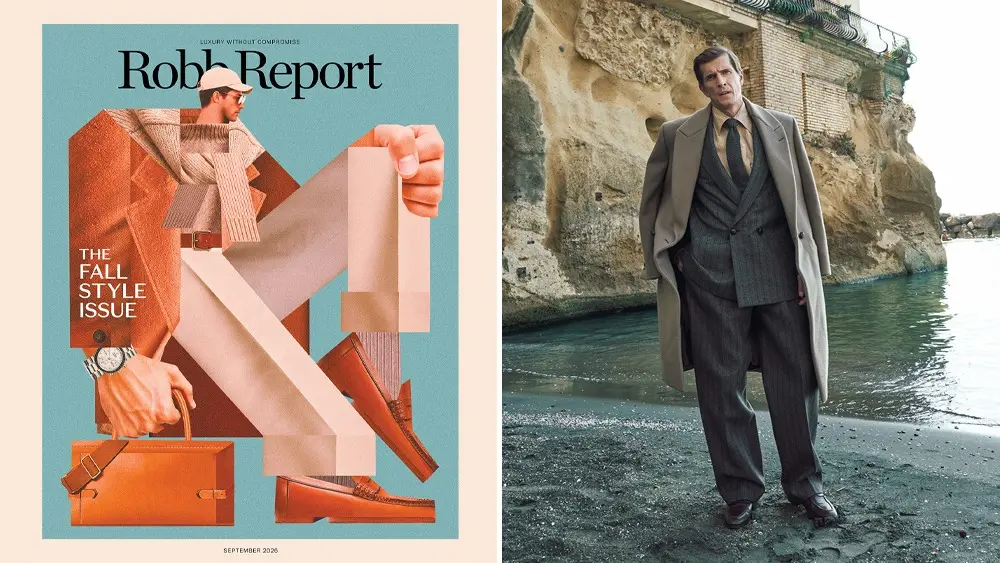
Maybe that perspective is just my California roots showing through. Growing up on the West Coast, a clean T-shirt routinely counted as formalwear, and board shorts paid allegiance to neither seasons nor formal occasions. That background gave me a quiet moment of recognition while reading “Measure of a Nation,” Eric Twardzik’s insightful feature for the Robb Report on the contemporary rise of American tailoring. In the piece, Ryan Devens, the founder of San Francisco’s Tailors’ Keep, describes the suit as a distinctly “rebellious garment.”
It is a sentiment that resonates deeply. In a modern professional landscape defined by the endless casual Friday, wearing a suit can genuinely feel countercultural. The suit is no longer just stiff office furniture or corporate armor. Instead, it has evolved into something swaggering, louche, theatrical—or, quite simply, a fantastic excuse to wear a brilliantly constructed jacket on an otherwise completely unremarkable Tuesday afternoon.

This shifting perception helps explain why the landscape of American tailoring feels remarkably vibrant right now. Men who possess no professional obligation or corporate requirement to wear a suit are purchasing them anyway. Tailoring has firmly reestablished itself as an essential part of the stylish man’s wardrobe vocabulary, and the options being crafted domestically have arguably never been better or more diverse.
The diverse array of modern makers shaping the American scene share no single house style or rigid philosophy, reflecting a healthy pluralism. J. Mueser successfully blends soft Neapolitan construction techniques with global tailoring influences and a distinct sensibility that could only emerge from downtown New York. Haitch takes a decidedly more architectural approach to menswear, favoring longer jacket silhouettes paired with strong, pronounced square shoulders. Angel Ramos channels the breezy ease of Southern Italian style alongside the undeniable bravado of Golden Age Hollywood. Meanwhile, Richfresh takes an entirely different route, applying the meticulous language of bespoke tailoring to bold, color-blocked tracksuits fabricated from technical scuba materials.
American menswear has historically never been precious or overly dogmatic about where its creative inspirations originate, and these contemporary tailors are no exception. They fundamentally disagree on what an archetype of an American suit should actually look like—which, paradoxically, might be the most authentically American characteristic about them.
Of course, the liberating freedom to dress up entirely on your own terms is not a uniquely American phenomenon. A broader look at global menswear highlights destinations like Naples, where the relaxed sartorial silhouette has been meticulously refined across generations. Those garments possess an effortless elegance that never appears careless or accidental, and the enduring Neapolitan influence continues to shape wardrobes and design philosophy worldwide.
In other corners of the fashion world, the traditional tailored jacket is occasionally stepping aside to let other garments take top billing. Contemporary design showcases stellar knitwear options that refuse to play a mere supporting role in an outfit. Major fashion houses ranging from Louis Vuitton to Kiton and Canali are blowing up traditional Fair Isle, Nordic, and other heritage patterns by utilizing bold, oversized graphics and striking colors. The result is a wave of statement knitwear explicitly built to steal the show.