




As horological historians and collectors look back at the formative decades of portable timekeeping, the early years of the wristwatch remain a fascinating study in unbridled experimentation. During an era when watchmakers were actively figuring out how to miniaturize complex mechanisms for the wrist, a wide array of experimental forms and complications were conceived. Among the standout treasures from this nascent period is a platinum Audemars Piguet triple calendar with a moon phase indicator dating back to 1927. This exquisite timepiece is now poised to capture the spotlight as one of the premier lots in Monaco Legend Auctions’ upcoming sale.

Now approaching its centenary, this ultra-rare triple calendar serves as a pristine physical textbook of a bygone era. It exemplifies a time when wristwatches, particularly those equipped with demanding complications, were treated as cutting-edge, highly expensive luxury objects reserved for an exclusive echelon of society. While the market today is flooded with mass-produced steel sports watches, looking back nearly a hundred years reveals a completely different paradigm of watchmaking, one driven by bespoke craftsmanship, artistic risk-taking, and artisanal ingenuity.
When wristwatches first transitioned from a military necessity into a fashionable civilian novelty, round "trench" watches used by soldiers were commonplace, but they were far from the only game in town. In fact, many of the most landmark and daring wristwatch designs conceived for civilians utilized distinctive form cases—rectangular, tonneau, cushion, or oval shapes that broke away from traditional pocket watch geometries. Iconic designs such as the Cartier Tank, the Cartier Santos, and the Cartier Tonneau all emerged from this fertile period of creative design.

While a vast majority of these early form wristwatches featured simple, time-only displays, a tiny, discerning handful of clients demanded advanced complications. Calendar watches, many of which were housed within these striking form cases, quickly came into vogue among the cultural elite. Most prestigious watchmakers of the era produced such complications, but they did so on an extremely tiny scale and in a near-artisanal manner. Because every single piece was largely crafted by hand without modern computer-aided manufacturing, these watches were rendered almost unique, carrying individual character quirks that set them apart even from their sister models.
To put this rare production scale into historical context, prestigious houses like Breguet were catering to similarly exclusive clientele. In 1935, for instance, Breguet sold a tonneau-shaped retrograde perpetual calendar directly to the romantic partner of iconic fashion designer Coco Chanel. Audemars Piguet followed a parallel trajectory of hyper-exclusive production. Historical records indicate that Audemars Piguet manufactured fewer than 50 of these rectangular triple calendar wristwatches across a span of 30 years starting in 1924. Crucially, the 1927 model heading to Monaco Legend is the single known surviving example crafted in platinum.

Virtually all of these remarkable calendar wristwatches relied on the caliber 10GHSM movement, and the 1927 platinum specimen is no exception. The sole outlier in this series is the very first prototype ever produced, which rolled out of the workshop in 1924 and now holds a permanent home inside the official Audemars Piguet museum. Although the timepieces within this limited series shared a remarkably similar overall architectural outline, their dials and finishing details were individually different—a direct result of manual, small-scale production methods. For example, the upcoming auction piece features applied Breguet numerals paired with white gold Breguet hands, whereas the museum-held model features printed Arabic numerals accompanied by classic blued steel hands.
Naturally, a timepiece approaching its hundredth birthday shows its age, yet this platinum Audemars Piguet remains remarkably appealing, honest, and historically resonant. A portion of the visible wear, particularly on the delicate surface of the dial, appears to stem from an inept attempt at cleaning performed by an unknown party in the distant past. Nevertheless, for a prospective buyer concerned with restoration, Audemars Piguet possesses an exceptionally skilled heritage restoration department renowned for executing sympathetic restorations on vintage complications, should the winning bidder choose to pursue that path.

An intriguing layer of this watch’s history lies in its distribution. All known specimens of this rectangular triple calendar wristwatch were originally retailed through high-end jewellers or regional dealers rather than directly from the manufacture in Le Brassus. Many of these pieces were stamped with the retailer’s own signature alongside or instead of the maker’s name. A prime example includes a 1925 model signed simply “A l’Emeraude” that was sold via Phillips in 2024 without a prominent Audemars Piguet signature on the dial.
The 1927 platinum specimen carries an even more distinguished provenance, having been retailed in Paris by Van Cleef & Arpels (VC&A). This French connection is verified by the presence of a French platinum hallmark and the jeweller’s distinct stock number engraved upon the case back. The watch made its way into the inventory of Van Cleef & Arpels via Egouvillon, Lafont et Cie., a prominent Parisian diamond dealer that served as Audemars Piguet’s official agent at the time. Tragically, not long after this transaction was completed, Egouvillon, Lafont et Cie. collapsed into bankruptcy in the devastating wake of the Great Depression.

This reliance on multiple intermediaries between the original manufacturer and the end client was entirely standard practice during the 1920s. Watch brands were typically small, independent cottage-industry outfits lacking modern commercial marketing power. Instead, they relied heavily on a network of regional agents, specialized importers, and prestige retailers. High-end jewellers in major fashion capitals like Paris and London frequently retailed a wide variety of luxury goods manufactured by entirely separate firms, branding the items with their own prestigious names to appeal to local clientele.
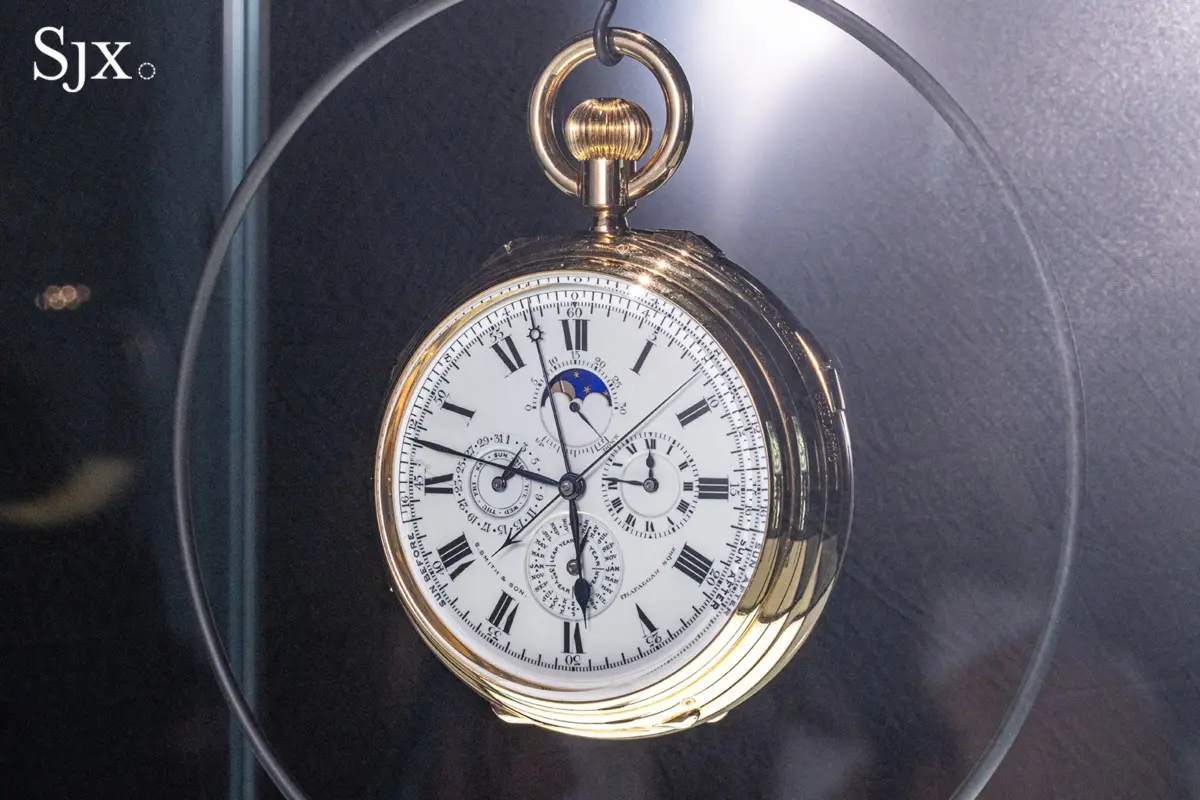
Consider the two most complex historical pocket watches ever produced by Audemars Piguet. One is the record-setting “Grosse Pièce” of 1921, which bears the signature of S. Smith & Son, the venerable London firm that retailed the instrument. The other is the legendary Universelle, which was initially delivered to Dürrstein & Co. and famously signed “Uhrenfabrik Union Glashütte” directly on the dial.

Yet, while this platinum triple calendar traveled quite a distance from its birthplace in Le Brassus to the opulent boutiques of Paris, it has remarkably remained within a very tight circle of custodians since leaving Van Cleef & Arpels in 1927. After spending decades with the family of the original buyer, the watch was finally sold by the descendants of the original owner in 2022. During that transaction, it was acquired by the current consignor for a little over €170,000. This means the historic timepiece has changed hands among private collectors only twice in nearly a century.
Because of their delicate physical dimensions, complex mechanical architecture, and the fact that the vast majority of wristwatches from this period offered zero water resistance, vintage pieces of this caliber do not always command the same mainstream cultural cachet as their immense historical importance warrants. While important early wristwatches still command substantial sums at auction, their prices do not always reach the astronomical heights of modern, heavily hyped sports watches. This dynamic arguably positions early complicated wristwatches as exceptionally strong value propositions relative to other heavily inflated luxury collectibles on the market today.

This extraordinarily rare Audemars Piguet triple calendar in platinum, carrying an estimated value ranging between €200,000 and €400,000, is slated as lot 208 in the upcoming Monaco Legend Auctions sale scheduled for November 1.