







Apple has officially opened the Apple Music Hall inside London’s iconic Battersea Power Station, introducing a brand-new 600-capacity live music venue that seamlessly doubles as a professional recording studio, broadcast facility, and high-end production space. Set against the historic backdrop of the River Thames, the venue has been meticulously conceived for intimate, up-close performances that can simultaneously be captured as Spatial Audio recordings, multicamera films, and global livestreams. In effect, Apple has designed a forward-thinking concert hall where the musical experience does not simply conclude when the house lights come back on, but instead ripples outward across its vast digital ecosystem.
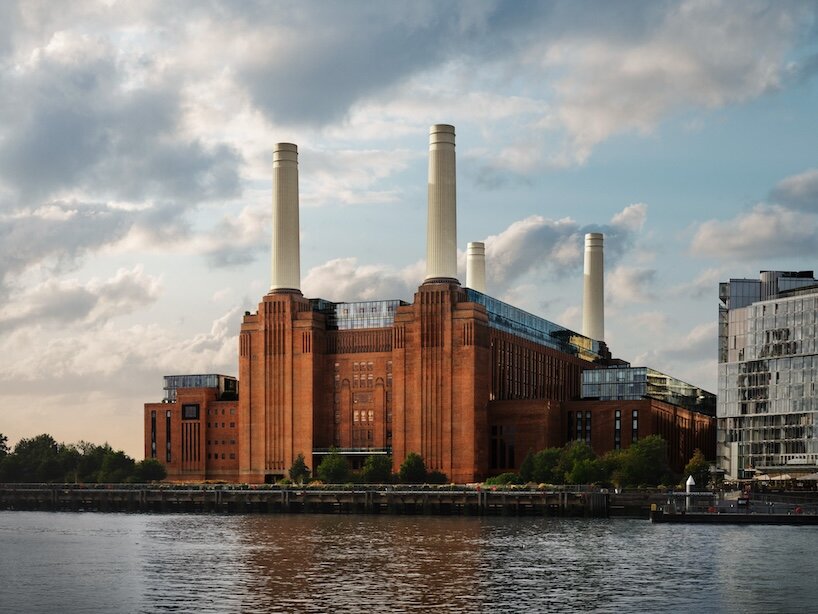
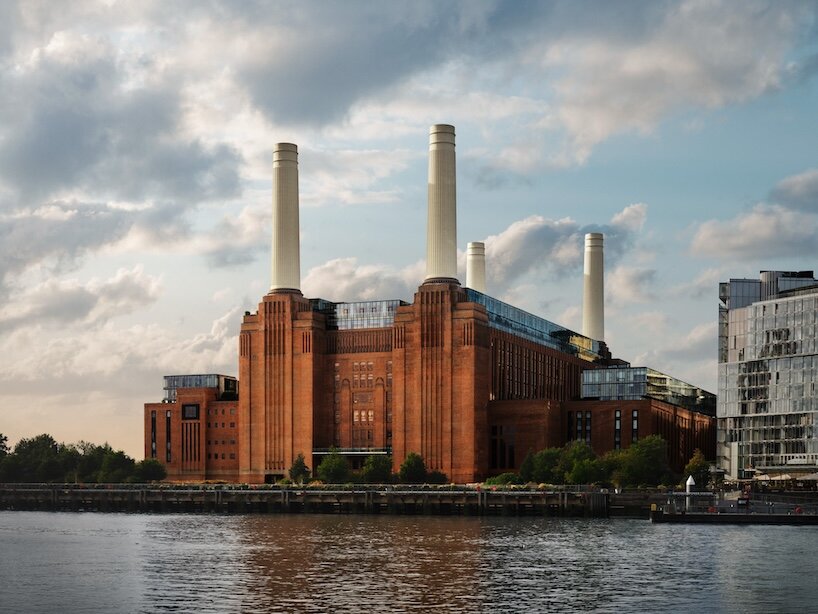
The architectural intervention inside the historic power station leans heavily into the industrial language of the landmark building rather than attempting to compete with its imposing scale. Heritage brickwork, soaring fluted arches, and striking bronze balconies carefully reference the architectural elements found across the rest of the thoughtfully restored structure. Meanwhile, a expansive glass wall opens the venue up toward the interior concourse and the river vistas beyond. The resulting design places Apple’s characteristically polished and controlled visual world inside a considerably rougher, more authentic architectural shell, allowing tactile traces of Battersea’s heavy industrial past to remain an integral part of the visitor and artist experience.
48 SPEAKERS WRAP SOUND AROUND 600 LISTENERS
Within the auditorium itself, the physical scale remains deliberately compact and focused to preserve a sense of intimacy between the artists and the audience. A flexible 38-foot-wide stage can easily shift between conventional front-facing concert configurations and more immersive, in-the-round setups that pull spectators closer to the performers. Overhead and throughout the room, a sophisticated 48-speaker spatial sound system completely surrounds the audience, wrapping them in a multidimensional audio experience. According to Apple, this ambitious technical setup is intended to combine the raw closeness and energy of a small club venue with the powerhouse infrastructure normally reserved for much larger stadium productions, ultimately giving musicians significantly more creative control over how their live performance is both staged and heard.
Behind the scenes, however, things become considerably more elaborate and technically advanced. Two dedicated recording and mixing studios are integrated directly into the venue, allowing live performances to be captured effortlessly as multitrack recordings and mixed in Spatial Audio either in real-time as the show unfolds or during post-production. Furthermore, the hall is heavily hardwired for sixteen or more cameras that feed directly into a dedicated broadcast control room. This robust infrastructure even allows mobile devices, such as iPhones, to capture professional-grade footage alongside traditional broadcast cameras. Consequently, a single live performance can leave the building as a fully mastered audio recording, a broadcast-ready mix, and a dynamic multicamera video—providing a remarkably efficient and high-tech afterparty for the modern music industry.
FROM LIVE SHOW TO GLOBAL BROADCAST
Performances staged at the new Apple Music Hall are not confined to the physical room; they can also be seamlessly livestreamed to international audiences across Apple’s vast digital platforms, instantly extending the reach of a modest 600-person room far beyond the banks of the Thames. This high-profile opening is further bolstered by the addition of brand-new Apple Music Radio studios situated within the very same London complex. From these specialized spaces, the service’s prominent London-based presenters and programs will now broadcast live on a regular basis. Together, these interconnected spaces bring live performance, radio broadcasting, professional recording, and video production under one cohesive roof, rather than treating each phase as a separate, disjointed step in the modern creative process.
The launch of this ambitious project neatly continues Apple’s long and evolving relationship with the music industry, tracing a clear line from the pioneering era of the iPod and iTunes to the modern dominance of Apple Music and its ongoing corporate push into immersive audio technologies. Yet, the introduction of Apple Music Hall finally gives that largely digital and intangible ecosystem a very tangible, physical address. Here, architecture successfully operates as a hybrid entity—functioning part as an intimate live venue and part as a high-performance production apparatus. Historic brick arches and bronze balconies frame the enraptured audience out front, while advanced studios, hidden cameras, and sophisticated mixing desks quietly prepare that exact same live performance for listeners everywhere else.