





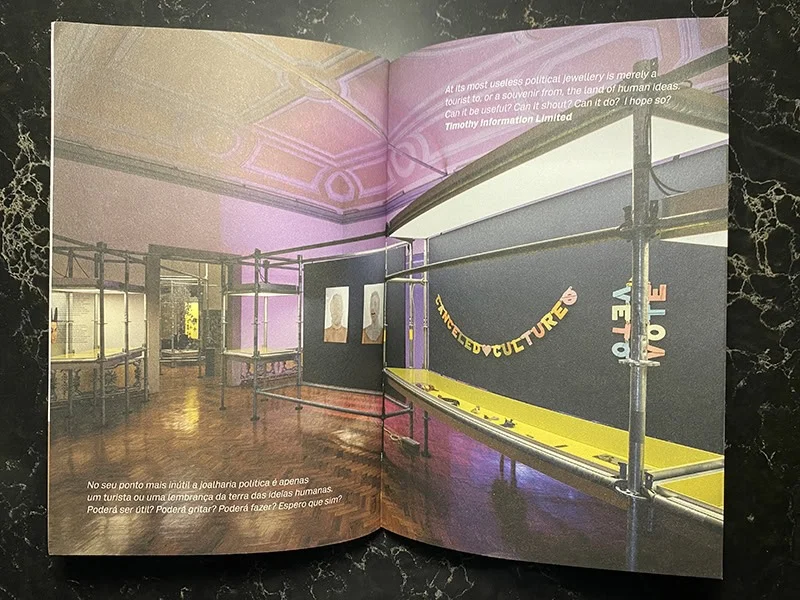
Marta Costa Reis, Mónica Gaspar, and Patrícia Domingues, eds., Madrugada: A joalharia e a política da Esperança (Daybreak: Jewellery and the Politics of Hope). Lisbon: PIN – Portuguese Association of Contemporary Jewellery and CML/MUDE Museu do Design, 2025. (In Portuguese/English)
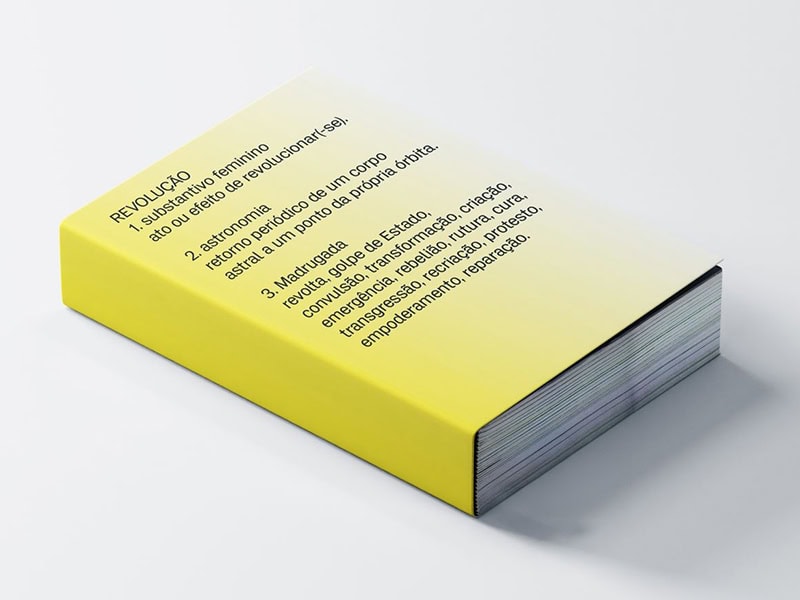
As the 3rd Lisbon Contemporary Jewellery Biennial prepares to launch its week-long run from September 19 to 27, 2026, the international design community is looking back at the intellectual and artistic foundations that made the event possible. Organized by PIN—the Portuguese Association for Contemporary Jewellery—this year’s biennial explores the theme Coexistences, a concept directly evolved from the final chapter of the monumental 2024 biennial exhibition, Madrugada. A careful review of the accompanying Madrugada catalog offers a fascinating window into the political urgency and theoretical ideas that sparked this ongoing creative movement.
"Madrugada" translates from Portuguese as "daybreak"—a fitting title for Madrugada. Jewellery and the Politics of Hope, which served as the cornerstone exhibition of Lisbon’s second contemporary jewelry biennial. The showcase brought together a vast and compelling collection of political works. Some pieces whispered their messages with quiet subtlety, while others demanded attention with intense gravity, but all shared a common determination to inspire hope amidst global turbulence.
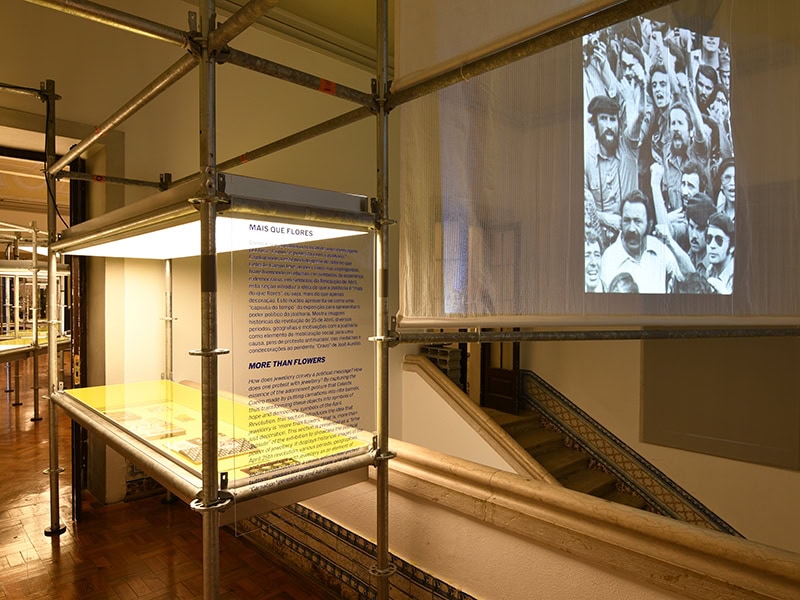
Marking the 50th anniversary of Portugal’s historic Carnation Revolution, the exhibition was meticulously curated by Marta Costa Reis, Mónica Gaspar, and Patrícia Domingues. Staged in collaboration with MUDE Museu do Design—the premier institution for contemporary jewelry in Portugal—the exhibition found a dramatic and unorthodox home within the vacant halls of the Calheta Palace.
The exhibition united 90 jewelers hailing from 34 countries, each addressing a spectrum of pressing contemporary injustices. The showcased works confronted systemic issues ranging from violence and discrimination against migrants to harmful, rigid beauty standards and the alarming global deterioration of queer rights. The curatorial vision was notably sharp. The specific brand of hope referenced in the exhibition’s subtitle is not a naive optimism nor a paralyzing pessimism; rather, it is an enduring resilience that stares uncertainty in the face, keeping human hands free to roll up their sleeves and get to work. The curators consciously sought out pieces carrying both the immediate, fiery sting of rage and this grounded, actionable sense of hope.
Primarily for the Initiated
Engaging critically with an exhibition of this nature inevitably leads to questions about how the jewelry is communicated to the public. In the case of Madrugada, this proved to be a complex endeavor. The curatorial team chose to accompany the physical works on view with only the sparest minimum of information, typically restricting display labels to basic factual details such as the maker’s name, the title of the piece, and the materials used.
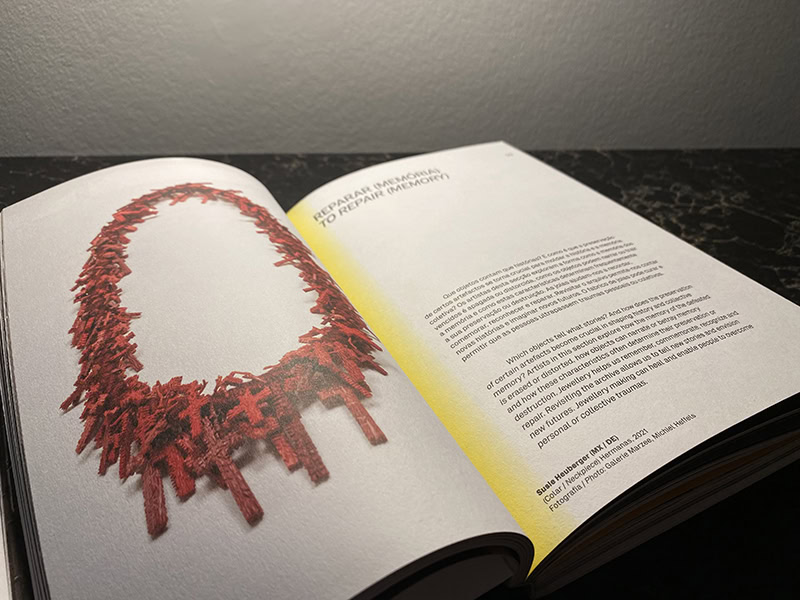
Visitors fortunate enough to tour the exhibition alongside Gaspar, Domingues, and participating artists gained a deeper appreciation for the narratives woven into the objects. During these walkthroughs, Nanna Melland unpacked the concept of a synchronized swarm behind her aluminum planes. Johanna Zellmer’s passport-inspired pieces clicked into place once she shared her personal migration journey. Susie Heuberger later revealed the poignant backstory of Hermanas, noting that its pinkish-red crosses serve as a memorial to Mexican women killed in violent conflict.
Encountering familiar works offered moments of recognition, such as Ana Escobar Saavedra’s replica of a baby’s ID band rendered in stone—a stark reminder that human identity construction begins the moment we enter the maternity ward. At the same time, many pieces introduced fresh perspectives. By actively challenging their own blind spots within the contemporary jewelry landscape, the curators selected numerous young and underrepresented voices, showcasing diverse reactions to modern socio-political crises.
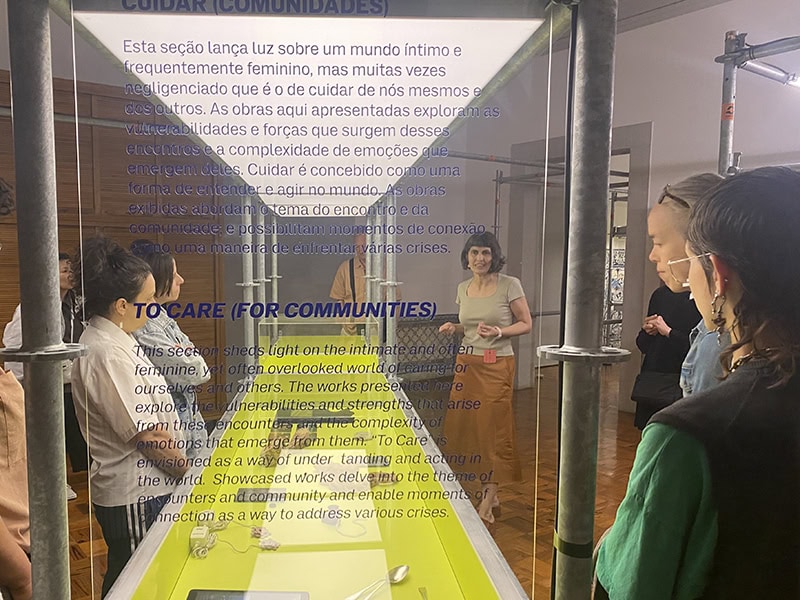
To structure this massive undertaking, the curators organized the works into eight thematic categories of hopeful action, including "To protest (voices)," "To empower (tools)," and "To reimagine (coexistences)." Each of these sections opened with a concise, insightful mini-essay. While these texts proved somewhat challenging to read on transparent display panels throughout the cavernous Calheta Palace, they can now be easily savored within the pages of the catalog.
A Practice of Curatorial Care
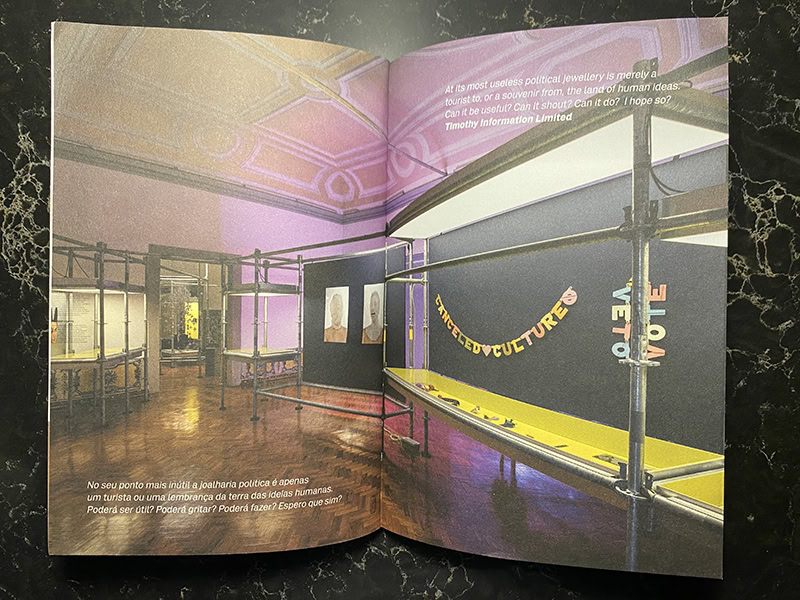
The catalog itself, easily identifiable by its striking yellow cover, functions as a vital instrument for tending to the exhibition’s afterlife. Nearly all the imagery featured in the book was captured in situ, documenting how the temporary exhibition scaffolding snaked its way through the palace’s soaring rooms and narrow corridors. Close-up photographs of works resting inside glass display cases even capture the atmospheric haze cast by the dominant yellow interior partitions.
The deliberate approach embraced by the curators during the exhibition extended far beyond its closing date, prompting deep reflection on what happens to a project once the artworks are returned to their creators. During their presentation at Schmuck 2025, Gaspar and Domingues explained that the publication of the book is itself an act of "care," serving to keep the core ideas of the project active and circulating within the cultural sphere for a little longer.
In an interview with art critic Elena Karpilova published in the catalog, the curators noted that they deliberately avoided burdening viewers with a massive 200-page explanatory manual. Instead, they opted for a minimalist approach featuring a small number of QR codes, expressing a hope that audiences would feel a spark of curiosity and self-initiate acts of micro-research. While this philosophical decision risked leaving certain complex works open to misinterpretation or confusion, it placed trust directly in the viewer’s intellectual autonomy.
Avoiding Labels
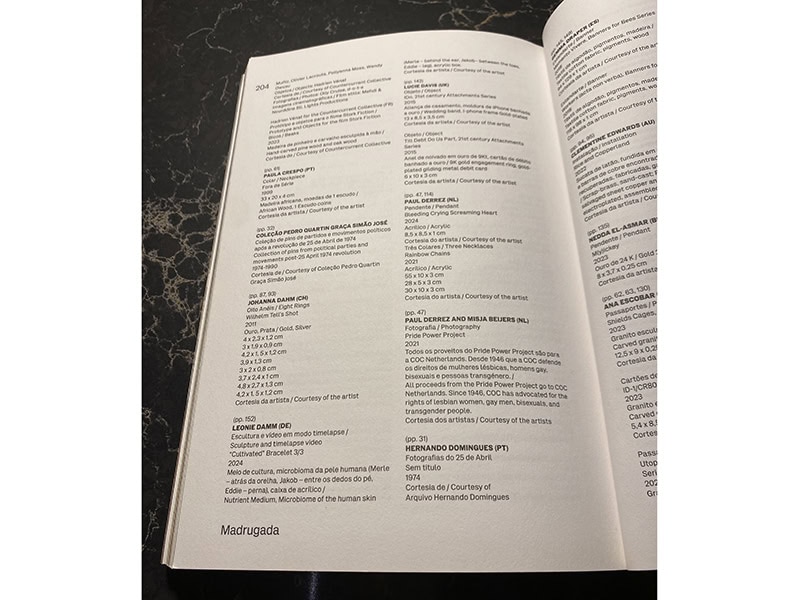
The catalog adopts a slightly more generous approach than the physical exhibition, providing detailed lists of materials and dimensions for every piece alongside occasional artist quotes and contextual background. For instance, Auli Laitinen’s Nobel Bow gains profound resonance when tied to the secretary of the Swedish Academy, who famously wore collared blouses with prominent bows until male colleagues engineered her departure to forestall #MeToo-related embarrassments. Wearing such a necklace demands genuine courage, particularly at a time when political authorities worldwide are increasingly expanding the legal grounds for arresting protesters over "subversive" accessories, down to the humble watermelon brooch.
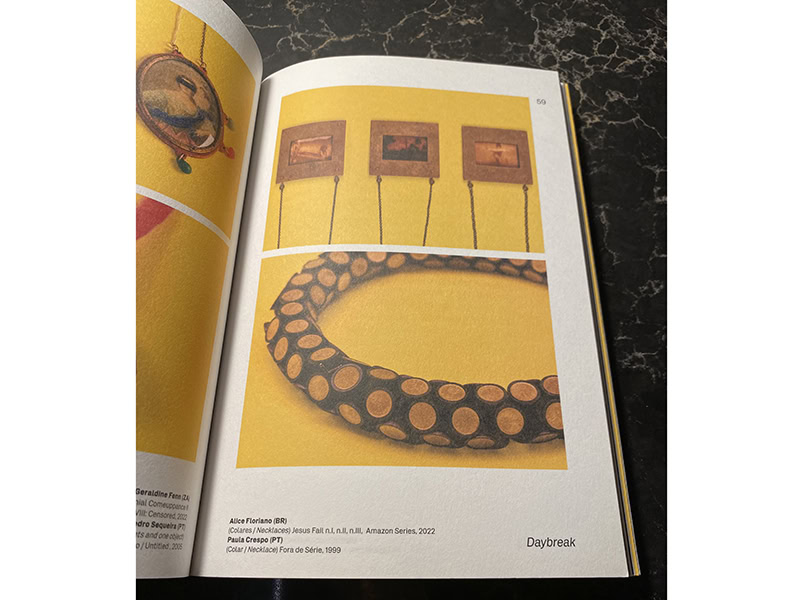
Similarly, encountering Paula Crespo’s necklace Fora de Série within the "To repair (memory)" section prompts immediate inquiry. What are the rounded wooden disks suspended from the piece? Flipping to the index at the back of the book reveals the materials: "African Wood, 1 Escudo coins." The realization forces a direct confrontation with the history of timber extraction in Portuguese colonies. Operating without the familiar crutch of explanatory wall labels made many viewers feel pleasantly or uncomfortably unmoored, shifting the burden of interpretation back onto the audience.
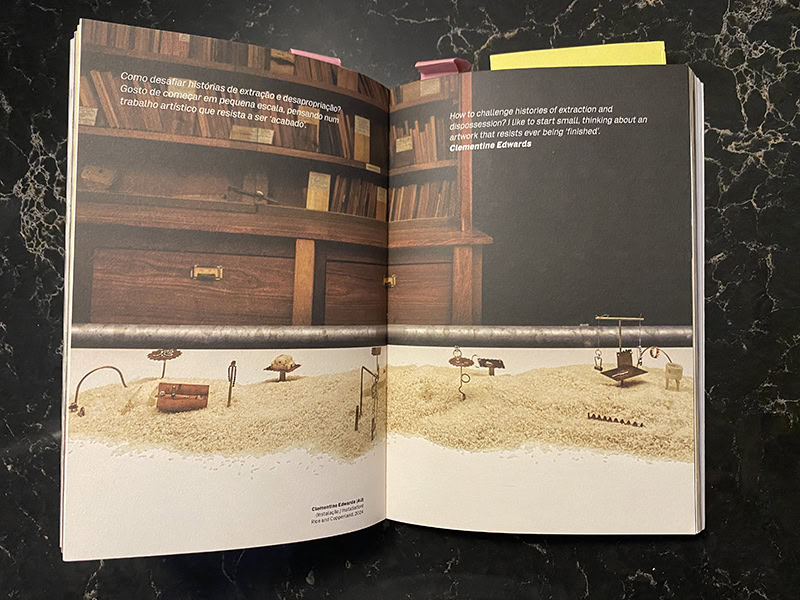
Questions likewise surround installations like Clem Edwards’s intriguing Rice and Copperland. Without immediate context, the choice of materials—rice, copper, miniature scale—remains a riddle. The catalog provides the necessary key through the artist’s own words: "How to challenge histories of extraction and dispossession? I like to start small, thinking about an artwork that resists ever being finished."
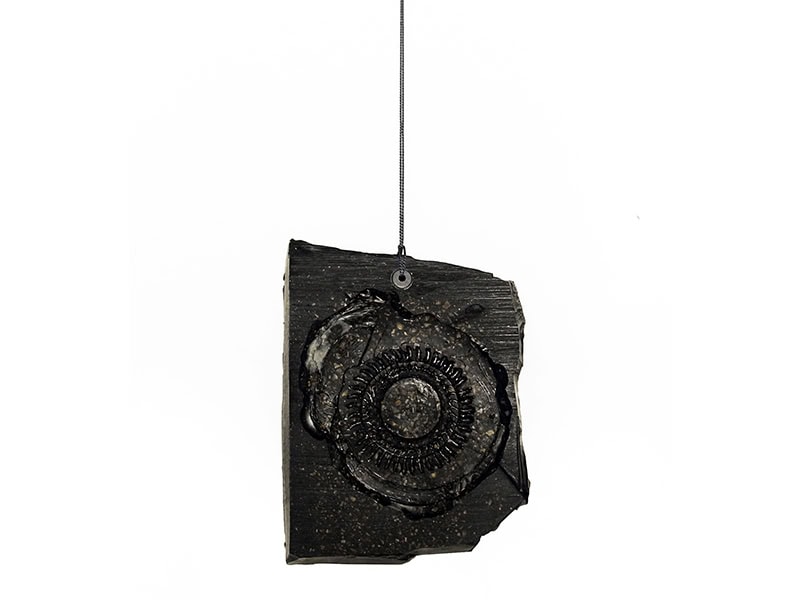
In the same vein, the pendant Black Box by Conversation Piece evokes the organic shape of an ammonite, yet acquires stark modern relevance through a statement addressing technological obsolescence, overconsumption, and conflict minerals. Armed with this snippet of text and the caption listing jet, seashell, and manufactured ferrite, viewers are invited to construct their own backstories.
Jewelry as Protest
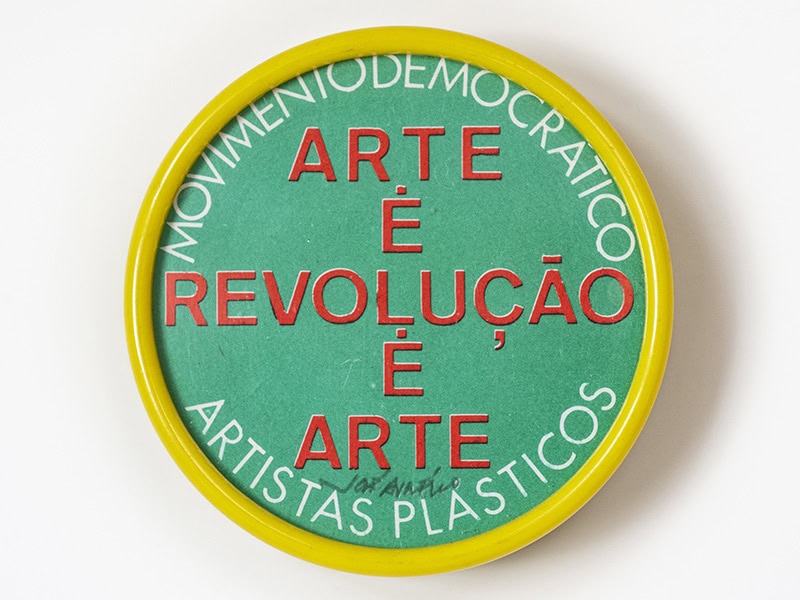
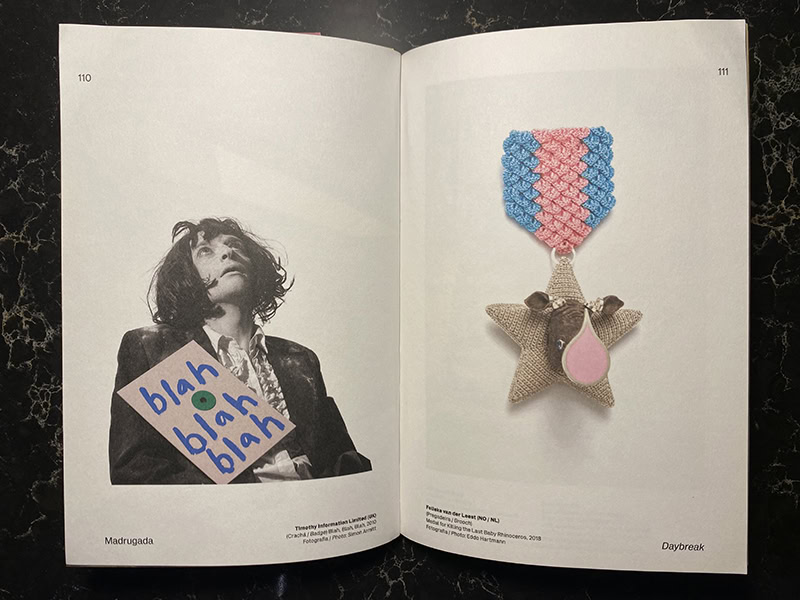
The catalog bypasses foundational debates over whether jewelry is an appropriate medium for political protest or expressions of hope, operating instead on the firm assumption that it is. After all, is not all art inherently revolutionary, much like the 1974 period pin declaring Arte é Revolução é Arte? Midway through its pages, the publication cites Timothy Information Limited: "At its most useless, political jewellery is merely a tourist to, or a souvenir from, the land of human ideas. Can it be useful? Can it shout? Can it do? I hope so?"
How, precisely, does jewelry accomplish this? Does it function by sounding alarms, or by sketching utopian horizons where humans and other-than-humans peacefully coexist, as seen in the Countercurrent Collective’s film Stork Fiction? As Patrícia Domingues suggests, dystopia can also serve as a valid methodology, acknowledging harsh realities while carving out mental space to imagine the exact opposite. Alternatively, jewelry can demonstrate precisely what is worth fighting for. When the Makers Move collective—comprising Josephine Winther and Gitte Nygaard—invited passing members of the public to twist wire into impromptu jewelry centered around the concept of "freedom," they captured hope in its most active, participatory form.
Addressing the Chatter
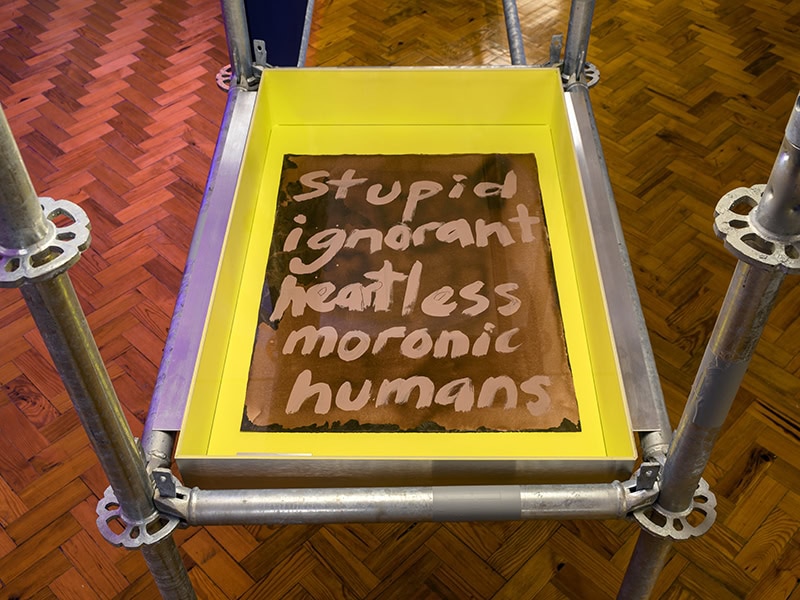
Under the banner "To protest (voices)," Helen Britton’s Shame Australia Shame delivers an urgent, unvarnished cry scrawled across a sheet of paper: "stupid ignorant heartless moronic humans." The inclusion of two-dimensional works, videos, digital phone filters, and large-scale installations successfully breaks up the rhythmic monotony of traditional jewelry forms like brooches, bracelets, and pendants. Confronted with unambiguous words rather than familiar decorative objects, one is forced to wonder whether text is overtaking abstract form as jewelry’s most direct medium of political indictment.
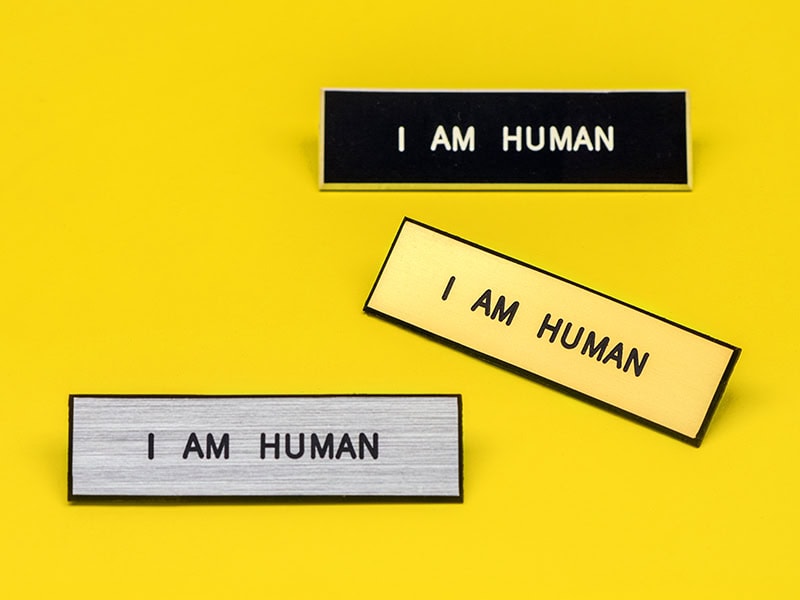
Other pieces within Madrugada utilize text with greater ambiguity. Timothy Information Limited offers a badge mimicking a standard protest sign that simply reads "Blah blah blah." Meanwhile, Auli Laitinen’s readymade name tags bearing the words "I am human" are brilliantly categorized under "To reimagine (coexistences)," functioning simultaneously as an ironic introduction for a more-than-being entity or a wry warning to keep your distance.
Ultimately, the eight thematic frameworks of Madrugada offer vital clues regarding how political jewelry "can do" the work of social commentary. The objects achieve this by acknowledging materialities, traversing physical and conceptual boundaries, and encouraging wearers to confront their own identities. Yet, grasping the precise mechanics by which each individual work embodies active hope remains a challenge without supplementary text.
The three curators candidly acknowledge this ongoing curatorial dilemma. The physical constraints of the exhibition space could not be entirely mitigated by the catalog alone, meaning that Madrugada—both as a temporary physical manifestation and a printed publication—inadvertently becomes a meditation on the complex, evolving role of text within the field of contemporary jewelry. Despite these tensions, the catalog stands as a substantial and enriching addition to the literature of art jewelry, leaving many to hope that an equally thoughtful publication will accompany the upcoming Coexistences biennial.
The Madrugada exhibition was on view from June 28 to September 22, 2024, curated by Marta Costa Reis, Patrícia Domingues, and Mónica Gaspar, with an artist and curator interview conducted by art critic Elena Karpilova.
The extensive roster of participating artists includes Ada Chen, Adeela Suleman, Alice Floriano, Ana Escobar Saavedra, Anna Avits, Anti War Medal exhibition archive (Velvet da Vinci Gallery), Artificial Intelligems, Auli Laitinen, Benedict Haener, Ben Lignel, Beverley Price, Bruno Nogueira, Carla Castiajo, Caroline Broadhead, Catarina Silva, Catherine Blackburn, Chequita Nahar, Christoph Zellweger, Clementine Edwards, Conversation Piece (Nicolas Cheng & Beatrice Brovia), Corrina Goutos, Countercurrent Collective, Damara Inglês, Daniel Ramos, David Bielander, Deganit Stern Stocken, Diana Silva, Eija Mustonen, Felieke van der Leest, Fernanda Fragateiro / Paula Paour, Filomeno Pereira de Sousa, Florance Tebbutt, Frank Tjepkema, Gemma Draper, Geraldine Fenn, Gisbert Stach, Gonçalo Camboa, Handmedal Project (Iris Eichenberg & Jimena Rios), Helen Britton, Kiseno, Johanna Dahm, Johanna Zellmer, Jonathan Boyd, José Aurélio, Joyce J Scott, La Frontera exhibition archive (Velvet da Vinci Gallery & Lorena Lazard), Lauren Kalman, Lauren Kalman & Kipp Bradford, Leonie Damm, Leonor Hipolito, Lin Cheung, Lisa Walker, Lucie Davis, Lucy Ganley, Luisa Kuschel, Luis Torres, Makers Move, Manuel Vilhena, Maria Ignacia Walker, Marilia Maria Mira, Masoumeh Rezaeilouyeh, matt lambert, Mengyin Sun, Miles Robinson, Naama Levit, Nanna Melland, Nedda Al-Asmar, Paul Derrez, Pride Power Project (Paul Derrez & Misja Beijers), Paula Crespo, Paulo Mendes, Pedro Sequeira, Pio Abad & Frances Wadsworth Jones, Pouya Bakhshi, Ramon Puig Cuyás, Reka Lorincz, Ruudt Peters, Samantha Vincent, Sophie Hanagarth, Susie Heuberger, Ted Noten, Teresa Milheiro, Timothy Information Limited, Timothy Veske-McMahon, Valerie Oi Ying Ho, Vhils, Viktoria Bulgakova, Vivi Touloumidi, and Yotam Bahat.