



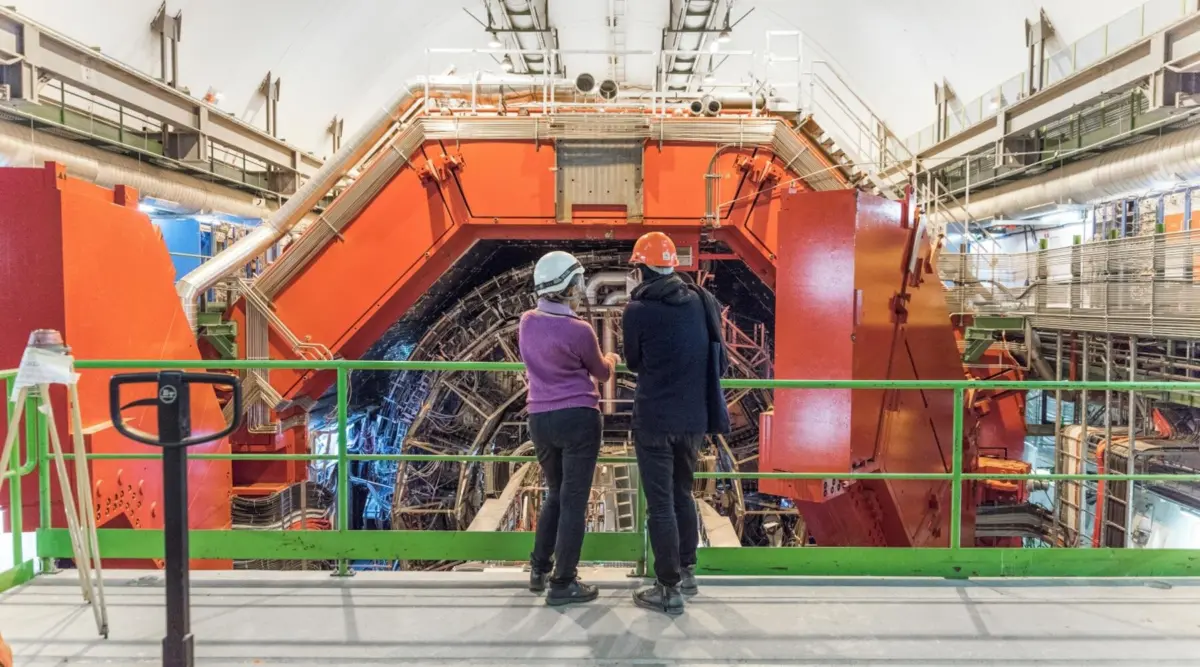
When most people are asked what CERN does, the immediate answer is usually physics. As the European Laboratory for Particle Physics situated in Geneva, Switzerland, the institution certainly occupies its time with fundamental physics, maintaining the colossal Large Hadron Collider, and even spearheading historical inventions like the World Wide Web. Yet, alongside its heavy computational power and particle accelerators, CERN harbors a unique cultural initiative: it regularly invites artists from all over the world to produce works in tandem with its scientific research. Through dedicated artist residencies, high-profile commissions, and collaborative programs, CERN has welcomed world-renowned creative minds—including Tomás Saraceno, Ryoji Ikeda, and numerous others—to craft works that, much like the laboratory’s empirical research, seek to demystify the complex world around us.
Where Art and Science Collide
There is a prevailing cultural sense that the principles of physics, particularly the sweeping discoveries unlocked during the 20th century, have mapped out the core mysteries of the universe. Cinematic blockbusters like Interstellar and Oppenheimer continually attempt to demonstrate the immense power of these principles through visual representations of atomic energy, time dilation, and cosmic wormholes. Yet, when faced directly with a fundamental equation like $E=mc^2$, how many individuals truly grasp its full implications? When peering into the intricate network of wires, flashing lights, and buttons inside a subterranean research laboratory, what signals successfully translate into the human brain?
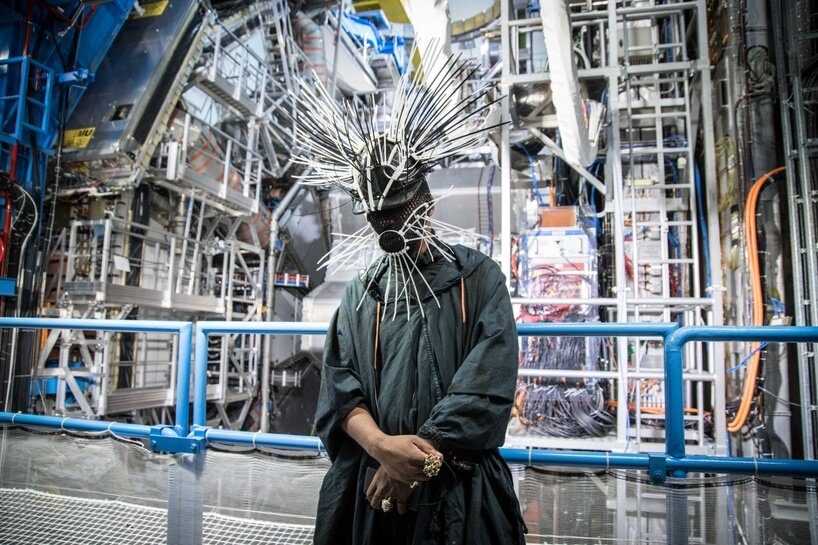
This is precisely where the transformative power of art comes into play at CERN. Creative interpretation not only helps translate abstract, highly mathematical ideas into comprehensible, tangible forms, but it can also occasionally suggest entirely new lenses and applications for these advanced scientific tools. Both art and science are fundamentally driven by an innate human desire to comprehend what lies beyond the immediate limits of ordinary perception. Whether that exploration involves tracking the smallest fundamental particles of matter, imagining higher dimensions that cannot be physically experienced, or mapping out the hidden infrastructures of the natural world, creative practitioners offer entirely new pathways for humanity to relate to the cosmos.
Visualizing the Fourth Dimension
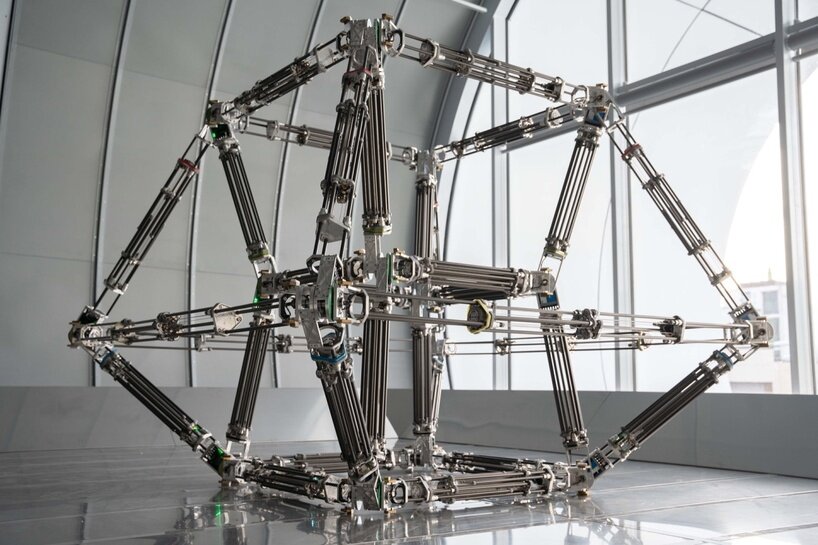
A striking example of this interdisciplinary synthesis is found in Julius von Bismarck’s 2023 kinetic sculpture, Round About Four Dimensions. The artist, who previously apprenticed at the Berlin Institute for Spatial Experiments, teamed up to create what is essentially a physical "tesseract"—a dynamic shadow of a four-dimensional cube. Constructed from a complex web of aluminum, stainless steel, brass, polymers, and sophisticated electronics, the sculpture embodies a concept that defies human spatial intuition.
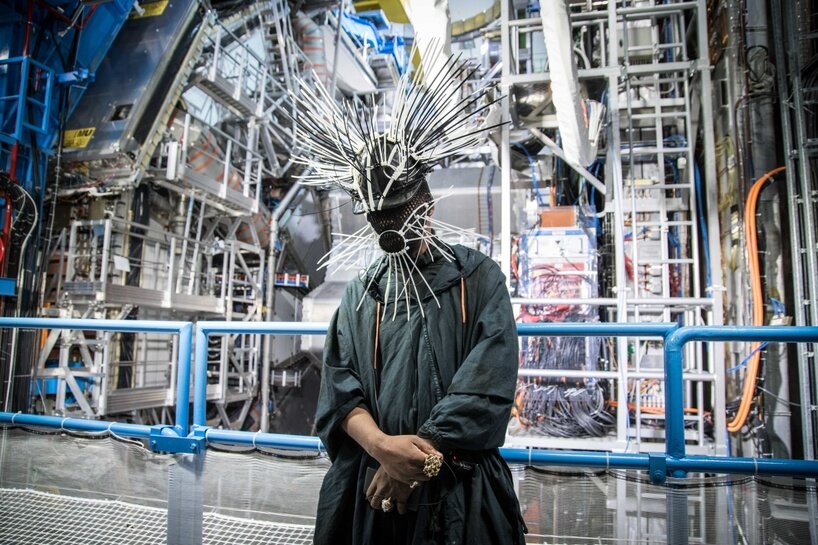
Describing the project, Arts at CERN noted that the piece’s continuous three-dimensional revolving motion serves as a direct projection of a four-dimensional rotation, representing a phenomenon that the human brain cannot fully grasp on its own. This previously intangible concept is brought to life by a kinetic sculpture that wraps endlessly around itself. Featuring 32 expanding and contracting edges, the structure creates a mesmerizing optical illusion, appearing as though it is swallowing the geometric form at its very center or constantly turning itself inside out. Through a series of carefully programmed software controls, the sculpture brings viewers perceptually closer to understanding the mechanical behavior of four-dimensional objects.
Semiconductor Navigates ATLAS
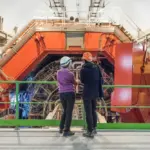
CERN is perhaps most globally celebrated for housing the Large Hadron Collider (LHC), a massive particle accelerator designed to launch protons at speeds approaching the speed of light. Within this sprawling facility, researchers operate specialized experiments such as ALICE, which investigates the physics of strongly interacting matter at extreme energy densities to study quark-gluon plasma. Another major experimental apparatus is ATLAS, a general-purpose detector functioning essentially as a massive array of cameras and documentation equipment designed to record the debris and subatomic fallout of high-energy particle collisions.
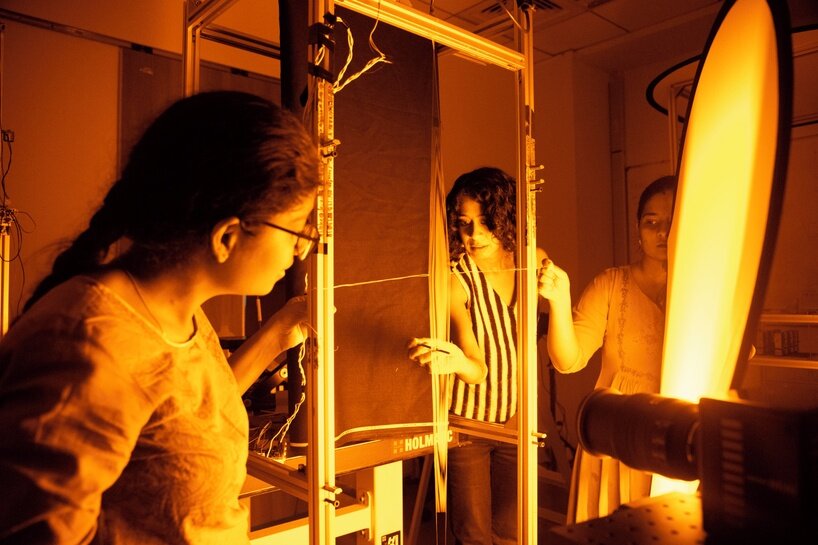
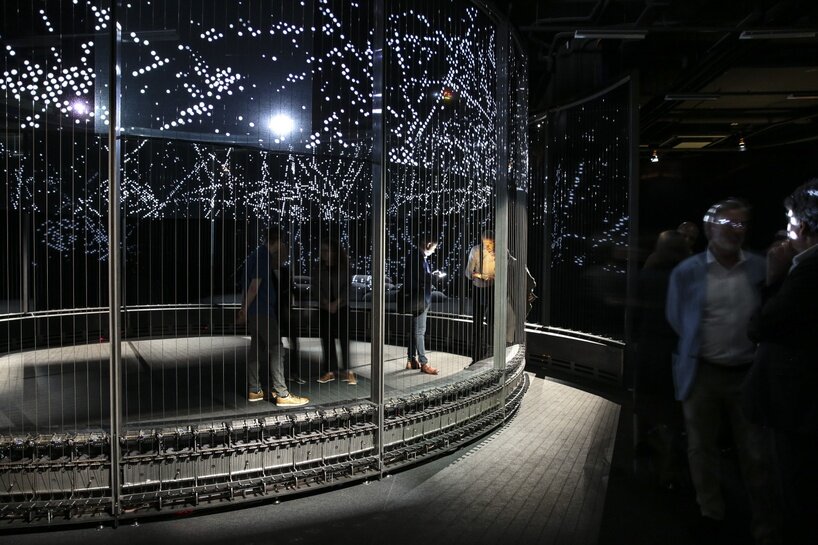
For their 2018 collaborative project titled HALO, the British artistic duo Semiconductor sought to visually and aurally interpret the immense streams of data generated behind the scenes at ATLAS. Commissioned by Audemars Piguet in partnership with CERN, HALO manifested as a large-scale, cylindrical installation that visualized the complex flow of experimental data. The inhabitable structure intentionally recalled the actual tube-like architecture of the particle accelerator itself.
During their initial residency at CERN in 2015, the members of Semiconductor familiarized themselves with the inner workings of the laboratory’s colossal machinery. In HALO, they took the overwhelming mass of raw information streaming from the ATLAS detector and slowed it down, translating the invisible digital metrics into sweeping sounds and rhythmic flashes of light that are directly perceivable to the human eye and ear.
The Collide Residency
Beyond standalone commissions and major public exhibitions, CERN organizes continuous residency programs that embed artists directly into its advanced machinery, cutting-edge research facilities, and daily scientific culture. In a recent expansion of these efforts, Arts at CERN—in collaboration with the Nobel Prize Museum—awarded the prestigious Collide Stockholm international residency to Lithuanian-born artist Emilija Škarnulytė.
CERN describes Škarnulytė’s artistic practice as being deeply rooted in the exploration of infrastructures that mediate between the visible and the invisible, the human and the post-human, the present epoch and deep geological time. Through meditative moving images and immersive audiovisual installations, the artist investigates the hidden systems and physical processes that quietly shape the natural world, frequently shifting the viewer’s perspective far beyond the traditional limits of human perception. Additional residencies have similarly welcomed creators like Antye Greie-Ripatti at the CMS Experiment and Andrea Anner and Thibault Brevet at the MEDICIS facility, fostering deep dialogues between creative practitioners and resident physicists.
Ultimately, these ongoing collaborations at CERN demonstrate that art and science are far from being distant or incompatible disciplines. By translating complex, invisible scientific processes into sensory, spatial, and immersive encounters, artists provide society with new ways of relating to the universe. More than simply making technical science accessible to the public, these creative engagements challenge our fundamental understanding of humanity’s place within the cosmos, suggesting that learning to see the world through a different lens may well be the first vital step toward truly understanding it.