





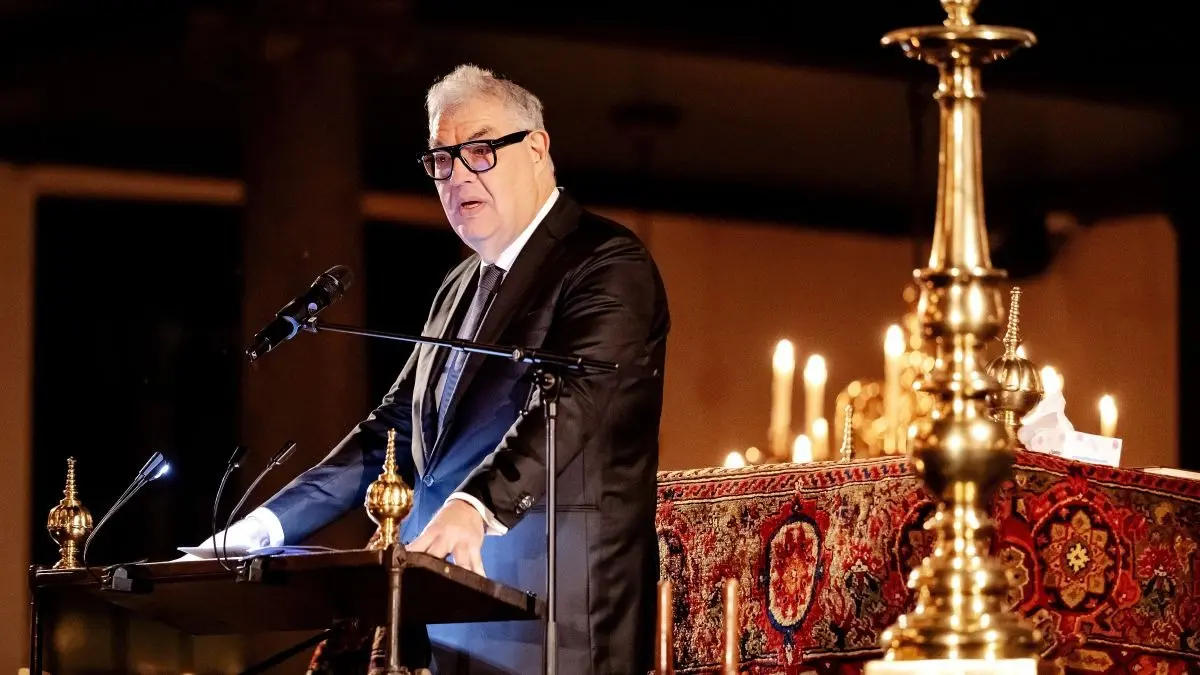
An annual Kristallnacht remembrance service held at Amsterdam’s historic Portuguese Synagogue has descended into deep controversy following an address by its keynote speaker, who strongly condemned recent pro-Palestinian protests and asserted that allegations labeling the ongoing conflict in Gaza as a genocide are fundamentally rooted in anti-Semitism.
The event, which drew prominent members of the Dutch political establishment including Prime Minister Rob Jetten—who also delivered remarks during the service—became the stage for an unusually charged political exchange. Chanan Hertzberger, the chair of the Jewish umbrella organization CJO, used his platform to denounce what he termed the "genocide lie" directly in front of the assembled dignitaries and congregation.
Hertzberger’s remarks quickly reverberated across the Dutch political and social landscape, drawing sharp rebukes from Palestinian rights advocates while highlighting the profound tensions currently gripping the Netherlands in the wake of the ongoing Middle East conflict.
"Who is being held responsible, in Arnhem, in Groningen, and in Amsterdam, for this so-called genocide?" Hertzberger asked the congregation during his address. "We, the Jews. In our own cities. In our streets. In our children’s classrooms. We are being ostracized and pushed to the margins of society."
The CJO chair pointed to a troubling rise in local incidents, mentioning the numerous attacks reported this year targeting
Jewish schools and synagogues across the Netherlands. At the same time, he acknowledged that the devastating visual media emerging from the Gaza Strip leaves no one entirely unmoved, noting that he himself is deeply affected by the suffering. However, he argued that weekly demonstrations on Dutch streets have amplified a false narrative regarding Israel’s military actions, creating a hostile environment for local Jewish communities.
The speech immediately drew a sharp reaction from Gerard Jonkman, the director of the Amsterdam-based Rights Forum, an organization that actively campaigns on behalf of Palestinian rights. Speaking to Dutch News, Jonkman described Hertzberger’s keynote address as "absolutely unacceptable."
"This is also mixing the issue of anti-Semitism with criticism of Israel, which is very, very, very dangerous," Jonkman said. He argued that directly linking public demonstrations and political protests against government policies to anti-Semitism effectively places collective accountability onto Jewish people in the Netherlands for the military and political decisions of the Israeli government.
Hertzberger countered in his remarks by asserting that the false claim of genocide is now being marched weekly through public streets, citing specific chants heard during a major demonstration held on the preceding Sunday. While maintaining that not every individual participating in these protests harbors anti-Semitic views, he maintained that the overarching rhetoric has crossed a dangerous line.
Zionism and the Debate Over Public Protests
During his address, Hertzberger also addressed the topic of Zionism, stating that the vast majority of Jewish people living in the Netherlands identify as Zionists. He defined Zionism as the foundational recognition of Israel’s inherent right to exist as a safe and independent Jewish state, arguing that these principles are now more critical and important than ever given the current geopolitical climate.
The nature of the conflict and the terminology surrounding it remain fiercely contested on the international stage. In September 2025, a United Nations commission of inquiry formally concluded that Israel has committed acts of genocide in the Gaza Strip—a finding that the Israeli government has strongly and consistently rejected. Meanwhile, the International Criminal Court based in The Hague has issued formal arrest warrants for Israeli Prime Minister Benjamin Netanyahu and former Defense Minister Yoav Gallant, citing alleged war crimes and crimes against humanity connected to the conflict.
Jonkman noted that Sunday’s "Red Line" demonstration was attended by many Jewish individuals, including Holocaust survivors and the children of Holocaust survivors, many of whom were deeply hurt and alienated by Hertzberger’s sweeping characterization of the protesters. He added that Jewish voices expressing critical views of Israeli government policy are frequently sidelined or ignored in mainstream public discourse.
Political Fallout and Prime Minister Jetten’s Position
The controversy was further amplified by the presence of Prime Minister Rob Jetten. Hertzberger began his speech by publicly thanking the prime minister for refusing to bow to what he described as the demands of the organizers behind the previous day’s anti-establishment and anti-Israel demonstrations—demands that Hertzberger claimed amounted, either directly or indirectly, to erasing Israel from the map.
Just hours before the remembrance service took place, Prime Minister Jetten had spoken with RTL Nieuws, explaining that it had been "impossible to miss" the large-scale protest. Jetten revealed that he ultimately chose to stay away from the demonstration—despite having attended similar events in the past—owing to the responsibilities of his new role as prime minister. He emphasized that both he and his cabinet colleagues have utilized their positions from the very beginning of the current administration to increase diplomatic pressure on Israel.
Jonkman asserted that Hertzberger’s pointed remarks effectively embarrassed the prime minister inside a house of worship, arguing that Jetten should respond publicly to what he termed "ridiculous accusations of hatred towards Israel." Representatives for the CJO have not yet issued a public reply to the criticisms leveled against the speech.
The tension at the synagogue underscores a broader deterioration in Dutch-Israeli diplomatic relations since the formation of Jetten’s cabinet. Tensions reached a significant diplomatic low in September when the Dutch government enacted a formal ban on commercial goods originating from illegal Israeli settlements in the occupied Palestinian territories. In retaliation, the Israeli government moved swiftly to strip Dutch diplomats of their official diplomatic status and barred Dutch officials from participating in a United States-backed Gaza ceasefire coordination center.