




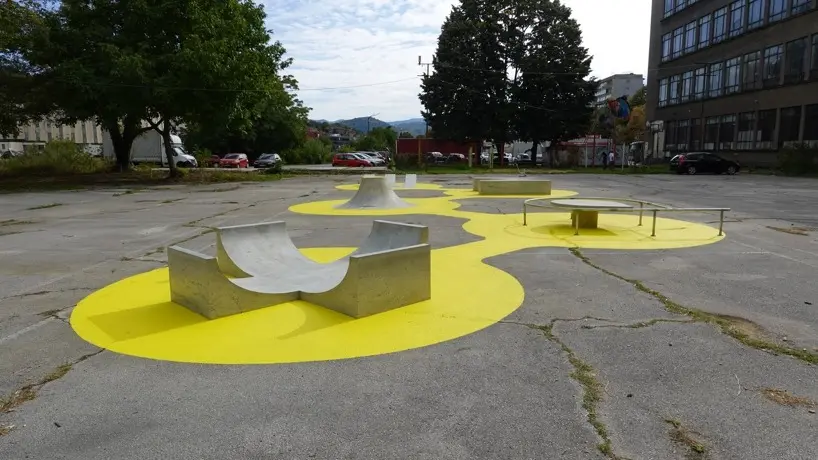
At the intersection of street art, typography, and action sports lies SKATEABLE, a striking new public installation created by Bulgarian graffiti artist XPOME. Situated in front of the historic Christo and Jeanne-Claude Center in Gabrovo, Bulgaria, the project transforms raw industrial materials into a functional mini skatepark. Conceived as part of an ongoing cultural exhibition tracing the history and evolution of skateboarding in Bulgaria, the installation redefines how urban spaces can simultaneously serve visual art and athletic performance.
Invited to contribute a sculptural piece to the exhibition, XPOME chose to move away from traditional gallery installations, opting instead for an interactive, site-specific work that engages directly with the community. By blending the fluid, expressive nature of graffiti lettering with the rigid structural demands of concrete and steel, the artist has crafted a piece that is as much a monumental sculpture spelling out his own moniker as it is a fully functional playground for skateboarders.
Five Concrete and Steel Letters Transform into Skate Obstacles
At the heart of the SKATEABLE project is a clever typographical translation. The installation spells out the artist’s tag, “XPOME,” utilizing a series of five distinct architectural modules fabricated from robust concrete and reinforced with steel. Rather than treating typography as a two-dimensional graphic medium or a passive gallery display, XPOME engineered each individual letter to function as a specialized obstacle for skateboarding, as well as a place for visitors to rest and observe.
The structural journey begins with the letter "X," which has been thoughtfully cast to form a double quarter pipe. This dual-sided transition allows skaters to carry momentum back and forth, generating speed and setting up lines across the rest of the sculptural spelling. Adjacent to the "X," the letter "P" introduces a classic street-skating element, incorporating a precision-engineered metal rail wrapping around an elevated concrete island. This component challenges skaters to test their balance, grind accuracy, and technical dexterity.
Further along the typographical sequence lies the letter "O," which achieves a significant milestone in the country’s skate architecture history. According to the project details, the "O" functions as the very first "volcano" obstacle ever built in Bulgaria. Characterized by its conical, dome-like center that slopes outward in all directions, the volcano allows riders to burst radially from its peak, introducing a dynamic, fluid geometry rarely found in traditional Eastern European municipal skate spots.
Continuing the sequence, the letter "M" provides a large, solid concrete and steel bench tailored for sliding and grinding maneuvers. Its clean, linear edges and durable materials make it an ideal spot for extended technical sessions, while simultaneously serving as an inviting public resting place for pedestrians and museum-goers. Finally, the installation concludes with the letter "E," which takes the form of a compact triple-jumping platform. This tiered element offers skaters varying heights to launch from, encouraging progression and creativity within a relatively tight spatial footprint.
Bridging Street Art, Architecture, and Community Engagement
The placement of SKATEABLE in Gabrovo—a city deeply rooted in industrial heritage—lends the project an authentic urban resonance. By locating the mini skatepark directly in front of the Christo and Jeanne-Claude Center’s old building, the installation bridges the gap between contemporary visual culture and the city’s architectural backdrop. It reflects a growing movement within modern urban design that values multi-functional public spaces where artistic expression and physical activity intersect.
The exhibition exploring the history of Bulgarian skateboarding provides essential context for XPOME’s intervention. Skateboarding, long viewed purely as a countercultural pastime or a fringe activity, has steadily gained recognition as a legitimate athletic discipline and a vibrant subculture across the country. By physicalizing his signature graffiti typography into skateable architecture, XPOME honors the rebellious, DIY spirit inherent to both graffiti writing and street skateboarding.
The project highlights how traditional mediums of street art—traditionally confined to walls, canvases, or freight trains—can evolve into three-dimensional, tactile environments. Skaters interacting with the sculpture are not merely using a park; they are physically engaging with the artist’s signature, writing their own lines across the concrete contours of the letters.
As the exhibition continues to draw visitors and local skaters to the Christo and Jeanne-Claude Center, SKATEABLE stands as a testament to the collaborative potential of public art. Through a meticulous synthesis of concrete casting, structural steel, typography, and action sports, XPOME has delivered a lasting urban intervention that enriches Gabrovo’s cultural landscape and offers a fresh template for skatepark design in Bulgaria.