


What Happens When a Phone-Free Arena Tour Transforms Live Music? Inside Phoebe Bridgers’ Brooklyn Kickoff
Published Oct 5, 2026 | 12:24pm
It is a near-impossible feat to experience a collective, phoneless environment in the year 2026. As a thirty-year-old, I possess the distinct luxury of recalling a time before smartphones reached their current cultural critical mass. Many of the concertgoers surrounding me on Thursday night at the Barclays Center were significantly younger, likely hard-pressed to remember any era devoid of glowing pocket computers.
“She wants the phones completely off—she doesn’t want any light coming from the pouches,” an attendant stationed outside the Brooklyn venue informed us, gesturing toward a large bin of gray, cushiony rectangles designed to swallow up our personal devices for the foreseeable future. The “she” in question was, naturally, Grammy-winning indie folk artist Phoebe Bridgers, and the momentous occasion was the opening night of the Brooklyn leg of The Lost Tour.
Bridgers initially broke the news of her ambitious, phone-free world tour back in June through a succinct social media post that immediately ignited a thousand online conversations. In an era where anyone can pull up TikTok and watch virtually any live performance from any major artist without paying a cent, I found myself intensely curious about what it would feel like to step into a show that existed exclusively for the physical bodies in the room. It promised a moment in time we would have no choice but to experience together, commit entirely to memory, and eventually let slip away—fittingly, given the tour’s evocative name. Would taking away our mini-computers materially alter the live music experience? I handed over my phone, stepped through the security checkpoints, and went inside to find out.
On that hazy September evening, throngs of fans arrived dressed in their finest Bridgers-inspired attire. Some leaned into classic aesthetics with skeleton suits, while others embraced newer visual cues featuring glitter tears. Those in the latter camp were remarkably quick studies, having drawn inspiration from a set of behind-the-scenes images Bridgers posted following the tour’s opening week, which revealed sparkly, glow-in-the-dark tears painted beneath both of her eyes.
The arena floor itself was cleverly divided into two distinct halves: “Above GA” and “Below GA,” a direct nod to the lyrical motifs of her latest album. After the opening act, Alex G, concluded his set, an indeterminate stretch of time passed before Bridgers was scheduled to take the stage. Without the habitual distraction of phones, the crowd was granted an unusual opportunity to deeply take in the architecture and atmosphere of the arena. (In my case, I kept a physical Moleskine notebook and a pen handy to chronicle the evening for the purposes of this report.)
Left to their own devices—or rather, the total lack thereof—showgoers began actually studying their surroundings. Was that massive apparatus on stage a planetarium? Would heavy velvet curtains open to reveal an elaborate stage design? Was there a hidden secondary stage somewhere in the middle of the room?
Most radical of all, people began talking to absolute strangers. Conversations bubbled up, discussing anticipated setlists and swirling rumors that Bridgers’ boygenius bandmates, Lucy Dacus and Julien Baker, might make a surprise guest appearance after being spotted on the venue’s kiss cam the very previous night. Attendees seated near the rear even initiated a shrieky, crowd-wide stadium wave that circled the massive arena six or seven times. Then, abruptly, the house lights faded to black.
“CRYING IN A SUIT AND TIE—” Above the center stage, a giant, nest-like sphere descended slowly from the ceiling, pulsing vibrant turquoise light beams with every vocoder-filtered syllable. “—BUT YOU SHOULD SEE THE OTHER GUY.” Screams erupted across the arena. The giant half-sphere positioned at the front of the room lifted upward, trailing the vocoder’s fade-out, finally revealing Bridgers and her full band as the lush choral harmonies of “The Outside” filled the air.
Draped in poet sleeves with pronounced shoulders, shimmering face paint, and Grace Kelly-worthy waves, Bridgers cut a striking figure that bridged the gap between a 19th-century Victorian widow, a space-age alien, and an old-Hollywood starlet. The nineteenth-century mourning aesthetic was entirely intentional: her custom gown was crafted by Susie Cave Weddings and Funerals, marking a notable return for designer Susie Cave following the abrupt closure of her celebrated label, The Vampire’s Wife, in 2024.
Bridgers’ third studio album is structurally designed to be visualized within the mind’s eye. Its musicality frequently extends far beyond its lyrical framework, leaving sprawling instrumental passages and eccentric sonic detours for the listener’s imagination to furnish. Even when listening passively through headphones, one naturally wonders what kind of theatrical chaos Bridgers envisioned while composing each track. Inside the Barclays Center, however, those instrumental openings blossomed into dazzling visual spectacles.
“The Governor’s Waltz” leaned heavily into literal interpretations of the cosmos, projecting a glowing Jupiter under the hood of the central half-sphere, framed by an expansive solar system of celestial bodies, including Saturn, the Milky Way, distant stars, and limitless darkness. Technicolor washes of blue, orange, and red flooded the stage. Tilting one’s gaze upward toward the sky while she sings has long been a classic Phoebe hallmark; beneath a custom planetarium of her own creation, the gesture felt profoundly earned.
During “Moon Song,” a gigantic lunar projection illuminated the underbelly of the dome via a single standalone beam of light positioned at the very back of the arena, transforming the darkened stadium into something resembling a classic movie palace. Toward the final coda, the projected moon vibrated with every acoustic guitar strum, receding further and further into the distance until, by the song’s end, it vanished completely—lost into the ether.
Even the stage production itself avoided standard modern concert tropes; notably, there were no towering LED video walls flanking the stage to broadcast close-ups of Bridgers’ face. Instead, her live likeness was projected softly onto large, translucent curtains. The effect felt like stepping inside a cinematic dream sequence shot straight from the subconscious. Bridgers has long established herself as a dedicated cinephile, with filmic themes consistently weaving through all three of her studio albums.
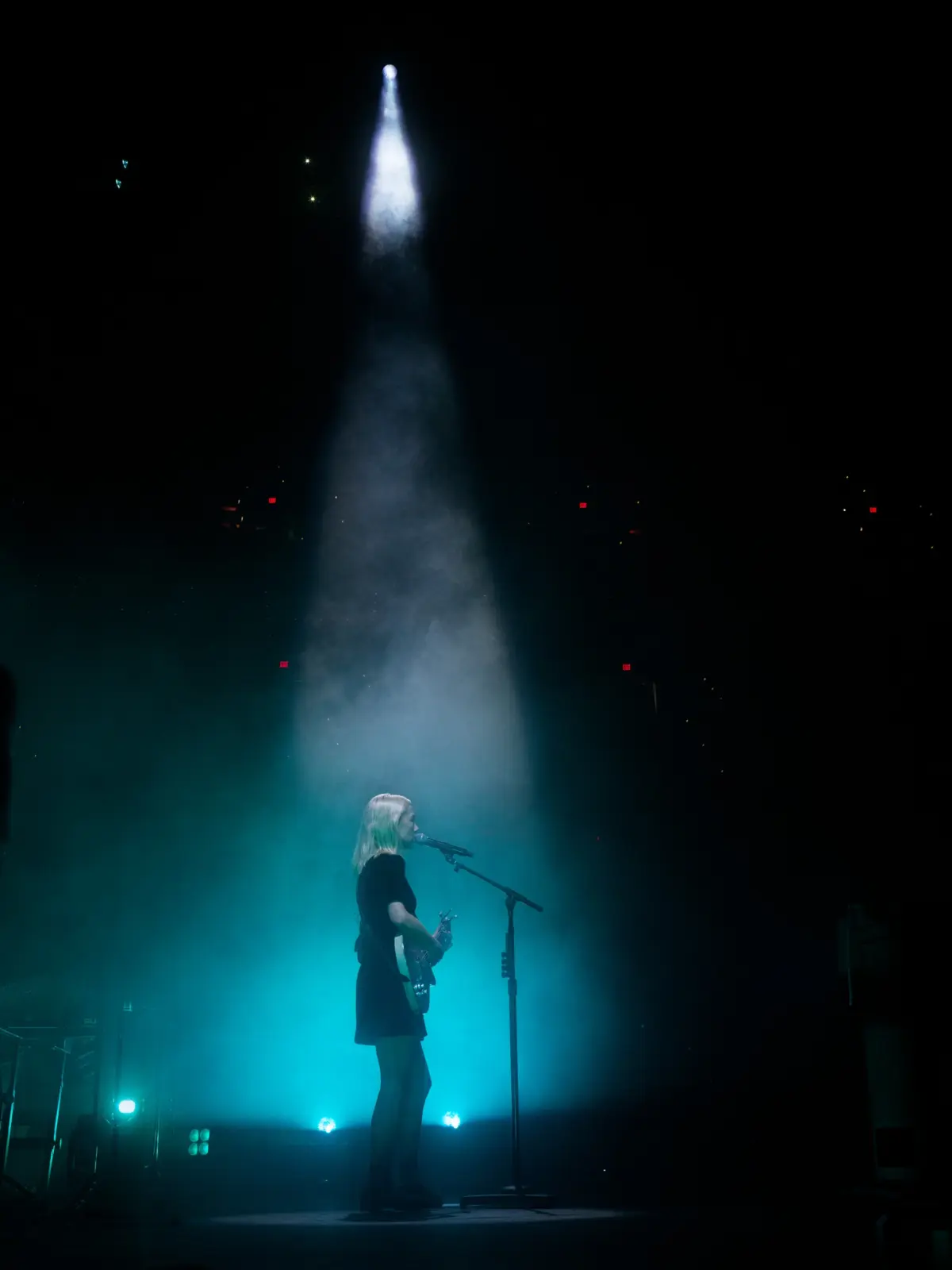
The strict phone ban quickly justified itself on a purely visual level. Had thousands of illuminated smartphone screens punctured the carefully managed darkness, the intricate mechanics of the lighting design would have been entirely undermined. At times, harsh spotlights struck Bridgers directly, bathing her in electric blue or warm amber; at other moments, she was completely backlit, rendering her a stunning silhouette with the edges of her hair and clothing glowing teal, crimson, or marigold.
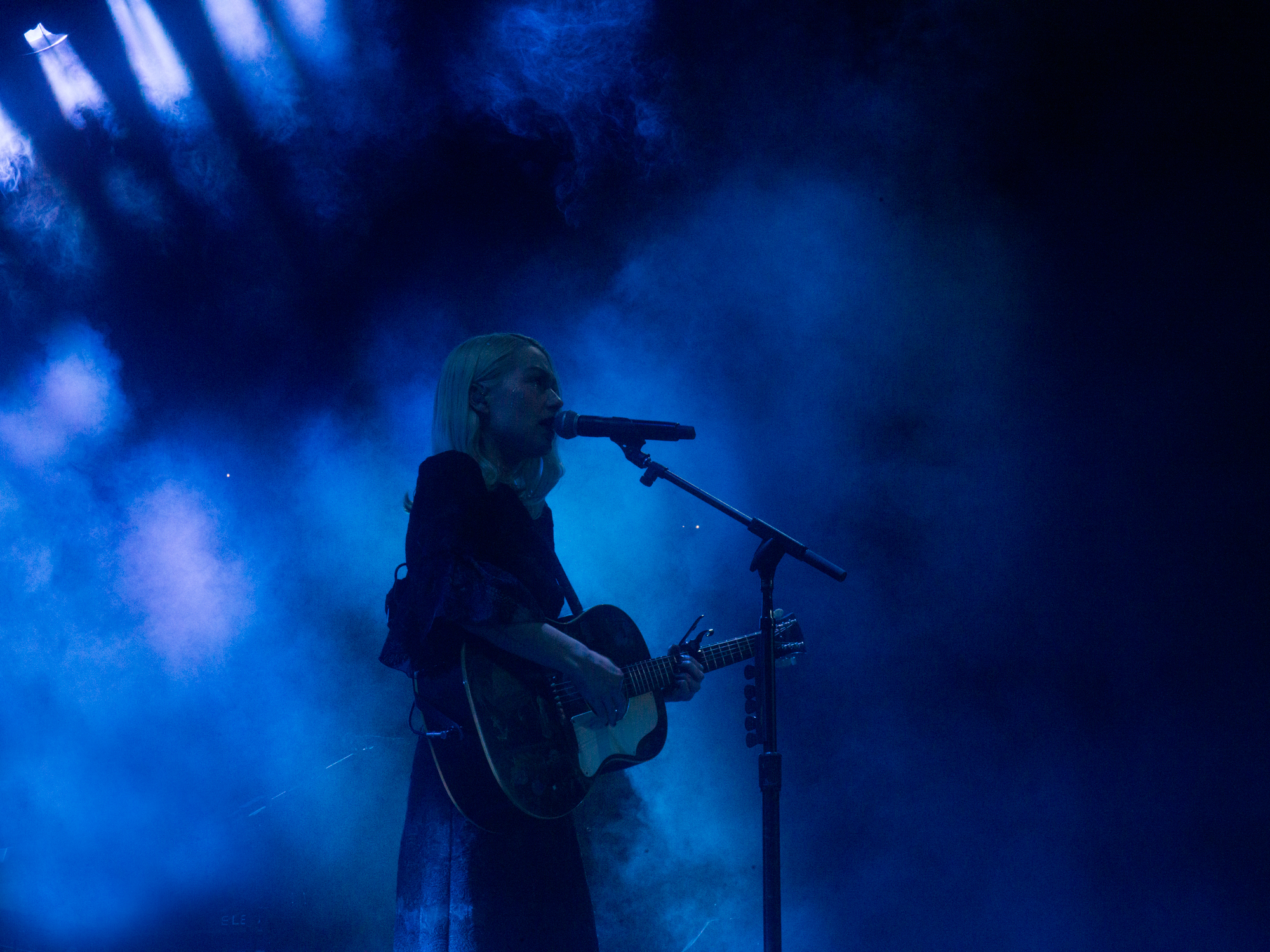
Despite the otherworldly grandiosity of the production, Bridgers herself remained endearingly earthbound. Her recorded music often sounds as though it were crafted by ghosts—hushed, haunted, and distant—yet her stage persona is disarmingly human and sharply self-deprecating, making it easy to forget both qualities stem from the same person. Every so often, she would drop from her airy soprano into her signature low speaking register to deliver a deadpan, gruff “hello,” as if casually chatting across a kitchen table rather than commanding an arena. When she fumbled the opening chords of a song, she muttered a quick, unapologetic “—fuck—” and simply started over from the top.
Midway through the evening, Bridgers addressed the phone-free policy not as a grand, high-handed artistic mandate, but rather as an imposition she deeply appreciated her fans enduring.
“I can’t tell you how much I appreciate that you put your phones away for this,” she confessed to the quiet crowd. “I had a shitty couple of years. My dad died, and it was at a time where I was getting a lot more attention than I am used to,” she added, alluding to the intense public scrutiny surrounding her personal, romantic, and familial life. “I developed this hatred in me. I worked through a lot of that on this album. To have it received so well is so personal and overwhelming. It makes it the opposite of bad,” she offered with a quiet laugh, before transitioning immediately into one of the most vulnerable performances of her career.
During “Still Standing,” a devastating track navigating themes of trauma, grief, and fragile forgiveness, Bridgers performed entirely solo with an acoustic guitar beneath a solitary overhead spotlight. A glowing aquamarine ring circled her boots on the stage floor, creating the uncanny optical illusion that she was being gently pulled upward into a spacecraft.
“You left your suitcase by the bed / like you needed to know you could go whenever you wanted,” she sang softly. The massive arena fell completely still. Not a single person reached their arms above their neighbor to capture a shaky recording through a glowing rectangle. No one whispered or murmured. The entire audience was thoroughly transfixed, granting her the uninterrupted emotional space to deliver something extraordinarily raw before letting it dissolve into the silence.
In that singular moment, the purpose of the phone ban crystallized. It was never a hollow marketing gimmick or an artificial engineering of exclusivity; it was the essential condition Bridgers required to perform material this intensely personal night after night—and for the audience to genuinely receive it. It proved to be a profound exchange of courtesy between artist and listener.
During “As Above,” piercing laser beams shot outward from the central nest-like structure, stretching across the entirety of the Barclays Center walls so that fans could reach out and pass their hands through the milky RGB glow. As Bridgers screamed the lyric, “You don’t have to believe in magic / leave it to me and I’ll make it happen,” shimmering silver snow drifted down from the ceiling.
During “Lost Weekend,” the vocals dropped out entirely, and the instrumentation surged into a chaotic swell of strange chords and sonic distortion. Instantly, the arena filled with colorful projections that flickered across every available surface, drawing audible gasps from the crowd.
As if the evening’s surprises weren’t enough, Bridgers treated the room to an unreleased track: “On Video,” a brand-new song from her upcoming project Primetime scheduled to drop at midnight. For once, hearing that a song would be released at midnight actually meant waiting until midnight. There was no pre-existing video clip circulating online; for a few precious hours, the song existed exclusively as an ephemeral shared memory.
Then, the persistent rumors proved true. Lucy Dacus and Julien Baker emerged from the wings to join Bridgers on stage, sending the arena into absolute hysterics.
“It was so hard to get through the previous song knowing they were coming out,” Bridgers admitted afterward with a grin. “I was like, hehehe!”
The trio smiled and laughed through a triumphant two-song mini-reunion, radiating as much joy as the screaming fans beneath them. When the three-way kiss occurred—a moment that would inevitably make the rounds on social media the following morning via word of mouth—the crowd roared with approval.
For the encore, Bridgers returned for a stirring rendition of “Scott Street,” dressed in stark white with her glittering tears exaggerated into angel-wing patterns across her cheeks. After two hours of carefully controlled darkness, the house lights finally illuminated the entire arena. Suddenly, thousands of strangers could see one another clearly, waving their arms in unison and chanting the familiar refrain: “Anyway, don’t be a stranger.”
The night vanished in what felt like an instant. Reclaiming my phone at the exit, I turned it on to discover that two full hours had simply evaporated. All around me, fans streamed out into the Brooklyn night with streaked makeup from unabashed tears.
So often, attending a concert brings an overriding urge to hoard pieces of the experience: a clip, a photograph, tangible proof of attendance. On Thursday, there was no choice but to let it go. And somehow, the entire room felt richer, more generous, and remarkably hopeful because of it.