






This month, the global fashion landscape faces a convergence of economic, environmental, and cultural pressures. From the turbulent stock market debuts of ultra-fast-fashion giants to the quiet retreat of size-inclusive collections, the industry is grappling with fundamental questions about its future. At the same time, investigative reports and market shifts reveal deep systemic flaws in how sustainability and circularity are financed, leaving smaller conscious brands and vulnerable supply chain workers to shoulder the heaviest burdens.
As consumers navigate these shifting trends, the tension between profitability and ethical responsibility has never been more pronounced.
SHEIN Shares Slide on Fast-Fashion Retailer’s Stock Market Debut
The ongoing saga of ultra-fast-fashion giant SHEIN took a fresh turn this month with its long-anticipated debut on the Hong Kong stock exchange. In the immediate minutes following its market launch, SHEIN’s stock slid by as much as 10%, dealing an early blow to the company’s overall valuation.
This rocky public market entry represents only the latest hurdle for the controversial retailer in its quest to go public. Prior attempts by SHEIN to float shares on the major stock exchanges in New York and London were repeatedly blocked or stalled amid intense scrutiny and mounting questions regarding its opaque supply chain practices, environmental footprint, and allegations of labor exploitation.
Industry analysts are watching the Hong Kong debut closely to see how public market investors will ultimately price the environmental and regulatory risks associated with the ultra-fast-fashion business model. For years, SHEIN has relied on a hyper-responsive, demand-driven manufacturing model based in China, churning out thousands of new styles daily at exceptionally low prices. However, as international regulators tighten oversight on forced labor, carbon emissions, and customs loopholes like the de minimis exemption, the path to maintaining a high valuation as a publicly traded entity is proving increasingly treacherous.
While Volunteers Keep Charity Shops Alive, a Billionaire Prince is Profiting
Beyond the glitz of stock market listings, the darker side of global textile waste continues to generate systemic inequalities. A compelling recent investigation by Tansy Hoskins, published in The Telegraph, has shed light on an unexpected beneficiary of the global secondhand clothing trade: the Crown Prince of Liechtenstein.
The investigative long-read examines the complex, opaque financial and corporate structures behind the clothing export business. It reveals that substantial profits derived from exporting unsellable, heavily worn clothing donated by well-meaning citizens to local charity shops—often maintained by unpaid volunteers—are ultimately flowing upward to ultra-wealthy royalty.
The findings underscore the profound disconnect at the heart of the circular economy narrative. While charity shops are widely celebrated as pillars of community-driven sustainability and charitable fundraising, the downstream realities of textile recycling and global rag trading involve multi-million-dollar supply chains. In these networks, the surplus clothing that cannot be absorbed by local markets is baled, shipped across borders to the Global South, and monetized, often leaving charitable organizations with pennies while private entities and high-net-worth individuals reap the financial rewards.
Why Fashion’s Economics Work Against Sustainable Brands
While ultra-fast-fashion giants navigate public offerings and massive conglomerates dominate global market share, smaller independent brands attempting to build a genuinely sustainable business model are finding the macroeconomic environment hostile.
The recent, high-profile bankruptcy of MUD Jeans has reignited critical conversations across the industry. Writing for Business of Fashion, Shayeza Walid explored the deep structural challenges that sustainable and circular brands face daily, noting that these companies are forced to shoulder the disproportionate costs associated with circularity, take-back schemes, and end-of-life care for garments.
"Asking individual businesses to build a more sustainable fashion system will only get the industry so far if the economics of the existing one continue to reward making and selling more," Walid writes.
Traditional fashion economics are built on linear models of extraction, production, and disposal, where externalized environmental and social costs are absorbed by society rather than the corporation. Sustainable brands that attempt to internalize these costs—by utilizing certified organic fibers, paying living wages, and designing garments for recycling—face immense difficulty competing on price with legacy brands that rely on cheap virgin materials and disposable production cycles. Without systemic policy interventions, financial incentives, or infrastructure support for circularity, the economic deck remains heavily stacked against conscious innovators.
Where Did all the XXL Clothes Go? Fashion Brands are Scrapping Plus Sizes in the GLP-1 Era
Cultural shifts are also directly impacting clothing availability. In the United States and other key markets, the rapid rise and widespread adoption of new weight-loss and diabetes medications, commonly known as GLP-1 receptor agonists, have coincided with a noticeable trend in the retail sector: the quiet reduction or outright scrapping of size-inclusive fashion ranges.
As a growing segment of the population experiences significant weight loss, fashion brands are recalibrating their inventory, leading to a shrinking availability of XXL and plus-size garments on retail racks. This pullback has left many consumers struggling to find properly fitting clothes, forcing them to turn increasingly to secondhand marketplaces and specialized peer-to-peer apps to source items in their sizes.
While certain retailers have publicly blamed falling sales or a lack of direct consumer demand for the reduction of their extended-size lines, industry experts and consumer advocates strongly dispute this narrative. Independent data suggests that consumer demand for size inclusivity remains robust and that finding well-fitting, stylish clothing continues to be a major hurdle for a significant portion of the shopping public. Critics argue that the retreat from size inclusivity reflects corporate risk aversion and a reluctance to invest in the complex grading and pattern-making required to properly serve diverse body types.
Global Fashion Brands’ Purchasing Practices Are Shifting Financial Pressure of Decarbonisation Onto Suppliers
Environmental commitments made in corporate boardrooms are likewise failing to translate into equitable practices on the ground. A recent tracking report by the Business and Human Rights Resource Centre has examined the real-world impacts of global fashion brands’ decarbonization initiatives on their manufacturing supply chains.
The findings indicate that, across the board, the substantial financial costs required to transition facilities to renewable energy, upgrade machinery, and reduce greenhouse gas emissions are being shifted downward onto suppliers. Major brands frequently demand that their manufacturing partners meet stringent environmental targets without providing corresponding financial assistance, long-term contracts, or higher purchasing prices to cover the investments.
Furthermore, labor leaders and human rights advocates have raised serious concerns that while corporate sustainability departments are heavily focused on carbon metrics and supply chain decarbonization, these initiatives do not necessarily correlate with improvements in factory working conditions, wage increases, or labor rights. Without reform in brand purchasing practices, the green transition risks exacerbating the financial precarity of garment workers and suppliers in manufacturing hubs across the Global South.
‘Good’ Brand Svala Creates New Material For Vegan Tote Bag
Amid these systemic industry challenges, certain independent labels continue to innovate with alternative materials and transparent manufacturing processes. Among them is the consciously rated brand Svala, which recently confronted supply chain disruptions when several of its long-relying next-generation materials, including MIRUM and Piñatex, became commercially unavailable.
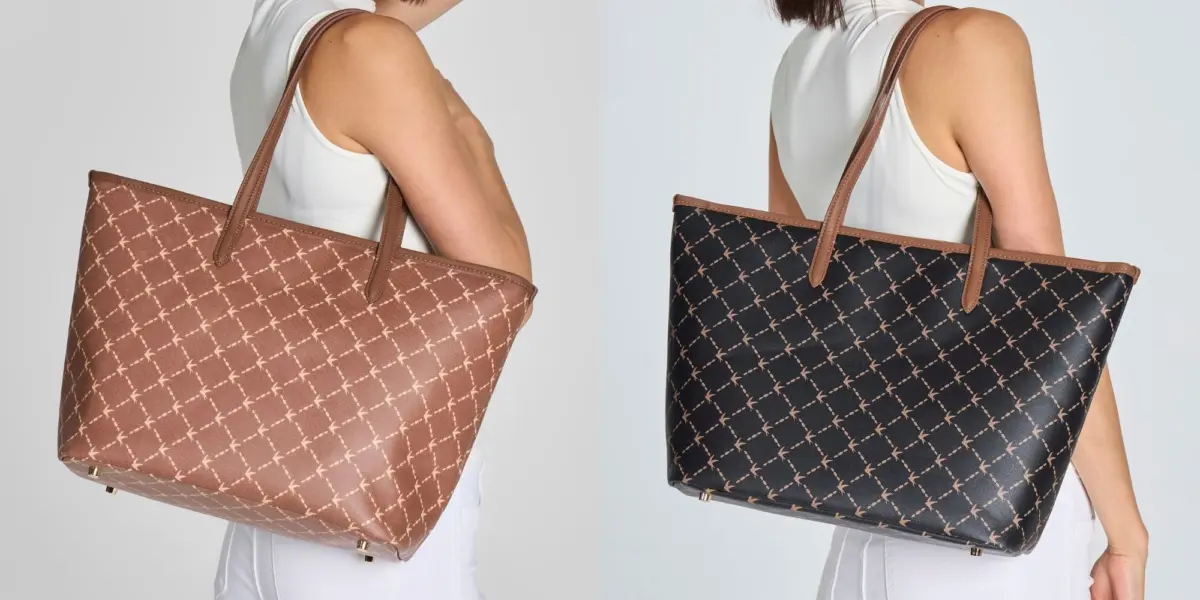
Rather than reverting to conventional synthetics, Svala partnered closely with a specialized supplier to develop a new vegan tote bag named the Vita. The bag is crafted from a novel printed coated canvas made of GOTS-certified organic cotton, finished with a durable, PVC-free TPU coating.
The material is produced in collaboration with a specialized coated-canvas manufacturing partner located in China, which is currently working toward achieving full B Corporation certification by 2027. This development highlights the persistent hurdles and adaptive problem-solving required of independent brands striving to maintain strict ethical and environmental standards in a volatile global supply chain.