





For 50 years, the upper echelons of the luxury market have consistently signaled what comes next for the broader world. From groundbreaking automotive engineering and supersonic commercial flight to revolutionary shifts in fashion silhouettes and culinary arts, high-end design has continually redefined how society lives, travels, and consumes. Over the last five decades, a select group of 74 objects, individuals, locations, and experiences have emerged to define an era of modern affluence and cultural transformation.

The roots of this half-century evolution trace back to the mid-1960s, a period when traditional craft practices began giving way to industrial efficiency. In 1965, Rolls-Royce broke nearly six decades of coachbuilding tradition with the introduction of the Silver Shadow. Moving away from custom bodywork on rolling chassis, the automaker embraced monocoque construction, integrating body and chassis into a single, unified structure. Designed by John Blatchley and powered by a 6.2-liter V-8 engine, the Silver Shadow offered a shorter wheelbase than its predecessor, the Silver Cloud, while dramatically expanding cabin space and delivering a vastly superior, quieter ride. The vehicle’s enduring relevance was cemented a decade later when it graced the inaugural cover of Robb Report in 1976.

As the 1970s unfolded, cultural shifts began altering daily life, travel, and personal style. In 1976, commercial aviation entered the supersonic age with the launch of the Concorde. Cruising at Mach 2.04—roughly 1,354 mph—the Anglo-French airliner cut the flight time between London and Washington, D.C., by more than half, flying at 60,000 feet where passengers could catch a glimpse of the Earth’s curvature. Despite its cramped cabin and high operating costs, the Concorde represented the ultimate expression of buying back time for executives and celebrities until its final flight in October 2003.

That same year, the culinary world experienced a seismic shock on May 24, 1976, during the "Judgment of Paris" blind tasting organized by British wine merchant Steven Spurrier. When a panel of French critics awarded top honors to California’s 1973 Chateau Montelena Chardonnay and 1973 Stag’s Leap Wine Cellars Cabernet Sauvignon, it shattered the European monopoly on fine wine and firmly placed Napa Valley on the global map. Concurrently, the Swiss watch industry faced a quartz crisis, prompting Patek Philippe to launch the Gérald Genta-designed Nautilus 3700/1A in 1976. As formal attire gave way to tailored jackets and sportier steel bracelets, the all-steel mechanical watch—initially a bold gamble priced at $3,100—became the blueprint for the luxury sports watch category, commanding six-figure sums on the secondary market decades later.

The decade’s nightlife and social architecture were similarly upended in April 1977 with the opening of Studio 54 at 254 West 54th Street. Co-founded by Steve Rubell and Ian Schrager, the nightclub became the epicenter of the disco era, fusing celebrity culture, theatrical spectacle, and strict, capricious door policies where the ultimate luxury was simply gaining access.

The 1980s ushered in a new wave of ambition, pop culture, and design disruption. In the hospitality sector, Bill Kimpton opened San Francisco’s Bedford Hotel in 1981, while Schrager and Rubell followed with Morgans in New York in 1984, effectively inventing the boutique hotel. By prioritizing sharp design, buzzy public spaces, and social energy over sheer square footage, these visionaries permanently altered luxury hospitality.

In the art world, 1982 marked the global breakout of 21-year-old Jean-Michel Basquiat, who became the youngest artist to exhibit at Documenta in Kassel, Germany, before launching a legendary friendship and artistic collaboration with Andy Warhol. Meanwhile, the executive class found its ultimate status symbol in 1984 with the release of the Motorola DynaTAC 8000X. Weighing nearly two pounds and priced at $3,995, "The Brick" offered 30 minutes of talk time and served as a conspicuous badge of corporate clout, famously wielded by Gordon Gekko in Oliver Stone’s 1987 film Wall Street.

The automotive and fashion landscapes saw parallel revolutions in 1984. Pininfarina styled the Ferrari Testarossa, whose aggressive side strakes and 380-hp flat-12 engine capable of 180 mph made it a permanent icon of 1980s pop culture, amplified by its starring role in Miami Vice. That same year, an encounter 30,000 feet in the air between actress Jane Birkin and Hermès executive chairman Jean-Louis Dumas on a flight from Paris to London led to the sketching of the Birkin bag on an airsickness pouch—creating one of the most elusive and enduring status symbols in fashion history.

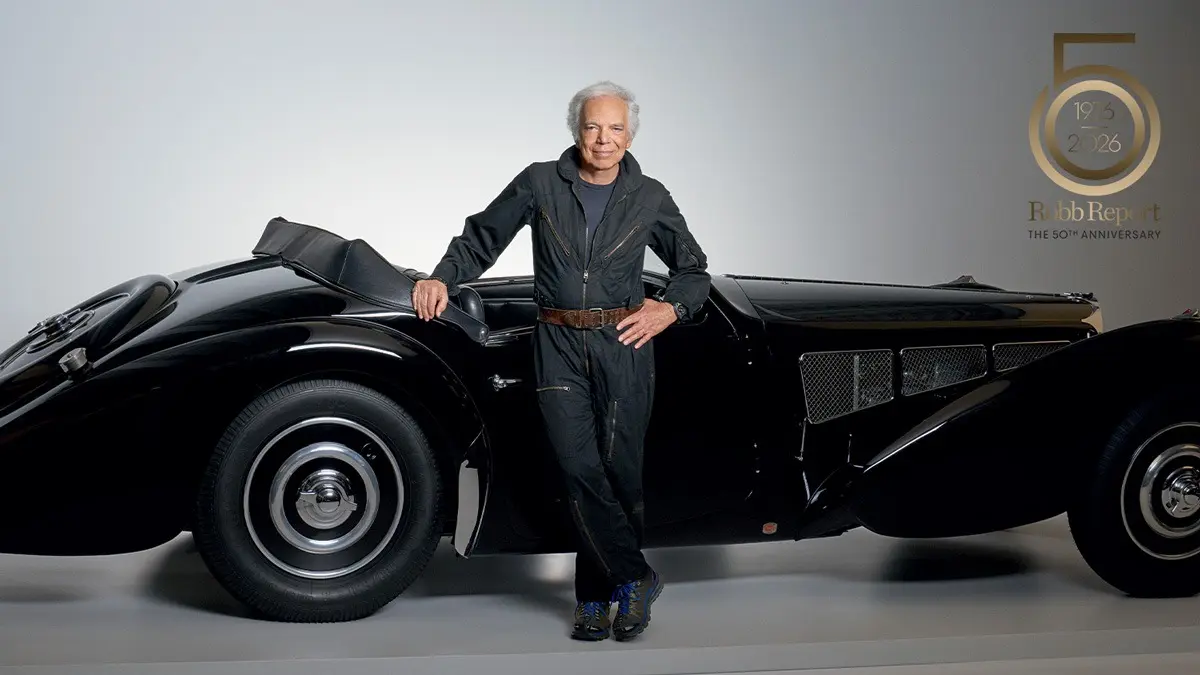
The latter half of the decade saw Ralph Lauren open his flagship store inside the historic Rhinelander mansion in Manhattan in 1986, setting a new benchmark for immersive retail and lifestyle branding. That same year, Riedel introduced Vinum, the world’s first varietal-specific, machine-made crystal wine glasses, democratizing fine wine service in restaurants globally. Executive Aviation also pioneered fractional aircraft ownership in 1986 through NetJets, transforming private jets from capital assets into accessible services that eventually scaled to a massive global fleet under Warren Buffett’s Berkshire Hathaway.

Culinary standards shifted dramatically in 1987 when a 24-year-old Marco Pierre White opened Harveys in London. Pairing formidable French technique with a punk-rock persona, White became the youngest chef at the time to earn three Michelin stars, inspiring a generation of cooks through his seminal memoir, White Heat. In 1988, Adrian Zecha redefined ultra-luxury hospitality with the opening of Amanpuri in Phuket, Thailand, establishing a blueprint of remote, intimate, low-density pavilions and high staff-to-guest ratios that birthed the devoted subculture of "Amanjunkies." In watchmaking, Rolex solved its lack of an automatic chronograph movement in 1988 by turning to Zenith’s legendary El Primero caliber—saved from destruction during the quartz crisis by watchmaker Charles Vermot—to power the new Daytona, creating an enduring object of desire.

The 1990s brought monumental shifts across design, architecture, and collecting. In 1990, the 344-foot superyacht Lady Moura, built by Blohm+Voss for Saudi businessman Nasser Al-Rashid, revolutionized yachting by introducing a beach club with a hydraulic swim platform, dedicated owner’s deck, and residential luxuries that recast superyachts as floating family homes. In 1991, Damien Hirst shocked the art world with The Physical Impossibility of Death in the Mind of Someone Living, suspending a tiger shark in formaldehyde at London’s Saatchi Gallery and shifting contemporary art’s center of gravity toward the UK.

Automotive engineering reached a pinnacle in 1992 with the debut of Gordon Murray’s 627-hp McLaren F1. Featuring a central driving position and a naturally aspirated V-12 capable of 240 mph, the F1 remains a masterwork of analog hypercar performance. That same year, Richard James opened on Savile Row, injecting vibrant colors, unconventional fabrics, and a slimmer silhouette into traditional British bespoke tailoring.

Hospitality and architecture continued to evolve in 1993 and 1994. The Hotel du Cap-Eden-Roc transformed its oceanfront pool into the modern infinity pool, creating a gravity-defying design trend imitated across five-star resorts worldwide. In 1994, Thomas Keller purchased the French Laundry in Yountville, California, expanding multi-course tasting menus and establishing a rigorous standard of American fine dining that trained generations of culinary leaders. Simultaneously, Ralph Lauren introduced Purple Label, offering tailored menswear with an American sensibility that offered a sharp alternative to prevailing 1990s grunge aesthetics.

Tom Ford took the creative reins at Gucci for the spring-summer 1995 collection, injecting a dark, unapologetic sensuality into the historic brand with jewel-toned satins and velvet hip-huggers that propelled the label to commercial dominance. In 1996, the final Riva Aquarama Special marked the end of an era for Carlo Riva’s mahogany runabouts, paving the way for the fiberglass Aquariva in 2000.

Architecture achieved a watershed moment in 1997 with the opening of Frank Gehry’s Guggenheim Bilbao, giving rise to "the Bilbao effect"—the concept that a single cultural landmark could entirely revitalize a city’s economic and cultural fortunes. That same year, Napa Valley cult Cabernets reached legendary status when Robert Parker awarded a 100-point score to the 1997 vintage of Screaming Eagle, setting off a secondary-market buying frenzy.

As the decade closed, Las Vegas was radically transformed by the 1998 opening of Steve Wynn’s Bellagio, an upscale resort that replaced the city’s down-market reputation with Italianate luxury and blue-chip art. In aviation, the first Boeing Business Jet entered service in late 1998, combining 737 airframes with intercontinental range to establish the ultra-large bizliner category. Horology also witnessed the birth of independent watchmaking titans: Collection Privée Cartier Paris launched in 1998 to revive historic shaped watches, while François-Paul Journe debuted his namesake brand in 1999 with the Tourbillon Souverain à Remontoir d’Égalité, redefining independent haute horlogerie.

The turn of the millennium welcomed a new era of cocktail culture, fashion minimalism, and culinary experimentation. On New Year’s Eve 1999, Sasha Petraske opened Milk & Honey on New York’s Lower East Side, launching the modern speakeasy craze through classic cocktail precision and strict behavioral rules. In 2001, Hedi Slimane debuted his knife-slim tailoring at Dior Homme, banishing voluminous cuts and reshaping menswear silhouettes globally. Concurrently, the molecular gastronomy movement—anchored by Ferran Adrià at El Bulli, Heston Blumenthal at the Fat Duck, and Grant Achatz at Alinea—applied scientific principles to subvert culinary expectations through foams, spherification, and unexpected textures.

Brunello Cucinelli expanded into full menswear design in 2002, elevating cashmere and casual luxury to match changing lifestyle needs. In 2003, Soho House expanded to North America by opening its New York club in the Meatpacking District, setting the standard for creative, members-only hospitality. That same year, Takashi Murakami collaborated with Marc Jacobs to reimagine the Louis Vuitton monogram in 33 vibrant colors, fusing fine art and luxury fashion. In Copenhagen, René Redzepi opened Noma in 2003, spearheading the New Nordic culinary movement through foraging and fermentation before stepping down amid industry controversies two decades later.

Maritime and automotive achievements marked the mid-2000s. Paul Allen’s exploration yacht Octopus, delivered in 2003, redefined superyachts by combining luxury amenities with ice-class expedition capabilities, submarines, and scientific research facilities. Simultaneously, the Rolls-Royce Phantom VII inaugurated a new golden age for the marque under BMW stewardship. In 2005, Loro Piana introduced the Summer Walk shoe, pioneering the understated aesthetic of quiet luxury, while the Bugatti Veyron 16.4 arrived with an 8.0-liter quad-turbocharged W16 engine delivering 987 hp and a top speed of 253 mph.

Private aviation and luxury hospitality continued to innovate in 2006 with the debut of the Eclipse 500 very light jet and the opening of Cheval Blanc Courchevel by LVMH, which pushed five-star hospitality into ultra-customized territory. That same year, the sailing yacht Maltese Falcon introduced the automated FalconRig with freestanding carbon-fiber masts, while Patek Philippe released the Nautilus Ref. 5711/1A-001 for its 30th anniversary, transforming Gérald Genta’s steel design into an unprecedented cultural phenomenon.

The late 2000s and 2010s were defined by private social clubs and unprecedented art and watch valuations. Monticello Motor Club opened in 2008 as the pioneer of private racetrack clubs, offering members testing grounds combined with luxury amenities. In 2010, Creed released Aventus, creating one of the most influential and enduring men’s fragrances of the century. The art market reached soaring heights in November 2013 when Jeff Koons’s Balloon Dog (Orange) sold at Christie’s New York for $58.4 million, setting an auction record for a living artist. Later that year, McLaren, Ferrari, and Porsche simultaneously unveiled the P1, LaFerrari, and 918 Spyder, ushering in the modern hybrid supercar era.

Watchmaking milestones continued with the 2014 introduction of the Patek Philippe Grandmaster Chime Ref. 5175, featuring 20 complications across 1,366 components, and the 2017 auction of Paul Newman’s personal Rolex Daytona Ref. 6239 at Phillips for a record $17.75 million. In November 2017, Leonardo da Vinci’s Salvator Mundi shattered fine art auction records by selling at Christie’s for $450.3 million. That same year, streetwear formally infiltrated the C-suite with the Supreme x Louis Vuitton collaboration under menswear designer Kim Jones, and Lamborghini launched the Urus, creating the sport-utility supercar segment.

Virgil Abloh took the reins as men’s artistic director at Louis Vuitton in 2018, permanently altering the intersection of luxury, youth culture, and high fashion before his untimely passing in 2021. Meanwhile, the luxury hospitality sector witnessed the rise of the post-pandemic "supervilla" and private spaces like San Vicente Bungalows in Los Angeles, which enforced strict no-photo policies to preserve exclusivity.

Entering the 2020s, heritage houses found new avenues for cultural dominance. The 2021 release of the Patek Philippe x Tiffany & Co. Nautilus Ref. 5711/1A-018—featuring Tiffany Blue dials and culminating in a $6.5 million charity sale at Phillips—created a global watchmaking frenzy. Concurrently, LVMH repositioned Jean Schlumberger’s mid-century Bird on a Rock brooch as a staple for A-list men on modern red carpets.

As the luxury landscape progresses through the mid-2020s, marine and jewelry design continue to break molds. Benetti’s 213-foot B.Loft 65M, introduced in 2024, replaces traditional compartmentalized yacht interiors with soaring multilevel spaces inspired by urban lofts. Meanwhile, Van Cleef & Arpels’ Alhambra motif, introduced in 1968, has evolved into a ubiquitous modern status symbol worn across generations and genders, from elite athletes to hip-hop artists, proving that enduring design remains the ultimate currency of luxury.