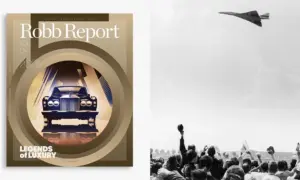





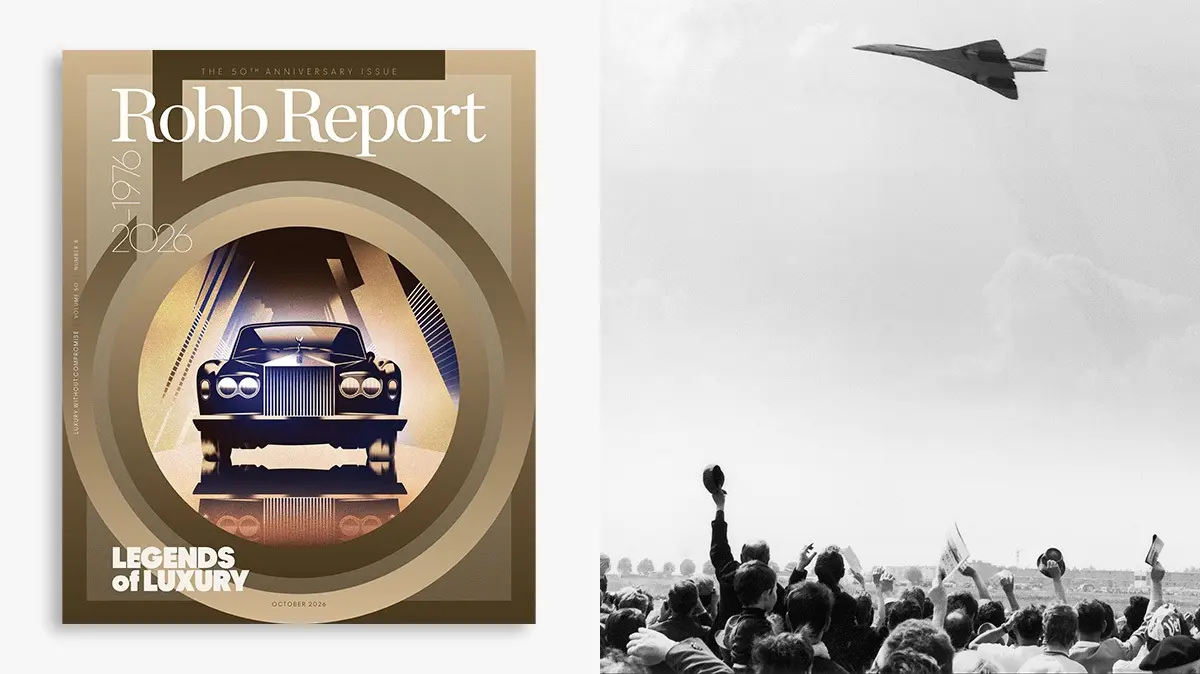
On January 21, 1976, the very year Robb Report was founded, the Concorde supersonic jet began commercial passenger flights, cutting the transatlantic journey down to a breathtaking three and a half hours at twice the speed of sound. While it would be a stretch to claim some grand, cosmic design behind the synchronicity, it stands as a fitting historical coincidence. Just as the Concorde was radically shrinking the globe, a new publication emerged to chronicle such unprecedented feats of human daring, engineering, and ambition.
Now, half a century later, Robb Report is celebrating its landmark 50th-anniversary issue. Any media institution still thriving after five decades has more than earned the right to look backward with a degree of nostalgia. Consequently, when editors and writers began assembling "Legends of Luxury," the expansive feature at the heart of this milestone edition, the goal was initially conceived as a sprawling retrospective—an opportunity for reminiscence and a celebration of bygone eras.
However, diving deep into the archives and sifting through five decades of history revealed something far more compelling than mere sentimentality. The 74 distinct objects, visionary individuals, defining places, and unforgettable experiences selected for the retrospective were never isolated novelties. Instead, they served as unmistakable harbingers of the future, offering a direct window into a world that was about to transform how humanity communicates, dresses, travels, dines, and chases thrills.

Consider, for example, the introduction of the Motorola DynaTAC 8000X. When the world’s first commercial handheld cellular telephone hit the market in 1984, it commanded a staggering price tag of just under $4,000—equivalent to roughly $12,000 today—and tipped the scales at nearly two pounds. Owning one was an unequivocal status symbol, a privilege reserved for the financial elite and ambitious trailblazers. If an individual could afford what quickly became known as "the Brick," they invariably made certain that everyone around them saw them using it. Pop culture immortalized the device through characters like Gordon Gekko, cementing its place in the zeitgeist. Fast-forward to the present day, and its sleek smartphone successors have achieved a level of ubiquity that arguably surpasses even television sets. What began half a century ago as an ultra-exclusive luxury has seamlessly transitioned into an indispensable modern necessity.
Of course, profound innovation has never relied exclusively on microchips and digital connectivity. In the late 1970s, legendary Italian designer Giorgio Armani executed a quiet revolution in menswear by stripping the rigid internal structure out of the traditional tailored suit. By softening the shoulders and loosening the trousers, Armani created a silhouette that was simultaneously louche and sophisticated. Hollywood quickly recognized its cinematic potential, adopting the look for sharply dressed characters navigating high-stakes worlds. At the time, the relaxed tailoring felt genuinely radical, challenging decades of sartorial convention. Today, that ease has simply been absorbed into the modern man’s everyday wardrobe, demonstrating how high-end design can permanently alter global fashion norms.
Other cultural shifts arrived as bold culinary experiments that risked total failure before ultimately upending entire industries. At the renowned Spanish restaurant El Bulli, visionary chef Ferran Adrià deployed food science to aggressively scramble diners’ expectations of what a meal could physically and sensorially be. While a wave of bad imitations eventually reduced molecular gastronomy to a tired punch line involving artificial foams, fleeting fogs, and controversial ingredients like meat glue, the foundational rigor of Adrià’s work survived. The most successful elements of his philosophy endured, profoundly influencing a new generation of boundary-pushing chefs worldwide and permanently expanding the vocabulary of modern fine dining.

A similar evolution reshaped the maritime world with the arrival of Octopus, a staggering 414-foot vessel commissioned by the late Microsoft co-founder Paul Allen. When the Lurssen-built mega-yacht was delivered in 2003, it fundamentally redefined luxury seafaring by pairing traditional superyacht amenities with the rugged capabilities of a serious oceanographic expedition ship. It was engineered to travel virtually anywhere on Earth, effectively making exploration itself the primary purpose of ownership, even if traditional pastimes like sunbathing at anchor remained firmly on the itinerary. In the years since, explorer yachts have transitioned from bespoke oddities into standard staples in the portfolios of nearly every major international shipyard.
Looking back across these milestones, it is tempting to claim that the trajectory of these innovations was obvious all along. Yet the reality of chronicling luxury and industry for half a century teaches a much more humbling lesson: predicting the future is infinitely easier in hindsight. The publication’s own historical record offers proof. Editors once boldly declared the internal-combustion engine entirely dead, only to watch it persist with stubborn vitality. Conversely, other supposedly inevitable next-big-things vanished from the cultural landscape almost as rapidly as they arrived. The sudden rise and fall of speculative digital assets like Bored Ape Yacht Club serve as a reminder that the future frequently humbles even the most astute observers.
Looking ahead another two decades, it is almost certain that at least one of the lavish extravagances highlighted in the anniversary pages will eventually become as commonplace as the smartphone is today. Meanwhile, another extravagant concept may vanish entirely, leaving behind only an influential idea that outlives the product itself. No one can accurately predict which trends will endure the test of time and which will fade into historical footnotes. Yet, after 50 years of observation, one fundamental truth remains unchanged: every so often, the future makes its initial appearance disguised as a luxury. And the publication remains as endlessly curious as ever to discover what it brings next.