






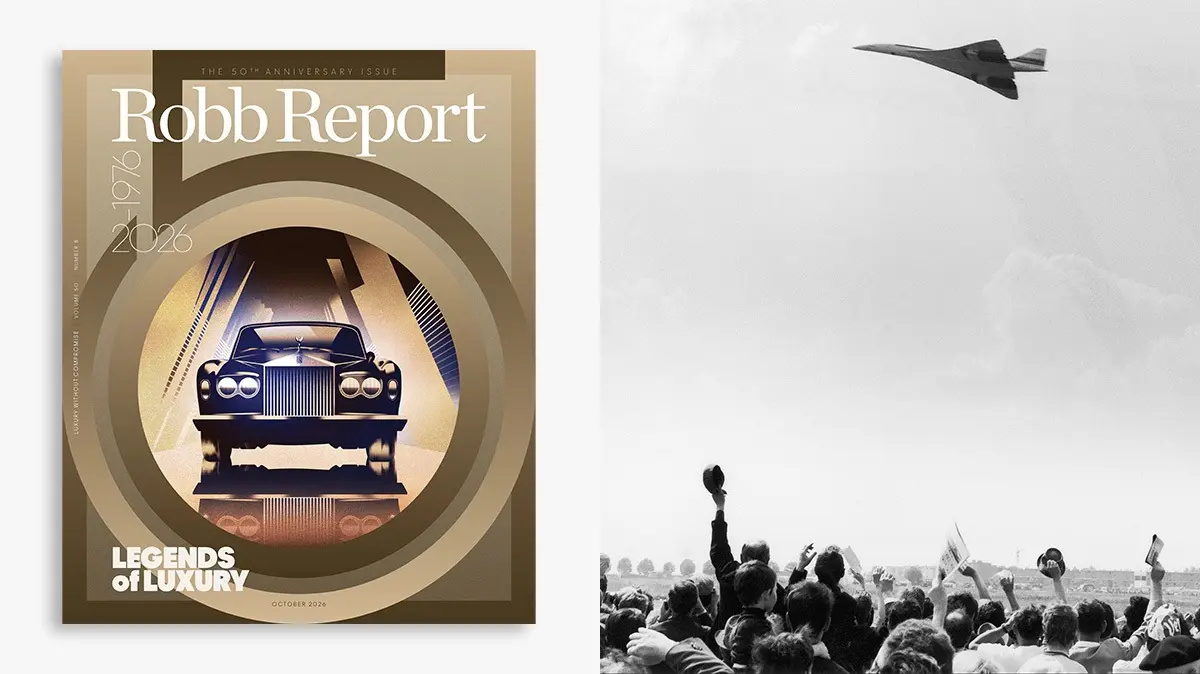
On January 21, 1976—the very year Robb Report was founded—the legendary Concorde began flying commercial passengers at twice the speed of sound. While it would be a stretch to claim some grand, cosmic significance to the exact timing of the launch, it stands as a remarkably fitting coincidence. Just as the Concorde was abruptly shrinking the Atlantic Ocean, making intercontinental travel faster than ever before, a new publication arrived to chronicle extraordinary feats of human daring, engineering ingenuity, and high-end luxury.
Now, as Robb Report marks its milestone 50th-anniversary issue, the publication is embracing the time-honored tradition of looking back over the decades. Any media outlet that manages to remain relevant and strong after half a century has earned the right to indulge in a bit of nostalgia. When the editorial team began assembling "Legends of Luxury," the sprawling feature at the heart of this commemorative issue, the goal was initially simple: create a retrospective celebration, offer a touch of reminiscing, and honor the journey.
However, sifting through five decades of history quickly revealed something far more compelling than mere memories. Many of the 74 objects, people, places, and experiences chosen for the retrospective offered a clear, unmistakable glimpse into the world that was to come. They were the early harbingers of a shifting global landscape that would permanently alter how humanity communicates, dresses, travels, dines, and chases thrills.
Consider, for instance, the Motorola DynaTAC 8000X. When the world’s first commercial handheld cellular phone hit the market in 1984, it came with a staggering price tag of just under $4,000—equivalent to roughly $12,000 today—and weighed in at a hefty two pounds. Owning one was an elite privilege reserved for the upper echelons of wealth and status. If you were fortunate enough to afford the device affectionately known as the "Brick," you almost certainly made sure that people saw you using it in public, a cultural touchstone immortalized by fictional corporate raider Gordon Gekko. Today, the smartphone successors to that clunky prototype are arguably more ubiquitous than television sets, transforming what was once an ultra-exclusive luxury into an everyday modern necessity.

Of course, profound innovation does not always rely on microchips, circuitry, or digital connectivity. In the late 1970s, legendary Italian designer Giorgio Armani revolutionized menswear by completely stripping the heavy internal structure out of the traditional tailored suit. He softened the shoulders, relaxed the cut, and loosened the trousers, creating a silhouette that was at once louche and effortlessly sophisticated. Hollywood quickly discovered that this relaxed tailoring was the ideal uniform for a very well-dressed man about town. At the time, it looked radically unconventional, pushing the boundaries of traditional sartorial norms. Today, that relaxed elegance is simply accepted as a foundational part of the modern man’s wardrobe.
Some visionary ideas flamed out spectacularly, but not before completely upending their respective fields. At the vanguard of culinary innovation was El Bulli, where chef Ferran Adrià utilized scientific principles to radically scramble diners’ expectations of what a meal could physically and sensorily be. While bad imitations and commercial overextensions eventually reduced the broader movement of molecular gastronomy to a tired punch line involving culinary foam, manufactured fog, and an unfortunate substance known as meat glue, the lasting impact remained undeniable. The best elements of Adrià’s philosophy stuck, fundamentally influencing and inspiring a brand-new generation of world-class chefs who continue to push the boundaries of gastronomy.
Then there was Octopus, measuring a staggering 414 feet in length. When the massive vessel, commissioned by late Microsoft co-founder Paul Allen and built by renowned German shipyard Lürssen, was delivered in 2003, it successfully bridged two previously distinct worlds. It paired the opulent comforts of a traditional superyacht with the rugged, heavy-duty capabilities of a serious oceanographic expedition ship. It was engineered to go virtually anywhere on the planet, helping to make genuine exploration the primary purpose of luxury maritime travel, even if sunbathing at anchor remained firmly on the itinerary. Today, explorer yachts have transitioned from eccentric novelties to a staple offering across nearly every major shipyard’s lineup.
Looking back, it would be tempting to claim that the trajectory of these innovations was obvious all along, and that editors and trend forecasters knew the exact outcome from day one. In reality, none of it looked quite so clear-cut while it was happening. As history repeatedly demonstrates, predicting the future is infinitely easier in hindsight.

The publishing team knows this reality firsthand, having once boldly declared the internal-combustion engine entirely dead—only to watch it remain very much alive and evolving. Similarly, other supposedly inevitable "next big things" have disappeared almost as quickly as they arrived, a cautionary reminder that cultural trends can be notoriously fickle. After all, digital fads come and go, leaving modern observers to wonder about the lasting power of phenomena like Bored Ape Yacht Club NFTs. The future has a consistent way of humbling even the most astute cultural commentators.
Looking forward, it is entirely possible that one of the fleeting extravagances cataloged in the pages of this anniversary issue will be as commonplace in another twenty years as the smartphone is today. Another extravagant concept may vanish entirely into obscurity, yet leave behind a singular, powerful idea that outlives the physical product itself.
There is no definitive way to know precisely which luxuries will endure and which will fade into memory. But after fifty years of tracking the apex of human achievement, taste, and ambition, one fundamental truth remains clear: every so often, the future shows up first disguised as a luxury. And as the publication enters its next chapter, the curiosity to see what the future brings next remains as strong as ever.