





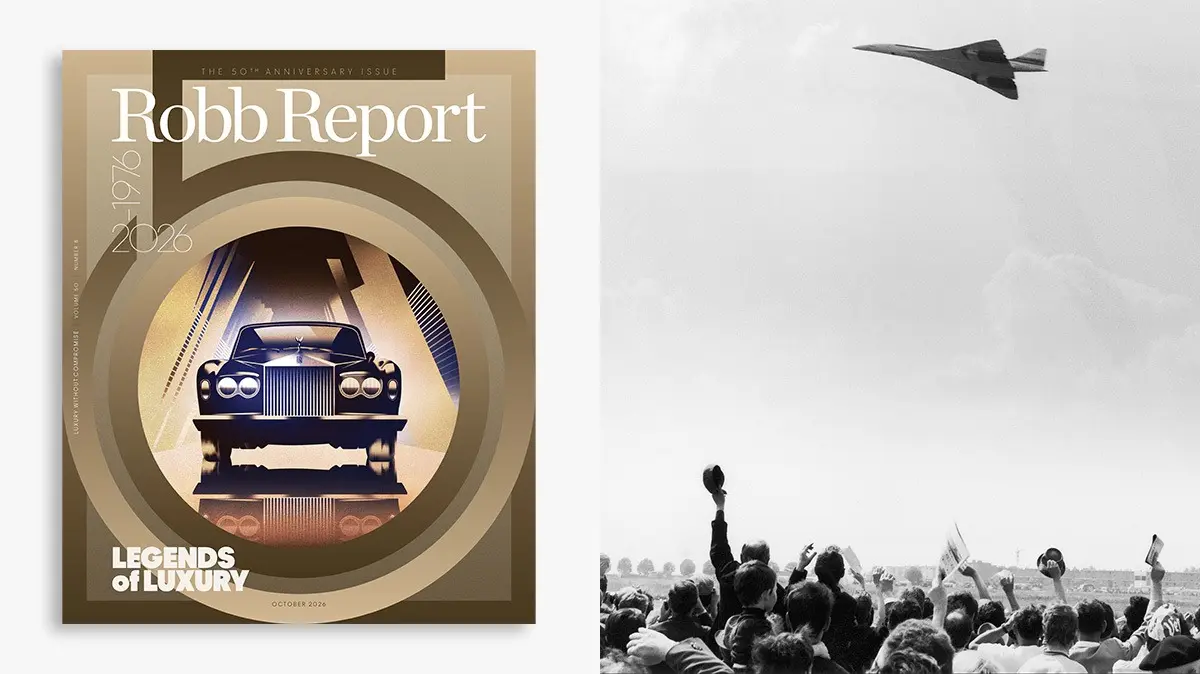
On January 21, 1976—the very year Robb Report was founded—the Concorde supersonic passenger jet began carrying commercial travelers across the Atlantic Ocean at twice the speed of sound. While it is tempting to view this timing as possessing a grand, cosmic significance, it serves as a remarkably fitting coincidence. Just as the Concorde was abruptly making the world feel much smaller by shrinking transatlantic travel times down to roughly three and a half hours, a new publication emerged to chronicle precisely those kinds of engineering feats, acts of daring, and shifts in modern high-end living.
Marking its 50th-anniversary issue, Robb Report is embracing the retrospective privilege earned by any publication that remains robust and influential after five decades. At the heart of this milestone edition is a sprawling feature titled "Legends of Luxury," designed to offer a deep dive into the past. However, what began as an exercise in nostalgia and reminiscing quickly revealed a much more compelling narrative. Upon closer inspection, many of the 74 objects, individuals, locations, and experiences selected for the retrospective served as harbingers of the modern world, quietly signaling profound changes in how society would soon communicate, dress, travel, dine, and pursue thrills.
Among these seminal developments was the introduction of the Motorola DynaTAC 8000X. When the pioneering commercial handheld cellular phone made its market debut in 1984, it came with a staggering price tag of just under $4,000—roughly equivalent to $12,000 today—and weighed nearly two pounds. Owning the device was an explicit statement of privilege. Those who could afford what was affectionately and physically known as "the Brick" ensured that others saw them using it, an aesthetic and status symbol immortalized on screen by characters like Gordon Gekko. Fast-forward to the present day, and its smartphone successors have achieved a level of ubiquity that arguably surpasses even television sets. What began strictly as an elite, high-cost luxury has systematically transformed into an indispensable everyday necessity.

Yet, innovation does not always rely on microchips or telecommunications breakthroughs to alter the cultural landscape. In the late 1970s, legendary Italian designer Giorgio Armani upended the menswear industry by stripping the internal structure out of the traditional tailored suit. He softened its shoulders and loosened its trousers, creating a silhouette that was simultaneously louche and sophisticated. Hollywood quickly recognized its potential, making it the uniform of choice for the impeccably dressed antihero. What looked radical and avant-garde on the runway decades ago has since settled comfortably into the baseline of the modern man’s wardrobe.
Other cultural earthquakes were culinary in nature, leaving behind disrupted fields even when specific iterations eventually faded. At El Bulli, visionary chef Ferran Adrià utilized scientific principles to completely scramble diners’ expectations of what a dining experience could entail. While subsequent bad imitations ultimately reduced molecular gastronomy to a frequent punch line centered around fleeting foams, atmospheric fogs, and controversial ingredients like meat glue, the foundational techniques and creative ethos survived. The best elements of that culinary revolution permanently influenced an entire new generation of chefs who continue to push the boundaries of gastronomy.
The evolution of travel and exploration also found powerful expression on the water. When the 414-foot superyacht Octopus, commissioned by the late Microsoft co-founder Paul Allen and built by Lurssen, was delivered in 2003, it redefined luxury marine architecture. The vessel successfully paired the lavish amenities of a traditional superyacht with the rugged capabilities of a serious, ocean-crossing expedition ship. It was designed to go virtually anywhere, shifting the very purpose of yachting from passive leisure to active global exploration. While sunbathing at anchor remained securely on the itinerary, so did charting courses to the most remote and forbidding reaches of the planet. Today, explorer yachts have transitioned from bespoke novelties into a staple offering across nearly every major shipyard’s global lineup.

Looking back across fifty years of cultural observation, it would be easy to claim that foresight guided every editorial choice and that these trajectories were obvious from the start. In reality, predicting the future is an exercise best executed with the benefit of hindsight. The publication’s own history offers humbling proof; editors once confidently declared the internal-combustion engine entirely dead, only to watch it remain stubbornly and very much alive. Conversely, other supposedly inevitable next big things vanished from the cultural consciousness almost as rapidly as they arrived—a reality highlighted by brief cultural manias like Bored Apes. The future, it turns out, consistently possesses a capacity to humble even the most astute observers.
Looking forward another twenty years, it is entirely possible that one of the modern extravagances currently spotlighted in the anniversary issue will become as commonplace as the smartphone is today. Alternatively, another might vanish entirely, leaving behind only an influential concept that outlives the physical product itself. While no one can definitively predict which trends will endure, half a century of publishing has yielded one enduring certainty: every so often, the future makes its initial appearance disguised as a luxury. Robb Report enters its next half-century just as curious as ever to discover what the future brings next.