






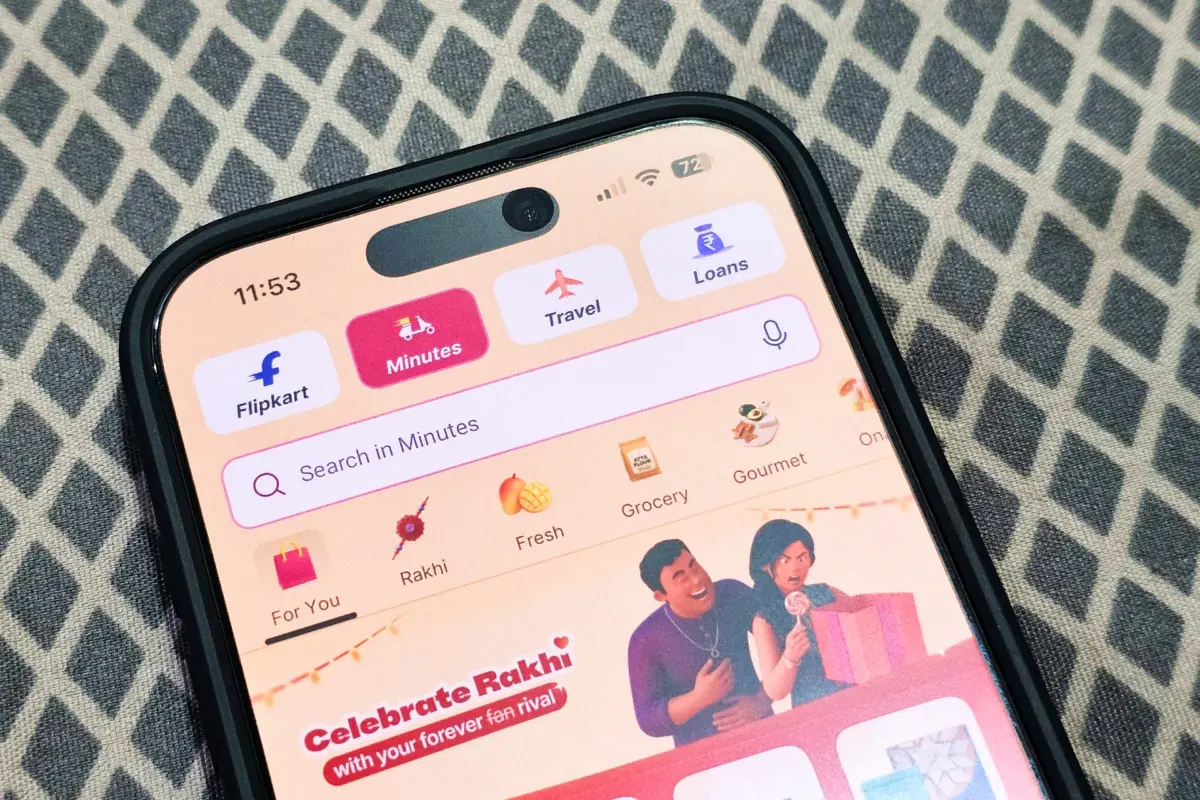
Indian startups spent years meticulously educating consumers and shaping habits to accept having groceries and everyday household goods delivered right to their doorsteps within minutes. Now, e-commerce heavyweight Flipkart—backed by retail giant Walmart—is rapidly closing the operational gap with those quick-commerce pioneers. This intense market tightening comes as global rival Amazon aggressively mounts its own high-stakes push into the realm of instant delivery across the South Asian nation.
Flipkart Minutes, which originally debuted in August 2024 as the e-commerce titan’s major foray into the hyper-competitive quick-commerce sector, has scaled dramatically. The service is now reliably delivering between 1.1 million and 1.2 million orders a day, marking a massive leap from the roughly 390,000 to 400,000 daily orders it recorded in November, according to people familiar with the matter. This explosive growth puts the relatively young service within striking distance of Swiggy’s Instamart, which currently processes about 1.4 million orders a day, according to insiders with knowledge of operations.
This narrowing gap is particularly notable because Flipkart entered the market as a latecomer. For years, the upper echelons of India’s quick-commerce sector have been firmly dominated by a trio of established specialists: Instamart, Blinkit, and Zepto. Food-delivery giant Swiggy originally launched Instamart back in 2020 promising grocery delivery within 45 minutes, while Zepto arrived on the scene the following year at the height of the pandemic with its signature 10-minute delivery model. Meanwhile, Blinkit traces its corporate lineage back to the online grocery platform Grofers, which was founded all the way back in 2013 before rebranding to focus entirely on ultra-fast logistics. Together, these three platforms have firmly entrenched themselves as India’s premier quick-commerce leaders.
Market research firm Datum Intelligence estimates that Blinkit continues to command the top spot in the market, processing roughly 3.4 million to 3.6 million daily orders. It is followed closely by Zepto, which handles about 2.4 million to 2.6 million orders daily. Flipkart, through its rapid scaling, is now quickly breathing down the neck of Instamart, which currently stands as the smallest of the three established legacy leaders by sheer order volume.
Despite facing intense pressure from latecomers, Instamart maintains a formidable operational scale. Earlier this month, parent company Swiggy reported that its quick-commerce arm boasts more than 14 million monthly transacting users and operates a sprawling network of over 1,200 dark stores spread across more than 130 cities throughout the country. Swiggy has also made significant strides in improving its financial unit economics, successfully narrowing Instamart’s contribution-margin losses. Today, more than 45% of its dark-store network operates on a positive contribution-margin basis.
To counter these entrenched players, Flipkart has aggressively fueled its growth by rapidly expanding its physical delivery infrastructure. Sources familiar with the company’s internal metrics report that Flipkart Minutes now operates between 1,020 and 1,050 micro-fulfillment centers. These facilities function as small, hyper-local warehouses strategically positioned in close proximity to residential neighborhoods specifically to manage lightning-fast logistics. This represents a massive expansion from the 600 micro-fulfillment centers the company operated in January and the mere 340 centers it maintained just a year ago. Insiders reveal that Flipkart is currently adding roughly 100 new dark stores to its network every single month, with a clear corporate target of reaching 1,500 facilities by the end of 2026.
However, Flipkart’s strategic advantages extend far beyond simply building out a massive network of dark stores. According to Satish Meena, an adviser at Datum Intelligence, the company can seamlessly tap into an enormous pool of pre-existing e-commerce customers. Having spent years and billions of dollars acquiring these shoppers for its traditional marketplace, Flipkart has effectively secured a ready-made, captive audience primed and willing to adopt faster delivery options.
“Flipkart is already a serious player,” Meena noted, emphasizing the weight of the company’s rapid deployment. “Once you open 1,000 dark stores and [are] doing a million orders per day, it’s serious enough.”
Beyond acquiring new users, Minutes is successfully fostering strong customer loyalty and retention. Industry insiders report that approximately 65% to 70% of customers placing purchases on the platform each month are repeat buyers. Furthermore, the volume of transactions completed per individual customer has climbed by 50% to 60% compared to the same period a year earlier.
Data shows that these active shoppers are spending an average of about 400 to 500 Indian rupees—roughly equivalent to $4.20 to $5.20—per order. While essential everyday items such as fresh fruits, vegetables, basic kitchen staples, dairy, and meat continue to drive the bulk of transaction volume, Flipkart is actively broadening its inventory. The platform is increasingly adding higher-end gourmet products, including organic choices and artisanal goods, in an effort to capture a larger share of consumer wallet spending during these rapid transactions.
Even as its geographic footprint and daily order volumes have expanded exponentially, Flipkart has managed to improve its operational efficiency. The service’s average delivery time has actually dropped to roughly 11 minutes, improving from an average of 13 minutes a year prior, according to internal sources.
A Battle for India’s Shoppers
Flipkart’s aggressive expansion unfolds against a broader macroeconomic backdrop where quick-commerce is fundamentally reshaping how Indian consumers approach online retail, even as traditional discretionary consumer demand has occasionally shown signs of softening. A recent report published by analysts at Bernstein highlighted that while India’s overall consumption growth cooled somewhat, the decisive consumer migration toward quick-commerce and broader e-commerce platforms continued unabated, with instant-delivery apps posting robust increases in monthly active users.
Reflecting similar strategic motivations, global e-commerce titan Amazon is fighting fiercely to carve out a meaningful market share within India’s booming quick-commerce ecosystem. The Seattle-headquartered multinational has been steadily scaling up Amazon Now, its dedicated quick-commerce offering, designed to introduce the ultra-fast delivery model directly to its massive base of legacy e-commerce shoppers.
During a corporate visit to India, Amazon CEO Andy Jassy highlighted the remarkable traction of the service. Company disclosures noted that Amazon Now had quickly become the fastest-growing business segment for the firm in India, with order volumes doubling every single quarter since its initial rollout. Looking ahead, Amazon has outlined ambitious capital expenditure plans to introduce the service to more than 300 cities. This expansion will be supported by a planned network of over 1,000 micro-fulfillment centers, supplemented by larger hub facilities designed to significantly widen the catalog of products that can be delivered to doorsteps within minutes.
Representatives for Flipkart, Amazon, Swiggy, Zepto, and Blinkit parent company Eternal all declined to comment when approached regarding their operational metrics and competitive strategies.
According to retail analysts like Meena, this widespread rush into quick-commerce is driven by a potent mix of offensive market capture and defensive necessity. As modern urban consumers grow accustomed to the unmatched convenience of receiving everyday purchases almost immediately, traditional e-commerce giants face a severe commercial risk. If they fail to offer comparable speed and convenience, they stand to lose those frequent, high-value transactions entirely to dedicated quick-commerce disruptors.
“Can you go back to scheduled delivery now in grocery? No,” Meena concluded. “You will not go back.”