



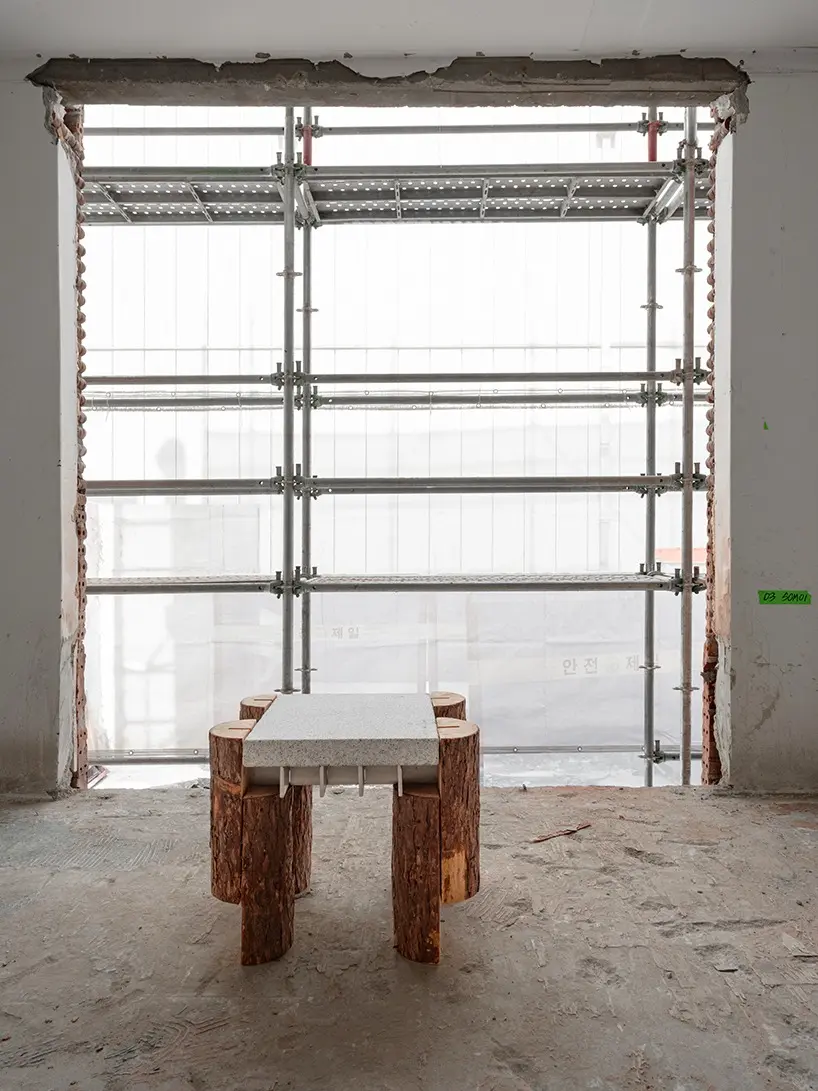
Design studio Sukchulmok and artist Kangyeon Lee have presented a compelling and ephemeral exhibition titled GHOST BARSTAIRS: Temporary Hypotheses, staged within a vacant, reinforced-concrete building in Sinsa-dong, Seoul. The intervention took place shortly before the structure’s impending demolition, utilizing the stripped-down, raw concrete shell as an unconventional canvas. By removing all accumulated interior finishes, the creators exposed the building’s bare structural frame, transforming it into a temporary setting that investigates the liminal space between its former utilitarian life and an entirely undefined, future redevelopment.
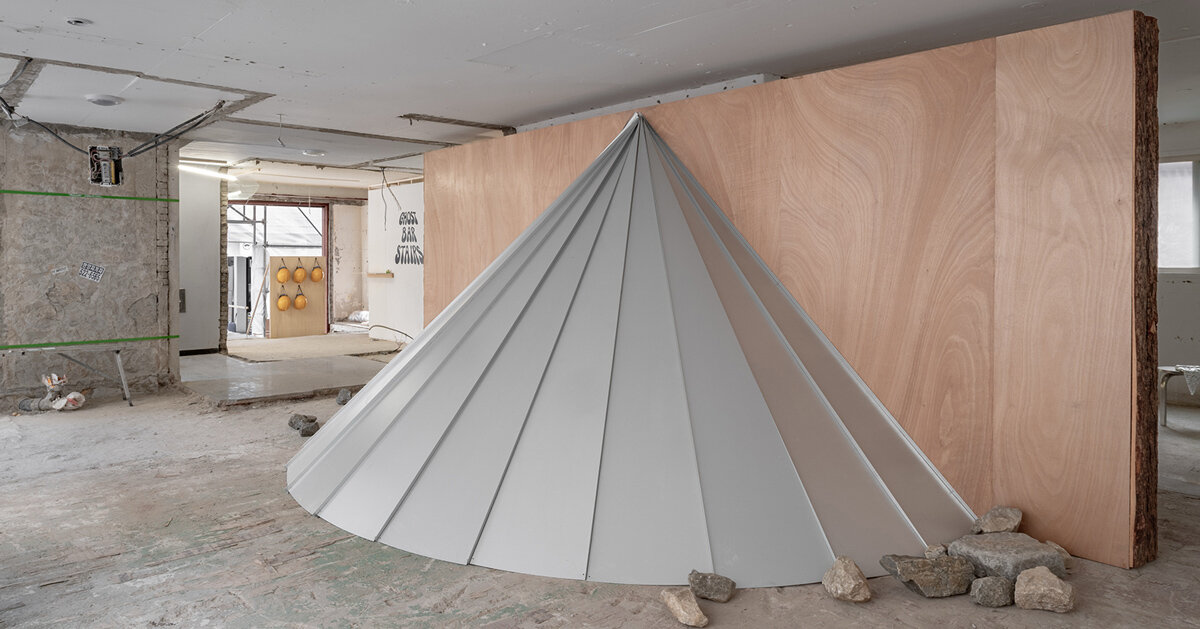
The title of the project serves as a conceptual framework, neatly breaking down into three distinct elements that guide the visitor’s interpretation of the space. "GHOST" refers to the haunting traces and lingering echoes of what has recently disappeared from the site. "BAR" describes the rigid lines, structural profiles, and boundaries that establish new divisions and geometric interventions within the open floor plan. Finally, "STAIRS" suggests the layers of vertical movement, encouraging visitors to traverse and experience the volume of the building from the basement up to the rooftop.
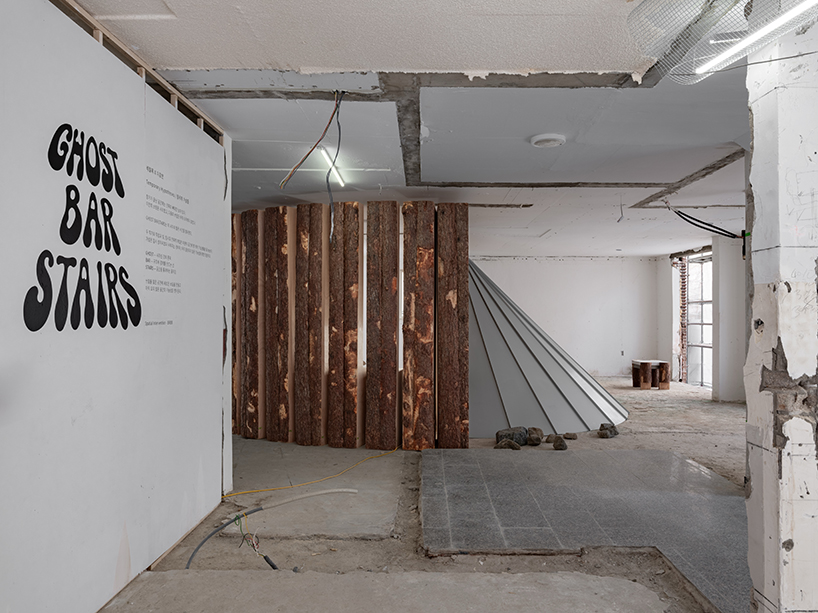
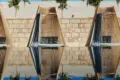
Throughout the building, natural light filters from the lowest levels to the highest reaches, illuminating the exposed frame and casting dynamic shadows across the interior. Within this raw spatial canvas, experimental furniture pieces designed by Sukchulmok intersect directly with the sculptural works of Kangyeon Lee. Rather than acting as a traditional gallery space, the multi-story building becomes a living "temporary hypothesis," capturing a fleeting moment of architectural transience and casting a sculptural query into the realm of undefined potential.
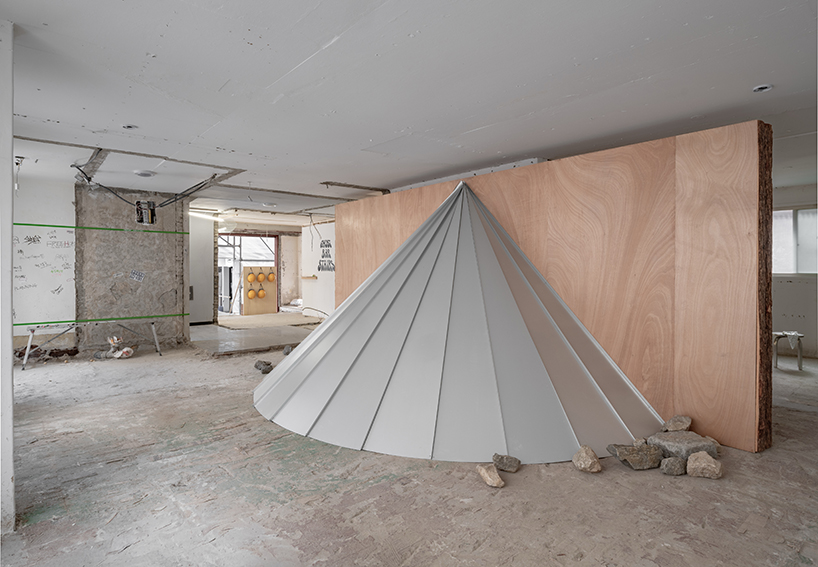
Timber and Steel Form New Structures Within the Concrete Shell
Studio Sukchulmok is widely known for its rigorous exploration of numerical proportions, translating them into the tactile and physical properties of foundational materials such as stone, steel, and wood. On the first floor of the Sinsa-dong building, the studio anchors the cavernous environment with a commanding central booth. This structural piece combines curved, semicircular timber components with a piercing steel cone, creating a striking focal point that contrasts sharply with the gritty, unfinished texture of the surrounding concrete walls.
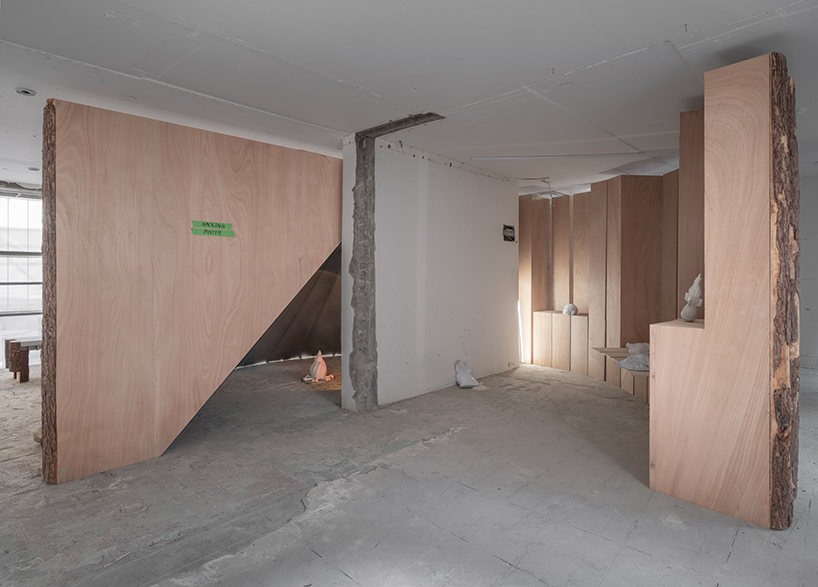
In close dialogue with Sukchulmok’s architectural furniture, artist Kangyeon Lee brings a deeply personal and socio-critical perspective to the exhibition. Drawing from his past labor experiences on a food production line—specifically the repetitive, mechanical task of placing ham onto pizza dough—Lee translates the resulting psychological sense of alienation into his physical art. His sculptures, crafted from industrial materials like metal and plastic, evoke anonymous figures that are routinely obscured or forgotten within fast-paced cycles of modern consumption.
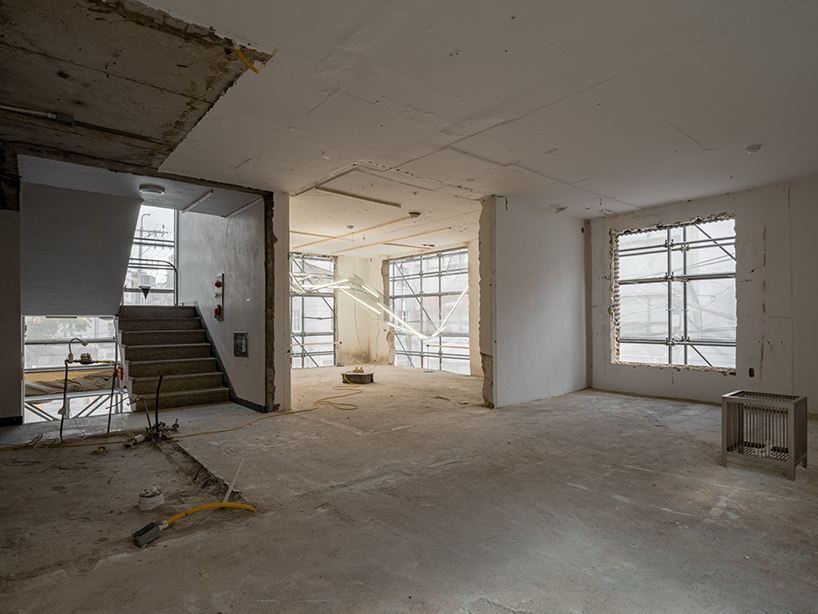
Adding yet another layer to the architectural investigation, the design practice BRBB introduced a distinct spatial intervention in the basement level. Here, large plywood panels lean, curve, and press against one another to construct self-supporting structures without relying on conventional walls, partitions, or fixed circulation routes. By treating the mere arrangement and physical friction of raw materials as a primary method for defining space, BRBB challenges traditional notions of interior architecture.
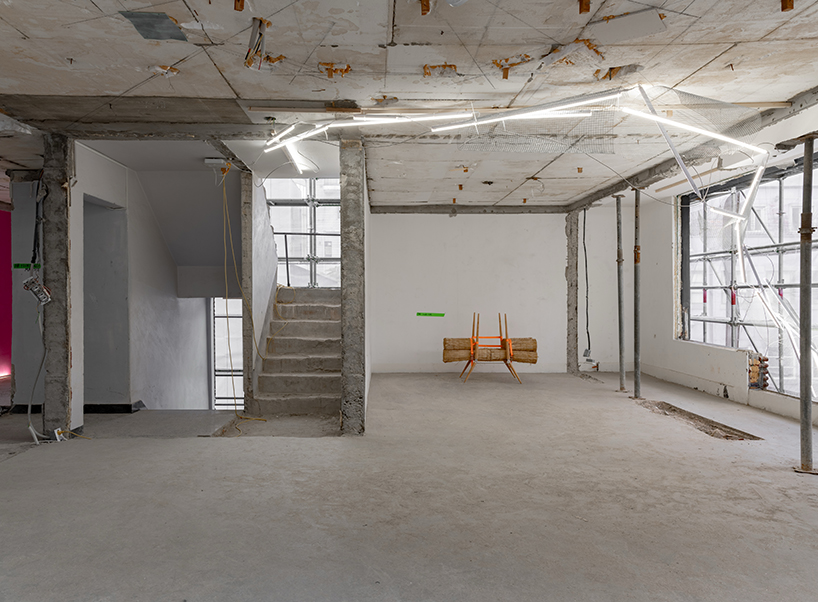
Installed moments before the building is scheduled to undergo its next phase of physical transformation, GHOST BARSTAIRS uses a blend of experimental furniture, conceptual sculpture, and temporary timber structures to examine the profound possibilities of an unfinished architectural setting. The exhibition successfully documents a rare, fleeting interval in time—a suspended window where the building’s historical identity has completely receded, yet its future remains entirely open.