





Jane Austen might have been born more than two centuries ago, but her sharp, enduring depictions of human relationships, social class, and the quiet domestic minutiae of the human condition have never lost an ounce of their original appeal. Fans who toasted to the cinematic celebration surrounding the re-release of the beloved 2005 film adaptation of Pride and Prejudice can now rejoice once again with the official arrival of a fresh cinematic take on Sense and Sensibility, starring Daisy Edgar-Jones.
This ongoing cultural return to Austen’s universe naturally prompts a broader look at how her world intersects with contemporary culture. Specifically, it sends fashion enthusiasts and historians alike deep into the archives to examine how modern designers continue to draw inspiration from the light, airy silhouettes of Austen’s Regency era.
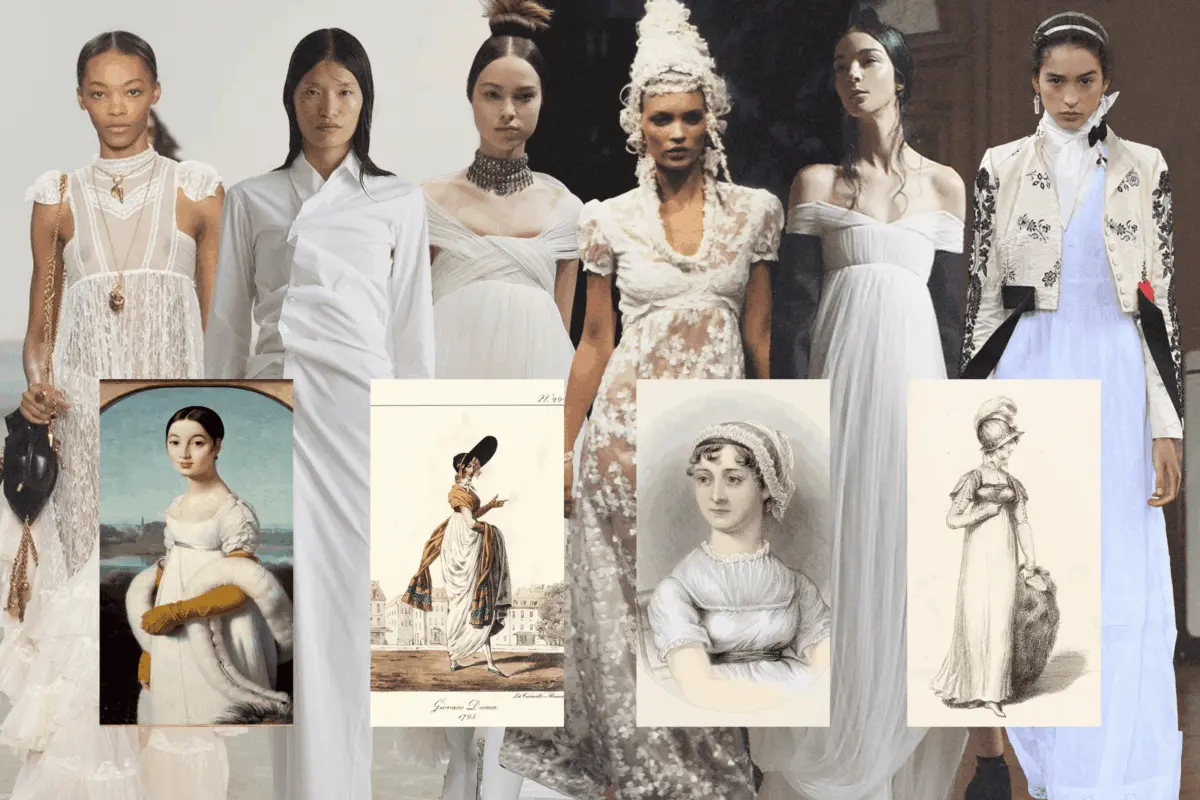
During Austen’s lifetime, the heavy, elaborate styles of the previous decades gave way to neo-classical forms of dress. These historical aesthetics were distilled into light, straight-lined garments defined by their high empire waists—a term referencing the Napoleonic era. These high-waisted dresses, often paired with open necklines, were designed to emphasize the décolleté, historically referred to as the "Regency shelf." A modern echo of this timeless aesthetic can be seen in collaborations such as the Vogue x Dôen collection, which captures that same romantic, historical ease.
These delicate silhouettes stand in stark contrast to the more structural, boxy silhouettes that frequently dominate modern runways today. Even so, the occasional resurgence of fluid, slim-tailored suiting makes a compelling case for the return of such graceful, body-honoring styles.
What makes Regency style so persistently appealing in the modern era is its accommodation of the natural human body. While the women in Austen’s novels certainly wore corsets, these undergarments were not tightly laced instruments of extreme modification. Furthermore, Regency wardrobes were entirely free of the cumbersome crinolines, heavy padding, and wide panniers that would later define Victorian fashion, which often restricted movement, made passing through standard doorways a challenge, or complicated walks across the open countryside.
Austen’s primary literary interest was never about physical body modification or superficial display. Instead, her narrative focus centered squarely on the internal transformations of the mind and the heart—particularly those emotional awakenings that render individuals vulnerable and truly open to love.
White Neoclassical Dresses
The aesthetic foundation of the Regency wardrobe was deeply rooted in a fascination with classical antiquity. Influenced by archaeological discoveries in Pompeii and Rome, fashion designers and trendsetters of the late 18th and early 19th centuries turned away from the artificial shapes of court dress in favor of the perceived purity of ancient Greek and Roman drapery.
White muslins, lightweight silks, and semi-sheer cottons became the fabrics of choice for fashionable women. These materials allowed the garment to drape naturally over the body, moving in tandem with the wearer rather than forcing the body to conform to an rigid geometric mold. In Austen’s novels, the simple white muslin dress is often a marker of youthful innocence, modesty, and understated taste, contrasting sharply with the older generation’s more ostentatious habits.
This emphasis on fluid, unadorned fabrics laid the groundwork for modern minimalism. When contemporary designers look back at this period, they are rarely interested in historical accuracy for its own sake; rather, they are drawn to the liberating simplicity of garments that prioritize comfort, ease of movement, and an unpretentious grace.
Empresses and Empire Lines
The silhouette that came to define the Regency period—the empire line—was inextricably linked to the political and cultural shifts of the Napoleonic era. Named in honor of the French Empire, the style elevated the waistline directly beneath the bust, allowing the rest of the fabric to fall in a gentle, uninterrupted cascade to the floor.
This revolutionary shift in tailoring mirrored the social upheavals of the time. By abandoning the constricted corsetry of the ancien régime, women’s fashion embraced a form of republican simplicity that resonated across Europe, eventually reaching the English countryside immortalized by Austen.
Today, the empire silhouette remains a staple of romantic and bohemian fashion. It offers a forgiving, comfortable fit that flatters a wide variety of body types while retaining an air of effortless elegance. As cinema continues to revisit Austen’s timeless narratives, introducing her heroines to new generations of viewers, the fashion world finds renewed inspiration in these historic lines. Whether through the delicate details of contemporary loungewear or high-end runway reinterpretations, the spirit of the Regency era—grounded in natural beauty, emotional depth, and unrestrictive grace—continues to endure.