





After spending more than two decades crafting high-end micromechanical components behind the scenes at Patek Philippe and independently for a roster of elite client brands, Jean-Marc Fleury has firmly shifted his focus toward watchmaking bearing his own name. His latest horological creation, the JM Fleury Chronograph Openwork, pairs a contemporary grade 23 titanium case with sapphire dial elements that pull back the curtain to reveal the meticulously finished calibre vibrating within.
At the heart of the timepiece beats the manufacture’s proprietary FM04 movement. This hand-wound chronograph draws direct inspiration from the legendary Lemania 2310 architecture, yet it has been profoundly re-engineered, modernized, and enlarged to suit contemporary proportions. As independent watchmaking continues to captivate collectors worldwide, Fleury’s latest release offers a fascinating glimpse into how deep industrial roots and master-level manufacturing capabilities can converge to produce an exceptional independent chronograph.
Initial Thoughts on Openwork Architecture
The contemporary horological landscape exhibits an unyielding fascination with elaborate movement finishing. With collectors laser-focused on mirror-polished steel, sharp inward angles, and gleaming bevels, independent watchmakers are increasingly experimenting with inverted architectures and transparent dials to bring more of their mechanical artistry directly to the surface.

Like the celebrated chronographs emerging from independent ateliers such as Petermann Bédat and Rexhep Rexhepi, the JM Fleury Chronograph Openwork stops short of full skeletonisation. Instead, it adopts a more refined approach, utilizing a selectively open-worked main plate that remains partially visible through sapphire crystal dial components.
The aesthetic result strikes a delicate balance. Enough of the main plate remains structurally intact to provide the dial with a largely coherent backdrop, while the strategic openings expand the visible canvas for high-end decorative techniques. The hand-wound FM04 engine builds upon the timeless foundation of the Lemania 2310, but its architecture has been comprehensively reimagined. Combined with uncompromising finishing standards, the Chronograph Openwork positions itself as a compelling value proposition within today’s superheated luxury market. Even carrying a price tag of CHF 59,000, it remains considerably more accessible than many time-only creations coming from upstart independent makers.
From Component Supplier to Watch Brand
A micromechanical engineer by formal training, Mr. Fleury studied at the École des arts et métiers de Bienne before forging a distinguished career in high-end watch manufacturing. He joined Patek Philippe in 1994, spending a formative decade there as a Manufacturing Group Leader. Among the prestigious calibres entrusted to his direct supervision was the manufacture’s renowned Lemania-based CH 27-70 chronograph, a movement that would profoundly shape his engineering philosophy.

In 2004, Mr. Fleury transitioned to BNB Concept as Manufacturing Director, a tenure that lasted until 2009. He subsequently spent five years directing manufacturing operations at Microedge, a specialized component supplier later acquired by La Fabrique du Temps. During his journey across these influential houses, his career path overlapped with fellow independent watchmaker Rexhep Rexhepi at both Patek Philippe and BNB, though Mr. Fleury’s core expertise remained firmly anchored in the industrial and manufacturing side of the craft.
In 2017, he established Suisse Précision Composants (SPC) to manufacture ultra-precise components for external independent watchmakers, alongside Fleury Manufacture. This component business ultimately provided the industrial capabilities and financial foundation from which his own branded watches could flourish.
This two-pronged operational strategy closely mirrors models utilized by entities like Kross Manufacture, illustrating a practical reality of modern independent watchmaking. High-end hand finishing imposes strict natural limits on annual production volume, making it difficult to amortize the steep costs of advanced machinery and specialist staff across just a handful of watches. Supplying components to other luxury brands generates the necessary industrial volume to support heavy capital investment. For small-scale independents like Fleury, external supply laid the groundwork for autonomy. Today, however, Fleury’s own growing collections demand a much larger share of production capacity, turning external client supplies into a steadily declining portion of their total output.

Opening Up the Chronograph
The Chronograph Openwork showcases a striking evolution of the FXR-4 chronograph platform introduced previously. Its robust 40 mm case is fashioned from grade 23 titanium, a material prized for its strength-to-weight ratio, while sapphire dial elements offer unobstructed views of the partially open-worked German silver main plate beneath.
Among Mr. Fleury’s functional additions to the legacy platform is a neatly integrated date display positioned at the six o’clock marker. This display incorporates a subtle day/night indication visible directly beneath the sapphire sub-dial, serving as a practical reference when setting the time or advancing the calendar via the dedicated corrector pusher located at the eight o’clock position on the case flank.
One of the most visually arresting details on the dial side is the massive, black-polished steel going-train bridge positioned prominently at nine o’clock. This brings an extraordinary amount of gleaming black-polished steel to the dial, evoking subtle visual comparisons to masterpieces like the Roger Smith Series 5. While the case leans slightly chunky in an era crowded with vintage-inspired chronographs, its proportions remain well-suited to a contemporary aesthetic, while the inherent lightness of titanium ensures an effortless, comfortable feel on the wrist.

The contemporary character of the Chronograph Openwork is further reinforced by the tactile feedback of the crown and pushers. The pusher action feels substantial yet remarkably crisp, steering clear of the delicate, fragile feel often associated with vintage chronographs. This purposeful tactile feedback enhances the overall impression of a robust, modern sports-luxury instrument.
Movement Construction and Finishing
Fleury’s proprietary FM04 movement is frequently viewed as a modern recreation of the historic Lemania 2310. While historical influences are undeniable, it is more accurately understood as a distinct, ground-up movement designed and manufactured entirely under Fleury’s direction.
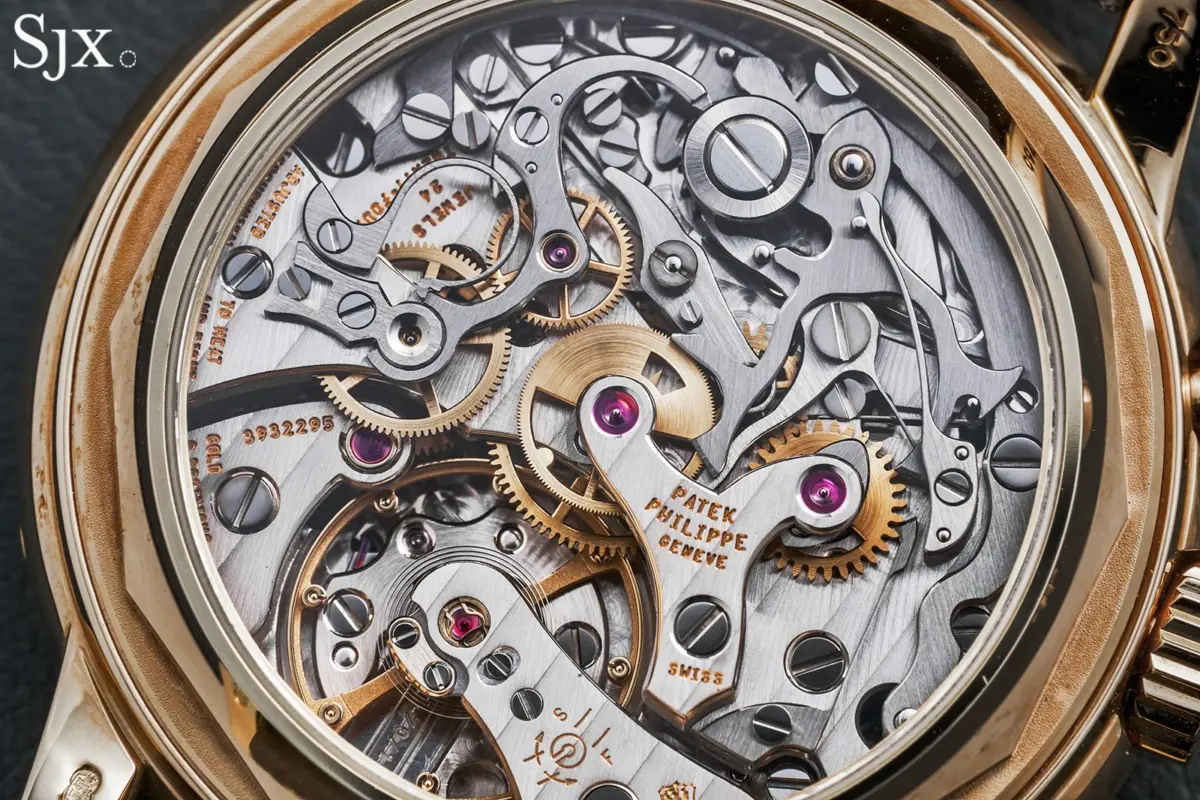
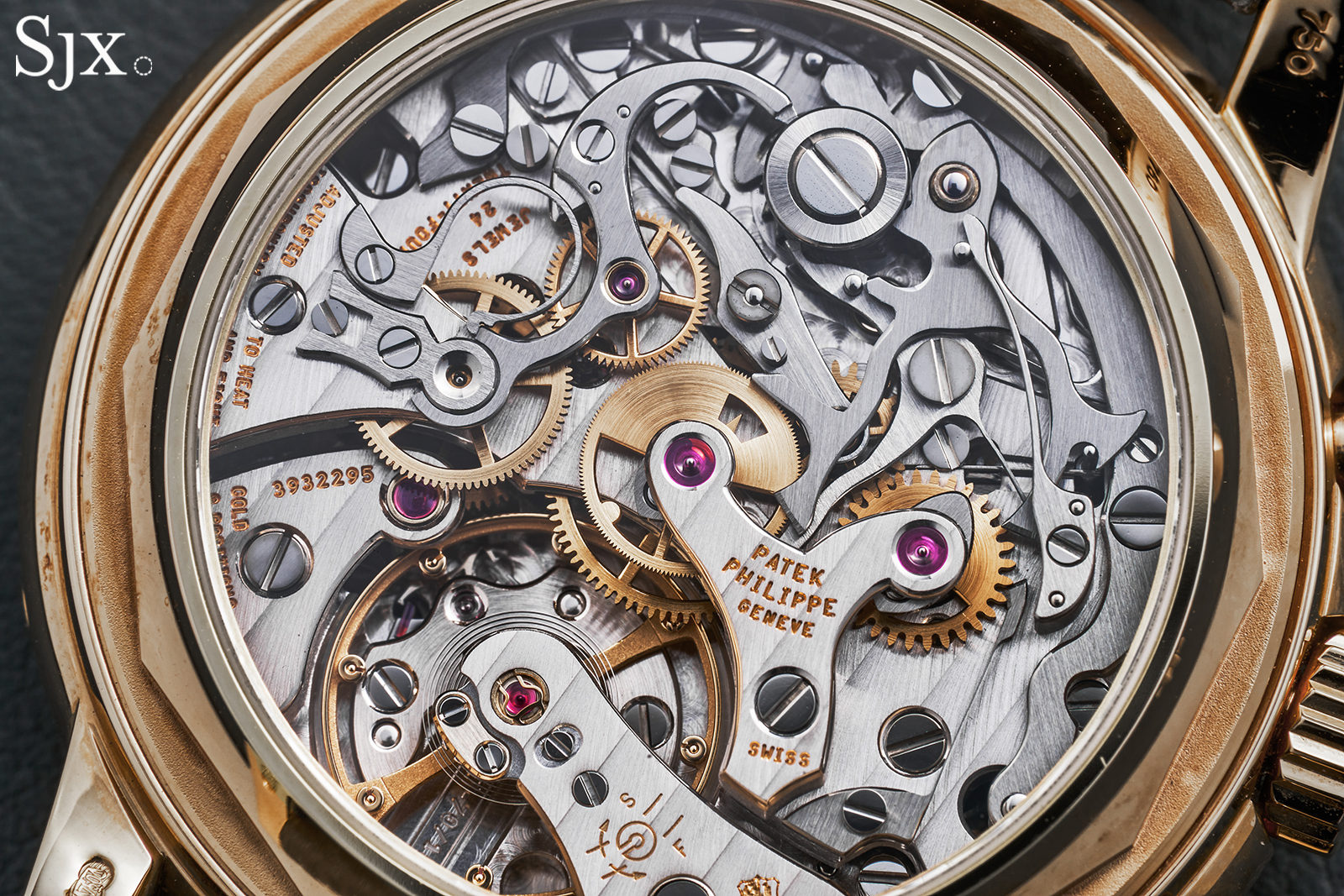
This technical direction is informed by direct, hands-on experience. During his decade at Patek Philippe, Mr. Fleury played an integral role in industrializing and producing the Lemania-based CH 27-70. That background directly influenced the architecture of the FM04, which retains several familiar nods to the classic Lemania layout. The distinctive shape of the reset hammer will look immediately familiar to connoisseurs, and the specific positioning of the hammer spring directly recalls Patek Philippe’s traditional treatment of the Lemania ébauche.
The overarching proportions, however, are vastly different. While the original Lemania measures a relatively compact 27 mm in diameter, the FM04 spans a generous 32.5 mm across. This larger canvas is vastly better suited to modern watch dimensions, paying immediate dividends in both the harmonious spacing of the sub-dials and the expansive, uninterrupted view of the mechanism through the exhibition sapphire case back.
The technical upgrades extend well beyond mere scaling. One of the most significant engineering refinements concerns the chronograph driving wheel, which draws power directly from the fourth wheel. In the FM04 architecture, both the driving wheel and fourth wheel sit neatly beneath the fourth wheel bridge, integrating the chronograph engagement mechanism far more cohesively into the primary going train.
Patek Philippe utilized a comparable arrangement in its earlier Valjoux-based calibre 13-130, but the legendary CH 27-70 employed a separate, unjewelled bridge specifically for the clutch pivot. This design choice highlights the clever ways elite independents breathe new life into classical calibres, paralleling updates made by Kari Voutilainen and Atelier de Chronométrie in their respective interpretations of the Valjoux 23 architecture.

A premium bill of materials elevates the movement’s overall execution. The anthracite-coated plates and bridges are constructed from German silver, creating a warm, golden-grey undertone that complements the abundance of black-polished steel components, most notably the graceful, S-shaped horizontal clutch lever.
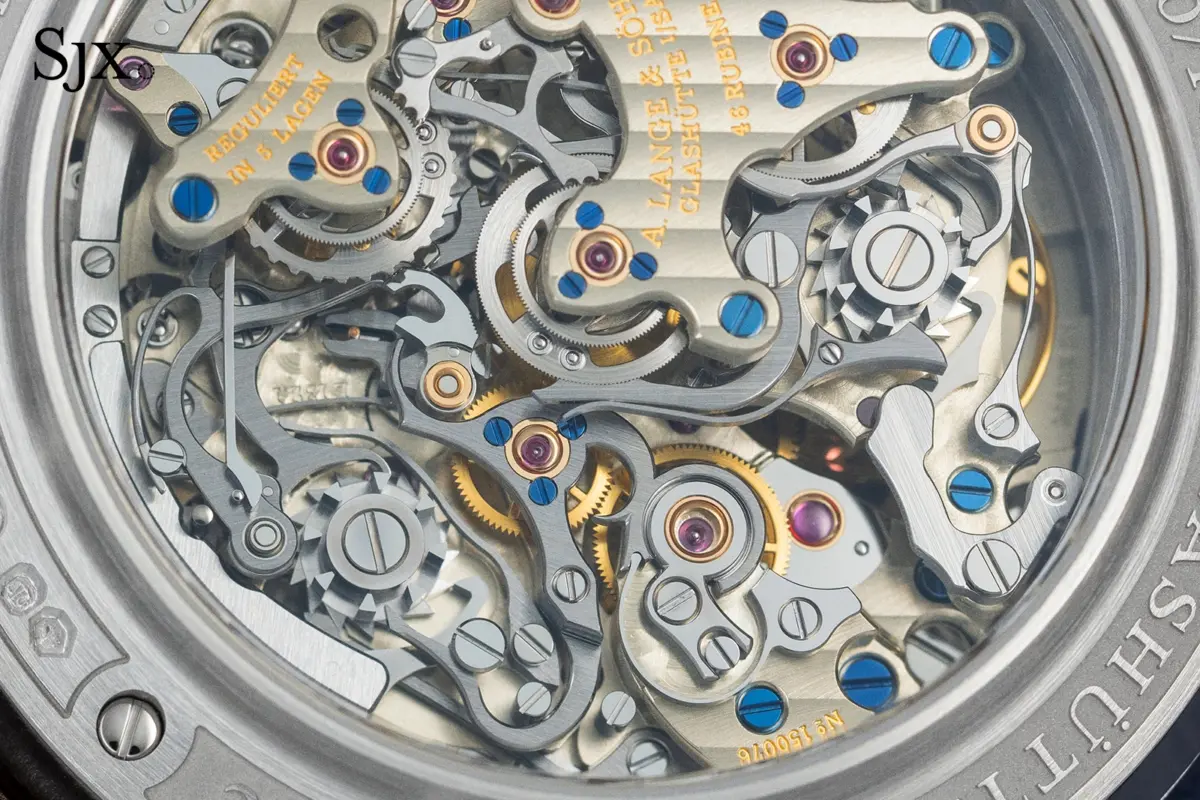
Finishing a component of this complexity to a mirror-polished standard is exceptionally demanding. As A. Lange & Söhne’s Anthony de Haas has noted, achieving a perfectly flat, uniform black polish across an elongated lever is notoriously difficult. While straight graining remains the industry norm for similar parts due to its lower production complexity, Fleury’s commitment to true black polishing serves as a genuine demonstration of high-end hand-finishing capability.
At the same time, Fleury’s deep roots in industrial component manufacturing reveal themselves in other finishing choices. The wide bevels, or anglage, and countersinks display the crisp definition typical of precision diamond-cutting tools used for repeatable results, complete with microscopic tool chatter visible under extreme magnification from certain viewing angles.

The regulating organ further underscores the manufacture’s technical ambitions. A free-sprung balance wheel aligns with the strict chronometric priorities Mr. Fleury absorbed during his tenure at Patek Philippe, though the hairspring dispenses with a terminal overcoil as the calibre evolved across its frequency parameters. Notably, Fleury manufactures its own balance wheel, escape wheel, and pallet lever entirely in-house—a remarkably rare feat for a brand of this scale, reflecting industrial capabilities honed over years of high-level component supply.
Keen-eyed watch enthusiasts may also spot the hollow arbour of the central chronograph wheel. This structural provision could easily accommodate the concentric arbour required for a split-seconds mechanism, hinting strongly that provisions for a future rattrapante complication were engineered into the baseline architecture from day one.
Key Facts and Price
JM Fleury Chronograph Openwork

Diameter: 40 mm
Height: 12.8 mm
Material: Grade 23 Titanium
Crystal: Sapphire
Water Resistance: 30 meters
Movement: FM04 Openwork
Functions: Hours, minutes, small seconds, chronograph seconds and minutes, date, day/night indicator
Winding: Hand-wound
Frequency: 21,600 vibrations per hour (3 Hz)
Power Reserve: 60 hours
Strap: Leather strap paired with a stainless steel pin buckle

Limited Edition: No
Availability: Direct from Fleury Manufacture
Price: CHF 59,000 excluding taxes
For further details, visit FleuryManufacture.ch.