





PARIS — One year into its comprehensive turnaround effort spearheaded by chief executive officer Luca de Meo, French luxury goods giant Kering is banking heavily on creative director renewal to spark demand and navigate a challenging global economic environment.
However, with vacant designer positions currently waiting to be filled at Saint Laurent and Alexander McQueen, lingering rumors of potential creative shifts at Balenciaga, and persistent questions regarding customer reception to the evolving direction at Gucci, investors are increasingly worried that this rapid creative churn might prove to be more of an operational hurdle than a strategic opportunity.
Kering’s broader growth engine notably stalled in the third quarter of the year. Its crown jewel and primary profit engine, Gucci, struggled to gain sufficient momentum amid a wider, sector-wide slump in consumer demand across China and parts of the United States.
The French luxury group reported that its overall revenues for the three months ended Sept. 30 remained flat at reported exchange rates, totaling 3.35 billion euros. This performance represented a minor decrease of 1 percent in comparable terms, which actually came in slightly above the consensus financial forecast that had predicted a 1.3 percent organic sales drop.
Despite beating aggregate top-line expectations, Gucci missed individual analyst projections. The iconic Italian label posted a 6 percent drop in sales at constant exchange rates, performing worse than the 5.4 percent decrease anticipated by market analysts. This setback followed a comparatively milder 2 percent decline during the second quarter, a period when the group had shown encouraging signs of progress by posting its first comparable sales increase in three years.
During a conference call held with financial analysts on Thursday evening after the market close, chief financial officer Armelle Poulou faced a barrage of pointed questions regarding the string of high-profile designer changes. Analysts openly expressed fears that these disruptions could delay the group’s nascent recovery phase. One analyst specifically questioned why Anthony Vaccarello departed from Saint Laurent earlier this month, given that the brand stood out as the sole major fashion division house enjoying positive sales momentum and consistent cultural traction.
Fielding questions without CEO Luca de Meo present for the first time since his arrival last year, Poulou maintained that all recent executive and creative decisions are direct consequences of the strategic roadmap de Meo laid out during a Capital Markets Day presentation in Florence earlier this spring.

"Each brand is on a specific trajectory, and each situation is very different," Poulou told analysts on the call.
Defending the timing of the transition at Saint Laurent, she argued that the brand is currently operating from a position of strength. "Saint Laurent is experiencing strong momentum, and we are very happy about it. The change of creative director is opening a new chapter after 10 years of success. It’s also good from time to time to bring a new point of view to the brand," she explained.
Outlining the immediate operational goals for the house, Poulou emphasized that management is fully aligned on future expansion targets. "Our priority and our growth levers at Saint Laurent is to develop the day wardrobe, to develop the main line to be more relevant in China, and we are very confident that the new creative director, together with the Saint Laurent teams, will be able to contribute to the development of this plan," she said.
Among the ambitious targets announced by de Meo back in April, the chief executive outlined plans to systematically double Saint Laurent’s menswear business and its overall market footprint in Asia by the year 2030.
Team Effort and Organizational Restructuring
Addressing the timeline for filling current vacancies, Poulou promised that Kering would announce new creative directors at both Saint Laurent and Alexander McQueen "very shortly," though she declined to provide a specific calendar for when these incoming designers would present their debut collections for the houses.
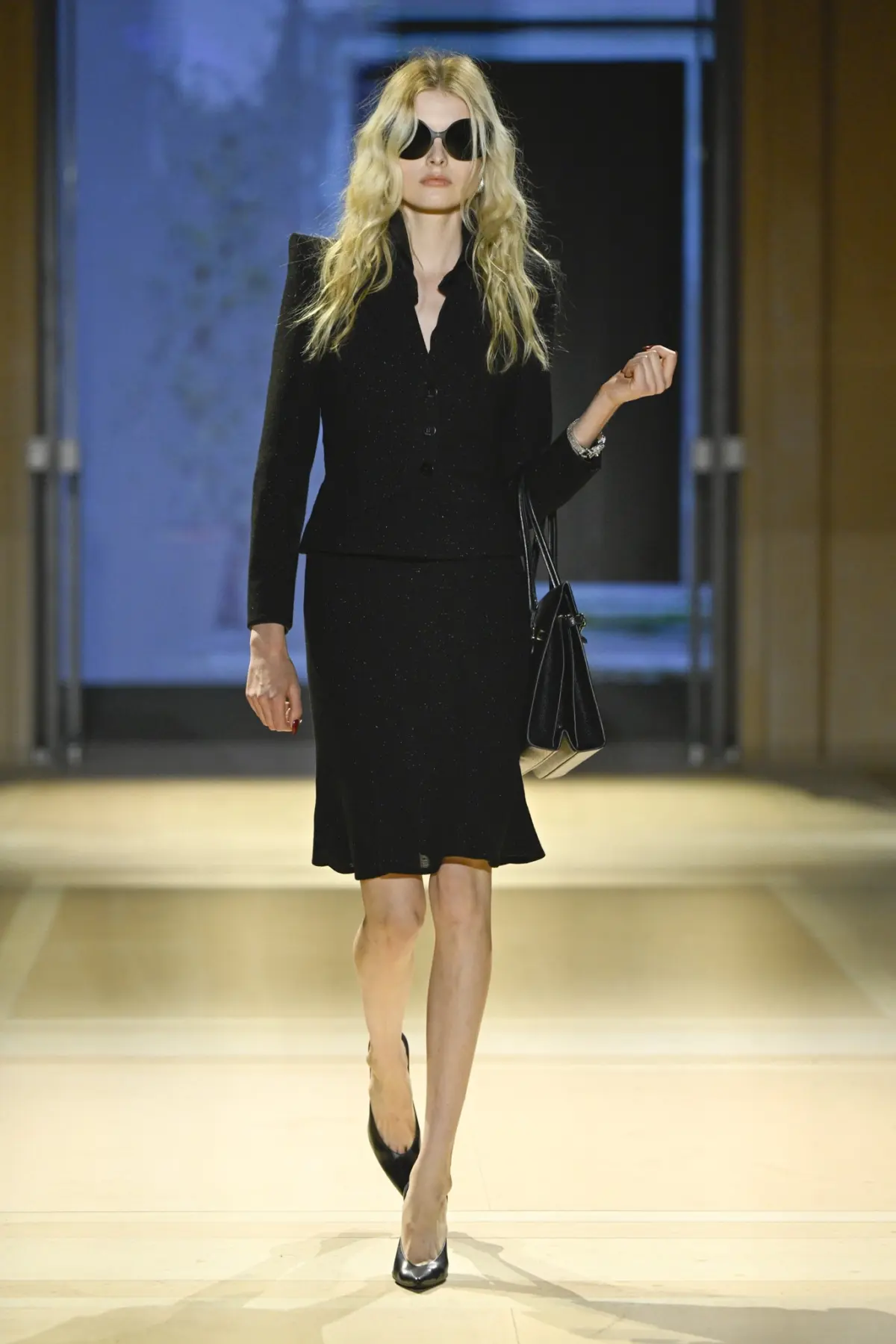
The departure of Seán McGirr after a three-year tenure at Alexander McQueen has coincided with a substantial corporate retrenchment of the business, which has involved targeted layoffs and selective store closures. The incoming successor at McQueen will be tasked with executing a precise repositioning of the brand. Poulou described this mandate as a return to a British tailoring approach infused with a very bold and distinct point of view.
When pressed on market speculation surrounding a potential changing of the guard at Balenciaga—where creative director Pierpaolo Piccioli is currently applying his haute couture expertise to steer the brand back toward its foundational roots—Poulou declined to comment.

Shifting focus to Gucci, analysts questioned whether management remains entirely satisfied with Demna’s ongoing creative work at the flagship label. In response, Poulou emphasized that Kering is actively putting in place a much more efficient operating model centered around designers. This structural shift is designed to ensure that each creative vision is robustly backed up by dedicated product development, marketing, and merchandising teams.
In an exclusive interview with WWD earlier this month, de Meo elaborated on his core ambition to systematically re-engineer the traditional creative process within luxury houses.
"A creative director for me is like a captain, the playmaker of a team. He’s the one that has more talent, that kind of technical ability to solve the game in an unexpected way," the former Renault Group boss explained during the interview.
However, de Meo cautioned against overloading creative talent with administrative and commercial burdens. "But without a [support] system around, I believe that we cannot run multibillion, multicategory, multi-geography businesses and ask them to do everything from store layout to marketing. So I will try to change the way the studio interacts with the rest of the organization in the spirit of finding a more collaborative way of handling the complexity."
Driving Store Traffic and Geographic Performance
Geographically, the luxury group posted a mixed performance across international markets during the third quarter. Comparable revenues rose by 2 percent in North America, 4 percent in Japan, and 2 percent across the rest of the world. However, these gains were offset by declines in key regions, with sales falling 5 percent in the vital Asia-Pacific market and slipping 2 percent in Western Europe.
"Clearly, the performance of the third quarter is not where we want it to be, but beneath the top line, the actions we have taken are becoming increasingly visible," Poulou noted.
While Kering no longer breaks out the individual financial performances of its smaller fashion houses, organic sales across the broader fashion and leather goods division declined by 3 percent during the three-month period. For comparison, rival luxury conglomerate LVMH Moët Hennessy Louis Vuitton reported that organic sales at its own fashion and leather goods unit fell 5 percent year-over-year, heavily dragged down by the ongoing, sharp slowdown in Chinese consumer spending.

Gucci certainly suffered from challenging year-over-year comparisons, but management noted that the principal hurdle remained weak physical store traffic across mainland China and the United States. Yet, encouragingly, there were tangible signs that the newly introduced product lines are strongly resonating with core clientele once they step inside boutiques.
"Even in this environment, in every region, we are pleased to see that we had an improvement of the conversion, an improvement of the average ticket and average unit price, and also cross-selling. So, difficult traffic, but once the customer is in the store, good reception with the newness," Poulou highlighted.
Addressing widely reported price-cut initiatives at Gucci, the chief financial officer clarified that these adjustments were highly selective and primarily intended to clear out lingering seasonal inventory from the design era of previous creative director Sabato De Sarno.
"It’s also a way sometimes to bring some clients to store, and actually it was very interesting to see that we did a lot of cross-selling," she observed. "But for us, the focus is really on recreating a desirable offer with the right pricing architecture and an improved quality perception, and both are very important."
Poulou added that while Gucci’s fall collections leaned toward a more fashion-forward aesthetic designed to capture high-end consumers and generate cultural buzz, the upcoming GucciCore cruise collection arriving in retail stores in November is expected to possess a much broader appeal among an aspirational cohort, helping to effectively flesh out the brand’s ready-to-wear and footwear offerings.
China Strategy and Retail Footprint
Sales were additionally impacted by deliberate store rationalization efforts. Kering shuttered 105 retail units during the first nine months of the year globally, a figure that includes 25 Gucci boutiques. Consequently, the group has increased its full-year target to 125 net store closures for 2026, up from a previous projection of 100 closures.
Looking ahead to the fourth quarter, the group plans to step up media investments, reinforce brand communications, and intensify targeted clienteling efforts. As part of this retail push, Kering will unveil an entirely new Gucci store concept located on Avenue Montaigne in Paris this November.

In mainland China, the company is pivoting toward a localized operational model by devolving greater decision-making responsibility to regional teams on the ground.
"We are putting Chinese clients more firmly at the center of our actions, stepping up outreach to top clients, timing major product moments around local occasions, and conceiving campaigns in and for China rather than adapting global ones," Poulou stated, while also revealing the establishment of a dedicated local content factory within the country.
Meanwhile, Kering continues to witness healthy, resilient market prospects for its jewelry division, despite the fact that comparable growth in the segment decelerated to 11 percent in the third quarter down from 18 percent in the preceding three months, as the broader economic slowdown in China impacted sales at Qeelin.
"With strong desirability, a growing retail footprint, and an increasingly integrated industrial backbone, we are confident in jewelry’s ability to increase its contribution to group revenue over time," Poulou said, noting that management will outline key strategic priorities for the jewelry business during an upcoming Kering Jewelry Day scheduled in Paris on Dec. 2.
The release of Kering’s sales figures follows a similarly sobering financial update from Hermès International, which earlier on Thursday reported that third-year revenues rose 4.3 percent at constant exchange rates, marking its weakest quarterly growth rate recorded in six years.
Despite the macroeconomic headwinds and structural transitions, Kering firmly confirmed its overarching financial objective of improving its recurring operating margin throughout 2026, though executives cautioned that they do not anticipate a material improvement in the second half of the year compared to the first half.
"We are clear-eyed about the work still ahead," Poulou concluded.