





The history of the diamond—spanning thousands of years of human fascination, linguistic confusion, and technological innovation—reflects a slow, arduous journey from rough, unshaped crystals to the precision-cut brilliance we know today. Long before diamonds became synonymous with engagement rings and industrial precision tools, their very existence in antiquity was a subject of intense debate, largely fueled by mistranslation, superstition, and geographic isolation.
Pre-Roman Diamonds
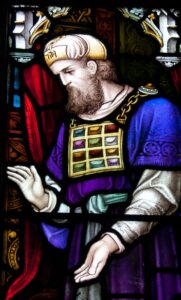
For centuries, biblical scholars pointed to passages such as Exodus 28:15–18, which describes the breastpiece of judgment worn by the high priest, as definitive proof that diamonds were recognized during biblical times. The text mentions a stone traditionally translated as a "diamond" in the second row of the sacred garment. However, gemological historians note that this reference stems from an erroneous translation of the Hebrew word yahalom—derived from halam, meaning "to beat"—and the Greek adamas, meaning "indomitable" or "invincible."
While these ancient terms certainly referred to an exceptionally hard mineral, assuming they specifically meant diamond is a modern projection. Ancient writers like Plato used adamas to describe gold, non-noble metals, or perhaps corundum, with zero concrete archaeological proof that actual diamonds were known to the classical Greek world. Early European historians also lacked access to translated Sanskrit texts, obscuring India’s rich historical record of diamond use.
Yet, while when diamonds entered human history remains shrouded in mystery, where they first appeared is undisputed: India. An ancient Indian political treatise titled the Arthasastra, dating back to the 4th century BC, provides the first clear historical insight into diamond utilization. By that era, diamonds were actively mined, traded, taxed, and classified by early experts in India, implying a deep, long-standing familiarity with the gemstone.
Roman Diamonds
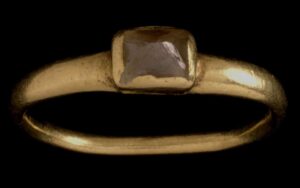
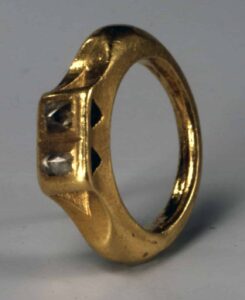
By the time of the Roman Empire, diamonds were undeniably known and worn, prized primarily as uncut ring stones. Several surviving Roman rings featuring raw diamond crystals now reside in the collections of The British Museum. The Roman scholar Pliny the Elder wrote extensively about diamonds in his Naturalis Historia, famously describing them as the most valuable substance on earth.
Pliny accurately documented the extreme hardness of diamonds, noting their ability to resist a blacksmith’s anvil and even shatter the iron itself. He also unwittingly described the stone’s perfect cleavage, noting how accidental breakage produced microscopic fragments that engravers could mount in iron tools to cut other hard substances. However, Pliny’s accounts also contain contradictions, indicating that Roman writers occasionally confused diamonds with other dense minerals. Furthermore, gemological historians suggest that Roman elites rarely had access to top-tier crystals, as Indian suppliers naturally reserved the finest stones for local markets.
For generations, superstitious beliefs hampered the evolution of diamond lapidary. Because diamonds were thought to offer divine protection against all forms of mishap, early cultures believed the crystal would lose its magical properties if altered from its natural state. Consequently, cutting diamonds was viewed as both a technical impossibility and a cultural taboo. Early practices were likely limited to chipping away unwanted mineral matter from freshly mined crystals, though historical proof of controlled cleaving during ancient times remains absent.
The Introduction of Diamond Cutting
Following the fall of the Roman Empire, diamonds temporarily vanished from European jewelry. The disruption of trade routes by the lack of Roman merchants, coupled with the spread of Christianity—which discouraged the superstitious attributes associated with the stones—largely severed Western Europe’s supply chain. Conversely, the gems retained their immense popularity throughout the Indian and Islamic worlds, leaving behind a wealth of medieval literary references.
Texts such as the Ratnapariska by Buddha Bhatta, dating back to at least the 6th century AD, warned against using flawed diamonds as personal gems, recommending instead that they be ground down to create diamond powder for polishing other stones. Later, in the 10th century, the scholar Al-Biruni detailed how Islamic jewelers pulverized diamonds using lead tools.
The breakthrough toward actual gem cutting emerged centuries later. Notable jewelry historian Jack Ogden reported examining medieval Islamic jewelry from the 13th century featuring simple table-cut diamonds, representing the oldest known cut stones in existence. This timeline aligns with the Indian text Agastimata, written shortly after the 13th century, which explicitly notes that diamonds could only be polished by other diamonds.
Europe
European diamond cutting likely originated in Venice shortly after 1330, following the reopening of Eastern trade routes by Venetian merchants. Whether cutting techniques traveled westward with the stones or were independently reinvented by Europeans remains uncertain. However, the scarcity of perfectly shaped crystals in the West—with elite Indian and Islamic middlemen retaining the finest specimens—likely drove European artisans to begin fashioning their own rough stones.
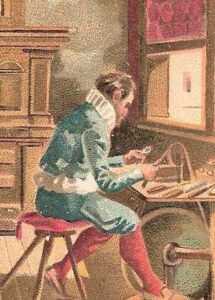
Technical limitations confined early European cutters to superficial polishing of natural rough. The introduction of continuous rotary motion in craft tools during the 15th century finally enabled artisans to grind facets into diamonds with greater precision, sparking an era of creative experimentation. Court documents from cities like Augsburg illustrate this transition, recording instances where rough stones lost half their weight during the polishing process, marking the true birth of European diamond cutting.
Transition
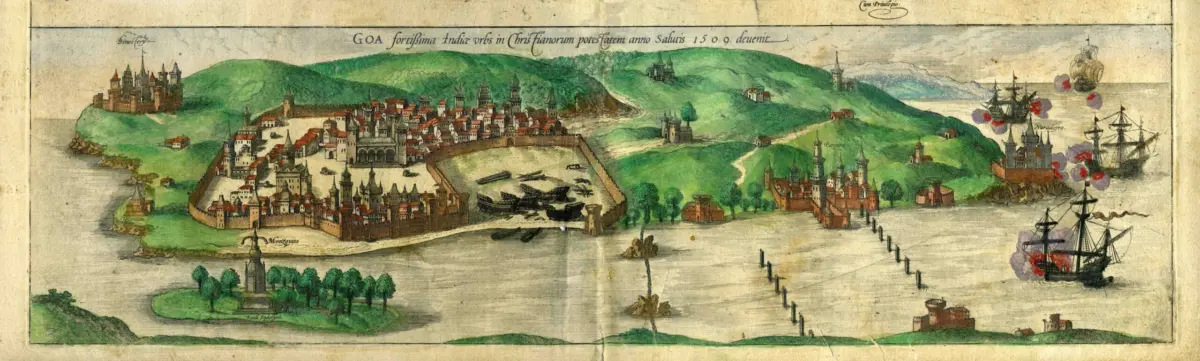
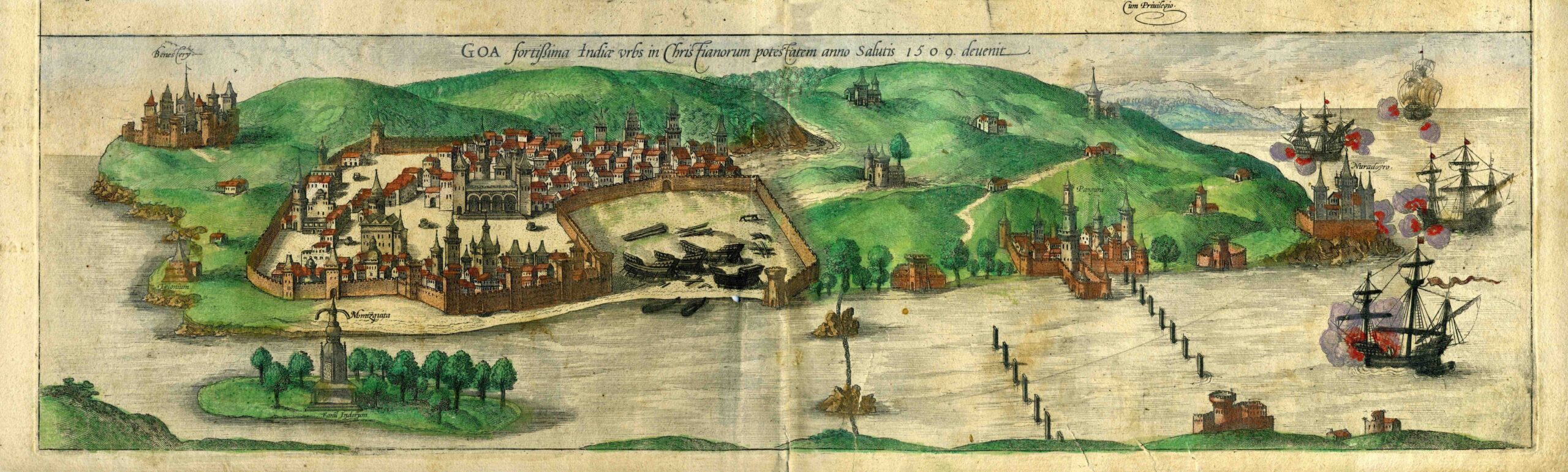
As European maritime powers—including the Portuguese, Dutch, Spanish, and English—expanded global trade routes, the influx of luxury goods accelerated. Following the Portuguese conquest of Goa in 510, the city became the primary port for Indian diamonds, steadily increasing Europe’s supply.
Toward the end of the 15th century, the economic center of gravity shifted northward, establishing Paris, Bruges, and Antwerp as major polishing hubs. Because cutting communities here operated outside the rigid traditional guild systems, Jewish artisans—who had fled religious persecution and the Inquisition in Spain, Portugal, and France—found a foothold in the trade, driving rapid advancements in cutting technology.
By the 16th century, the traditional reverence for raw crystal shapes had fully dissolved. Artisans mastered faceting, giving rise to the rose cut and advanced table cuts with additional facets on both the crown and pavilion. Elongated rectangular stones known as "hogbacks"—the forerunners to the baguette cut—became widely popular for creating letters and figures in jewelry.
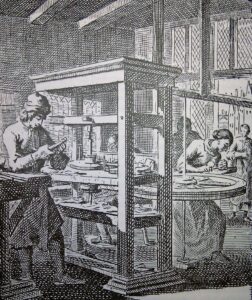
The cutting techniques of this era were meticulously documented by Benvenuto Cellini in his 1568 treatises. Cellini described how artisans rubbed two diamonds together to achieve basic shapes while collecting the resulting diamond dust. This dust was mixed with oil and applied to a high-speed steel wheel to impart a final, brilliant polish to the stones.
Grinding and Cleaving
Understanding the physical properties of diamond is essential to appreciating historical cutting methods. Beyond its unmatched hardness, diamond possesses "directional hardness," meaning it resists scratching differently depending on the crystallographic orientation. For example, octahedral crystal planes are significantly harder than dodecahedral planes. Because octahedral faces lie in planes of immense relative hardness, they are virtually impossible to polish directly; cutters were forced to place facets at slight angles to these planes.
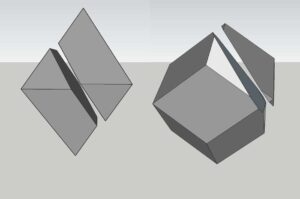
Furthermore, while diamonds rank highest in hardness, they possess perfect cleavage, meaning they fracture smoothly along specific crystallographic planes when subjected to precise force. Although ancient artisans knew how to crush diamonds into fragments for engraving, and mid-13th-century Islamic texts acknowledged diamond cleavage, utilizing cleavage to shape rough stones for jewelry is a post-medieval invention. By the 17th century, travelers like Jean-Baptiste Tavernier observed that Indian miners had mastered the art of cleaving flawed stones far more skillfully than their European counterparts.
Sawing and Indian Diamond Cutting
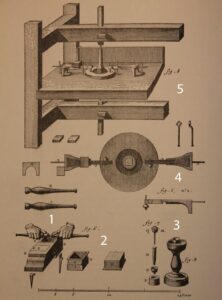
The final major addition to the cutter’s repertoire was diamond sawing. Described in 1647 by Johannes de Laet, this labor-intensive method involved running a thin wire dressed with diamond powder and oil across the stone—a technique that persisted well into the 19th century, though cleaving remained preferred for its efficiency.
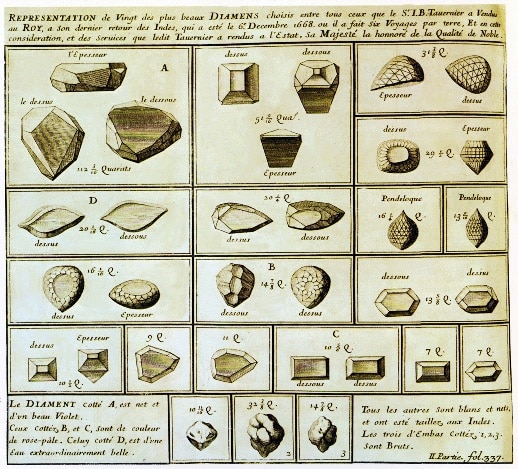
Jean-Baptiste Tavernier’s 17th-century travel accounts provided Europeans with unprecedented insight into Indian diamond fashioning. Tavernier documented Indian mills operated by manual labor, where young assistants continuously anointed cutting wheels with oil and diamond powder using wooden spoons. Although Indian cutting methods—collectively referred to as the Mughal Cut—sometimes produced a less glassy polish than European techniques due to the frequent need to remove and redress steel wheels, Indian artisans were uniquely willing to cut difficult, knotted stones that European cutters typically refused to touch.
Baroque Roses and Brilliants
During the late 16th century, the rose cut evolved into a standardized form, featuring a flat bottom and a dome covered in triangular facets. As the Baroque era ushered in candle-lit evening gatherings, the demand grew for more sparkling designs to complement rose cuts, leading to the birth of early brilliants.
Unlike modern round brilliants, these early versions were asymmetrical and took their outlines directly from the natural rough—dodecahedral crystals yielding roundish shapes, and octahedral crystals yielding square shapes with rounded corners, now recognized as cushion cuts. These early brilliants featured pavilion-based cuts with triangular and diamond-shaped facets, though they were still vastly outnumbered by table, point, and rose cuts well into the 18th century.
Enter Brazil
Just as Indian diamond mines began to exhaust their yields in the early 18th century, new deposits were discovered in Brazil around 1725, centered in a region appropriately named Diamantina. By 1730, steady alluvial production was underway, flooding the global market with rough diamonds and causing prices to drop to 30 percent of their previous levels.
This influx democratized diamond ownership, shifting the gems from exclusive treasures of the European nobility to accessible luxuries for a broader public. The cutting industry expanded rapidly as the brilliant cut gradually superseded older styles, paving the way for the popularization of Old Mine Cut stones throughout the 18th and 19th centuries.

Eureka and Modernization
The rise of a prosperous middle class in Europe and America during the 19th century drove demand upward once more, causing prices to recover as Brazilian production began to wane in the 1860s. The Belgian and Dutch cutting industries faced severe supply shortages until the monumental discovery of the Eureka diamond in South Africa in 1867.
The subsequent mechanization of the craft revolutionized the industry. In the early 1870s, Henry D. Morse and Charles M. Field patented steam-driven bruting machines, followed by the invention of the electric bruting machine in 1891 and the motorized diamond saw in 1900. These technologies allowed cutters to shape rough stones with unprecedented precision, transforming an ancient, manual craft into a modern industrial powerhouse.

While historical centers like Antwerp and Amsterdam suffered devastating population losses during the Holocaust in World War II—from which their local cutting industries never fully recovered—new global centers emerged in Israel and India. Today, advanced technologies such as virtual 3D modeling and laser sawing continue to maximize yields, ensuring the ancient evolution of diamond cutting endures in the modern era.