





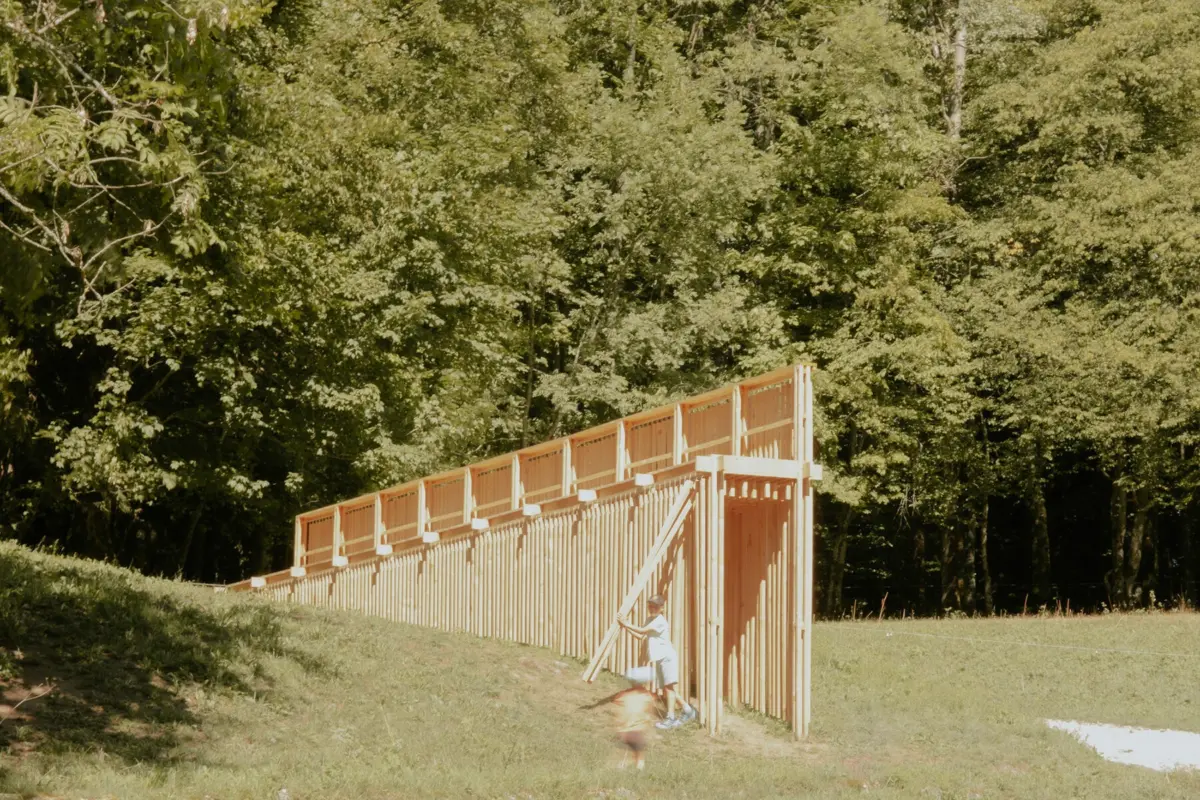
High above the commune of Faverges-Seythenex in the breathtaking French Alps, a long, slender timber structure cuts horizontally across a steep, grassy mountain slope. It is a temporary pavilion in form, but its architecture offers an entirely unexpected second use: visitors can pick up a wooden stick and actually play it. Comprising rows of suspended timber pieces, the installation produces a carefully sequenced progression of musical tones that travel along the length of the structure and echo out into the expansive valley below. Visitors who have already made the journey to experience the site recall how its warm, organic sounds effortlessly blend with the natural audio of the landscape, harmonizing with the whistling alpine wind and the distant clanging of cowbells that drift through the high-altitude terrain.
Called Le Bruit du Bois, which translates to The Sound of Wood, the fifteen-square-meter installation is the creative work of Antoine Aunave, Flora Peyrot, Mathilde Steenhaut, and Luc Loviton. The four talented young designers are students at ENSA Montpellier, a prominent architecture school in France. Their winning proposal triumphed in a competitive field, standing out among close to 200 entries submitted for the prestigious 2026 Festival des Cabanes. Now in its eleventh edition, the festival is renowned for commissioning temporary architectural interventions and placing them in scenic locations around the Sources du Lac d’Annecy, inviting the public to discover art and design in unexpected wilderness settings.
Nearly 1,000 Timber Chimes Tune the Valley
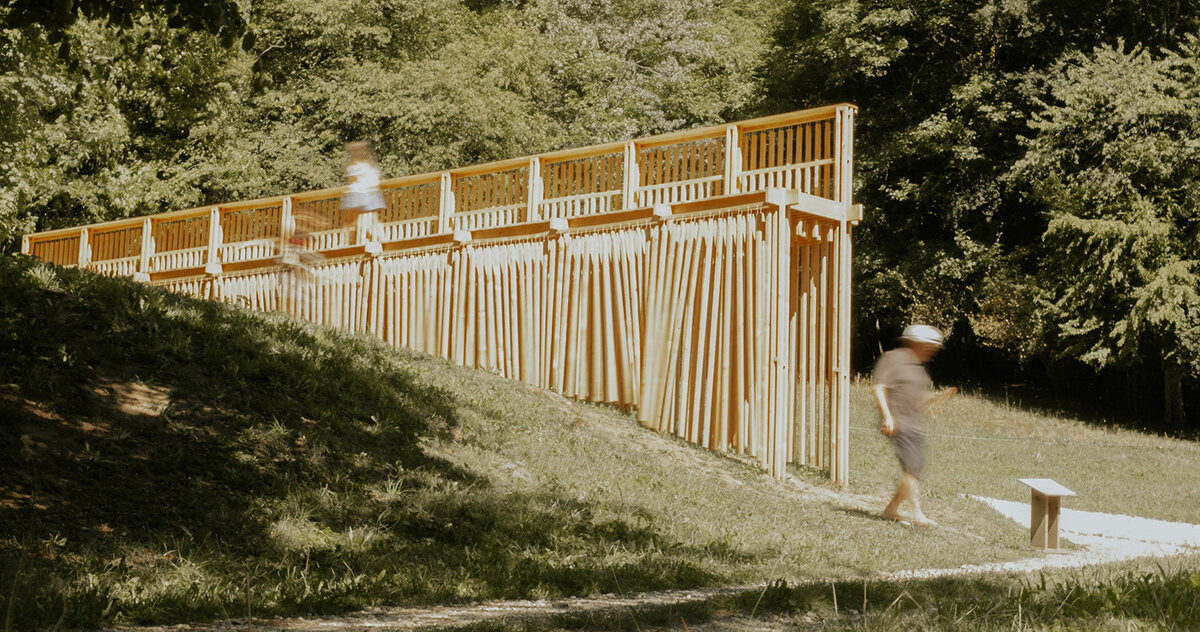
The true genius of the installation becomes immediately apparent the moment a visitor begins moving alongside The Sound of Wood pavilion. The individual timber elements vary systematically in length across the structure, ensuring that each discrete section produces a distinct tone or note. When someone runs a wooden stick across the rows, it triggers a cascading ripple of audio notes down the exterior wall. A single, sweeping gesture transforms the entire architectural elevation into something resembling an oversized, rustic xylophone, utilizing the wide-open geography of the surrounding alpine valley as a natural acoustic chamber.
Achieving this sonic and visual feat required the fabrication and installation of close to 1,000 individual wooden chimes. Crafting, tuning, and hanging this massive collection of elements formed a substantial portion of the labor-intensive construction process for the young team of designers. To bring the concept to life, Aunave, Peyrot, Steenhaut, and Loviton collaborated directly with a group of fellow architecture students, rolling up their sleeves to construct the ambitious project entirely on site.
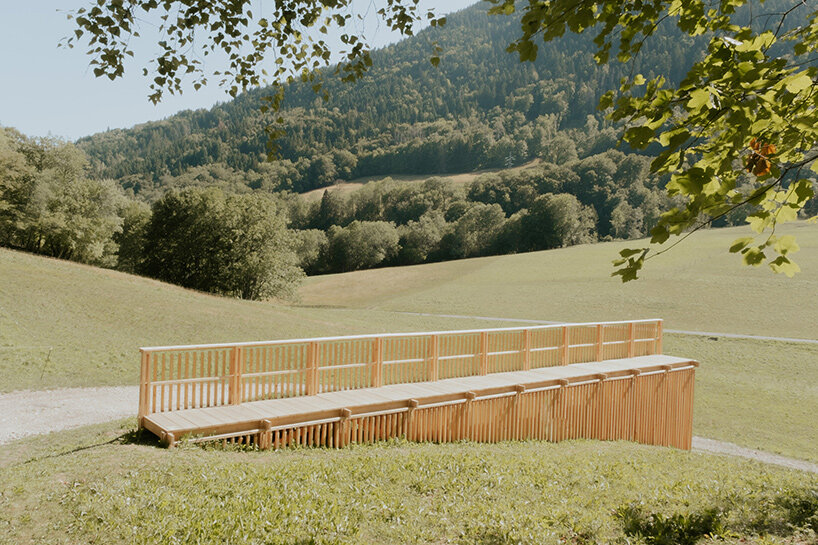
This profound repetition of slender wooden elements also gives the pavilion its distinct visual identity. Viewed from a distance across the dramatic mountain topography, the thousands of hanging pieces merge into a fine, delicate horizontal band that sharply contrasts against the steep green terrain. Up close, however, the deliberate gaps and spacing left between the chimes ensure that the landscape is never blocked; instead, the surrounding alpine views remain constantly visible through the perforated walls of the pavilion.
A Slender Batten Becomes Structure and Sound
At the very heart of the design strategy is a simple, unassuming timber batten measuring just four centimeters across in profile. This identical slender dimension is meticulously repeated throughout the entire construction of the pavilion, giving the architectural frame a sense of rhythmic consistency. Because of its narrow proportions, the wood bends slightly as it rises, reacting dynamically to passing gusts of wind with subtle, living movements. By relying on this single standardized profile, the architects managed to perform a dual function: the exact same piece of milled timber acts as both the primary structural support and the sound-generating instrument, allowing a straightforward material to shoulder the majority of the workload.
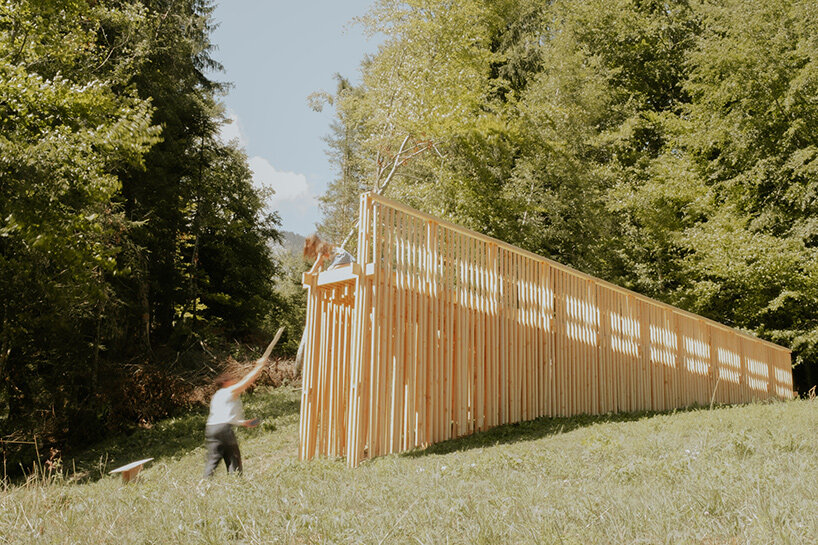
The pavilion is elevated slightly above the uneven, sloping ground on an integrated wooden walkway, complete with a handrail that traces one edge to guide visitors safely along the path. Its asymmetrical framing stretches significantly farther on the northern side, gently directing the approach of arriving hikers and guests before they step inward toward the denser, more immersive field of hanging wooden pieces. Once inside this threshold, the spatial experience shifts dramatically. The body is suddenly surrounded by walls of warm timber, yet the open intervals between the swinging chimes ensure that the sweeping vistas of the mountains and open fields remain perpetually within reach.
Architecture Joins the Existing Sounds of the Alps
The integration of sound gives this alpine cabin a profound, interactive relationship with its environment—a depth of connection that a purely visual, framed architectural view could never hope to achieve on its own. A visitor can initiate a cascade of wooden tones with a flick of a stick and listen as the notes decay, softly fading back into the vast stillness of the valley. At other times, when human hands are entirely absent, the mountain breeze moves independently through the slender array of wooden chimes, causing the pavilion to sing on its own accord. In this way, the structure constantly oscillates between an interactive instrument played actively by the public and a passive kinetic sculpture that responds organically to the shifting weather of the region.
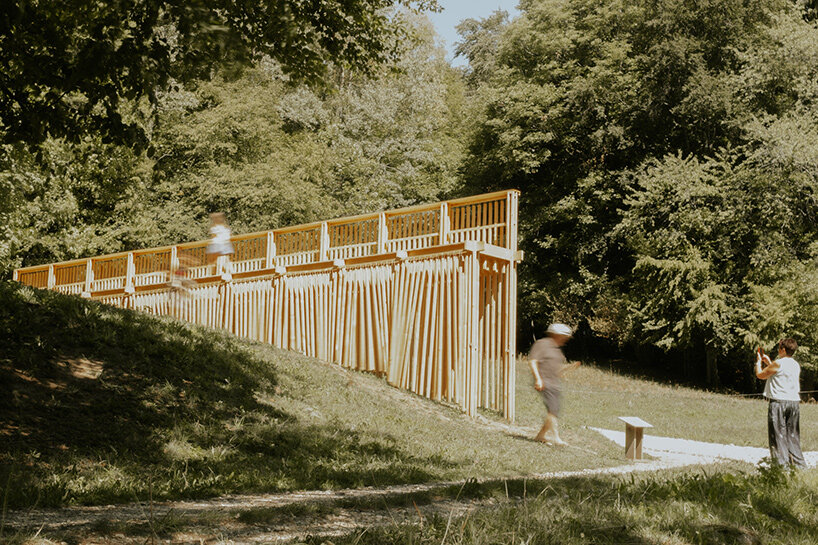
This participatory approach makes the installation a remarkably fitting addition to Le Festival des Cabanes. Dedicated to temporary architectural interventions scattered around the pristine landscapes of Lake Annecy, the festival encourages people to experience architecture through all of their senses. Le Bruit du Bois challenges its audience to listen just as intently as they look. What makes the project particularly compelling is its absolute simplicity and the restraint of its design; it relies on no heavy machinery, complex electronics, or artificial power sources. Instead, raw timber, human movement, and the natural acoustics of an open mountain valley are all it takes to turn a modest, fifteen-square-meter cabin into a resonant instrument whose voice carries far beyond its physical footprint.