



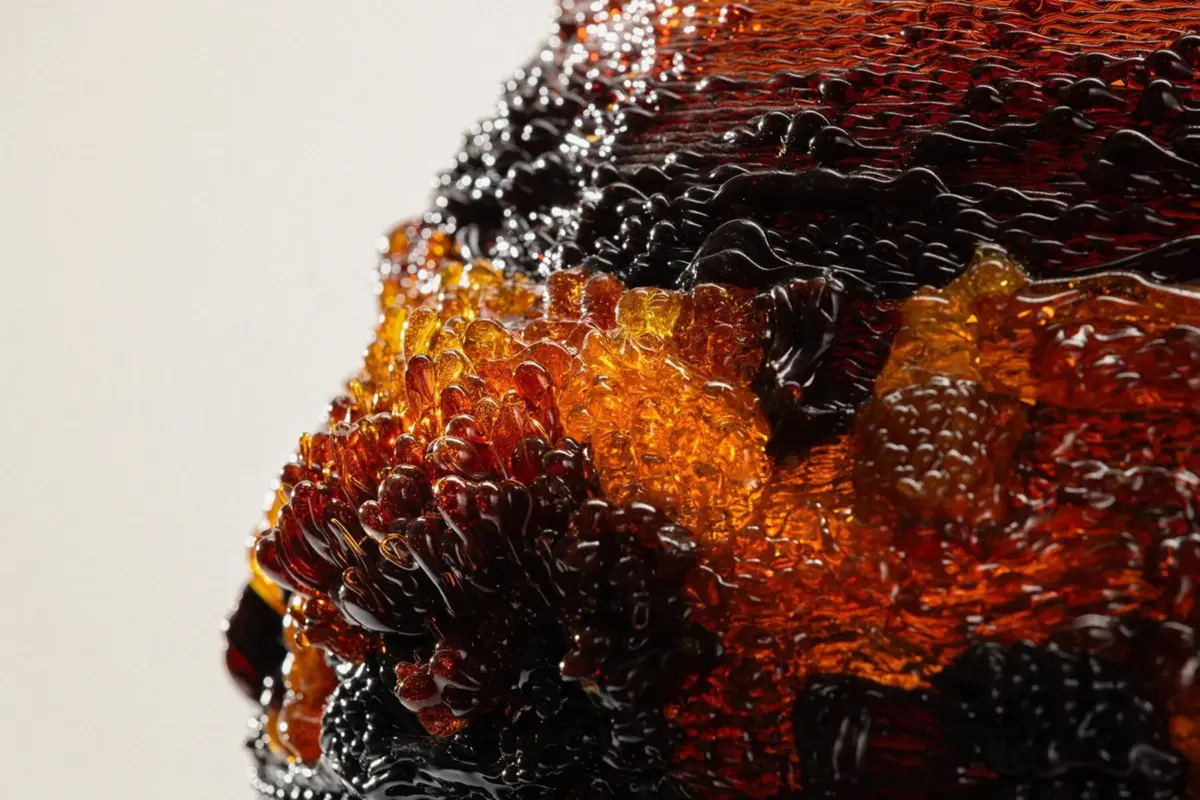
Brussels-based designer Ori Orisun Merhav is redefining the boundaries of material science and contemporary design through an ongoing exploration of multispecies collaboration. In her groundbreaking research practice, Made by Insects, Merhav harnesses a natural polymer produced by tiny lac insects, transforming their resinous secretions into luminous sculptures, avant-garde furniture, and experimental architectural installations.
By applying traditional glassblowing techniques and cutting-edge digital fabrication methods to a substance commercially known as shellac, the designer is challenging conventional manufacturing paradigms. Her work points toward a future where biological processes directly inform how humans inhabit and build the world. Following years of meticulous material research, Merhav’s innovative approach has earned her a prestigious 2026 Dutch Design Award, cementing her status as a visionary voice in the movement toward ecological and post-human design.
The Tiny Organisms Behind an Unlikely Material
At the heart of Merhav’s practice is Kerria lacca, a species of scale insect roughly the size of a grain of sand. These microscopic creatures lead a specialized existence, attaching themselves securely to the branches of host trees to feed on nutrient-rich sap. Through their natural biological processes, the insects metabolize the plant sugars, converting them into a viscous resin that hardens into a protective encasement around their bodies. This durable shell shields the insects throughout their development and reproductive cycles.
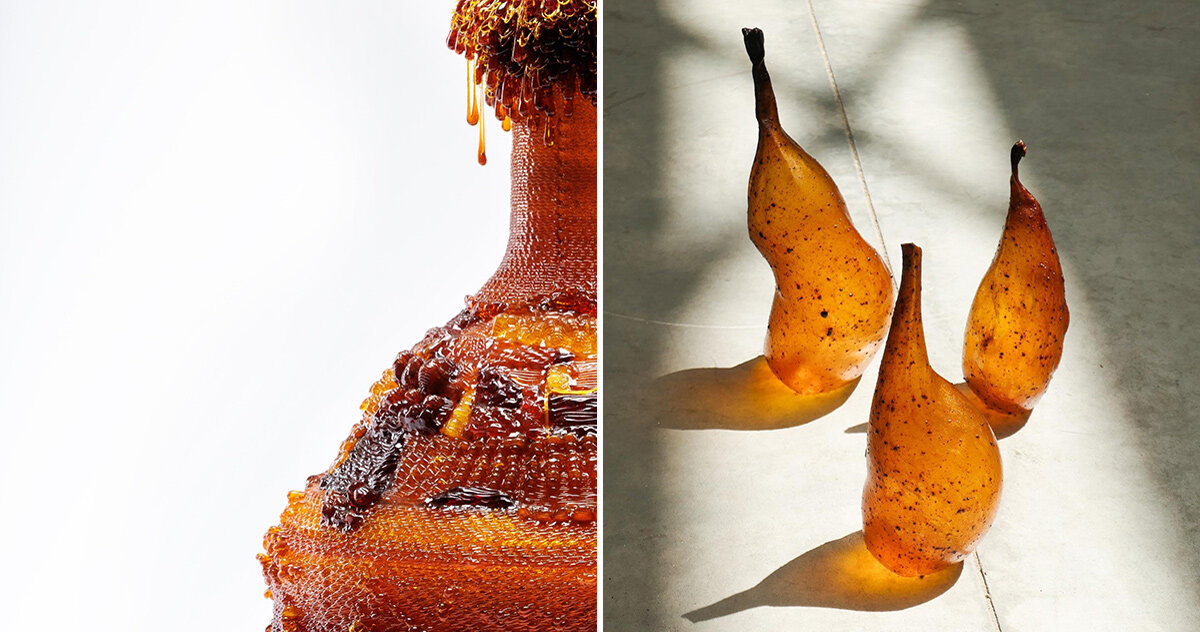
For centuries, humans have harvested this hardened resin from tree branches, washing and processing it into shellac—a substance traditionally utilized as a wood finish, protective coating, and historical thermoplastic. However, modern industrial manufacturing has largely sidelined natural shellac in favor of synthetic, petroleum-based polymers.
Merhav first encountered these remarkable insects during her studies at the Design Academy Eindhoven, where she became deeply captivated by interspecies ecological relationships and the inherent manufacturing capabilities of non-human organisms. Driven by a desire to understand the full lifecycle of the material, she traveled to Thailand to observe lac cultivation firsthand and engage directly with the agrarian communities responsible for harvesting the resin. This immersive fieldwork served as the foundation for her 2022 graduation project, The Lac Lab Open Source, an evolving archive of material experiments that eventually blossomed into her comprehensive research practice, Made by Insects.
Learning Architectural Logic From the Natural World
Returning to her studio in Brussels, Merhav began pushing shellac far beyond its conventional surface applications. Because the natural polymer softens when exposed to heat and solidifies as it cools, the designer realized she could manipulate it much like glass. Utilizing traditional glassblowing techniques, she began stretching the amber-colored material into delicate, ultra-thin membranes and blowing it into hollow, bulbous forms.
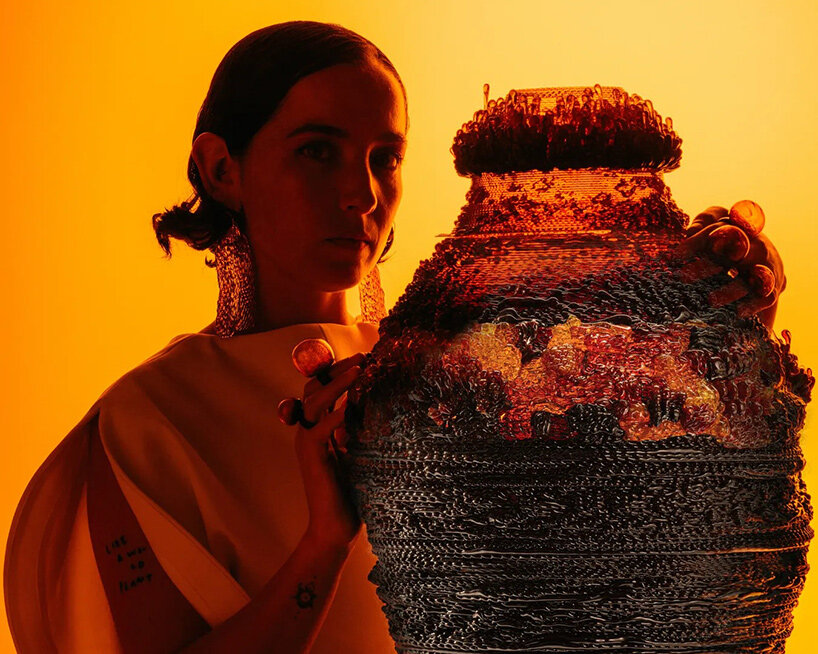
Her earliest experiments yielded large, isolated bubbles, yet their delicate structural walls proved exceptionally fragile and difficult to transport. Seeking a solution, Merhav returned to a closer observation of the insects’ native architecture. She discovered that the protective enclosures built by Kerria lacca are not singular massive shells, but rather intricate networks composed of countless smaller, tightly interconnected cells.
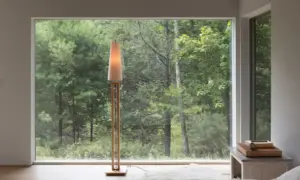
This critical realization fundamentally shifted her design methodology. Instead of forcing the material into large, unreinforced volumes, Merhav began blowing smaller quantities of resin and fusing them into complex, clustered structures. This biological mimicry gave rise to a sophisticated new design language, visible in striking works such as the Branching Insects Chandelier and Meet Me Under the Insects Tree. In these pieces, glowing amber bubbles propagate along slender, branching steel armatures, casting a warm, organic radiance through their uneven, textured surfaces. While the finished objects possess an unmistakably botanical aesthetic, their underlying structural logic is entirely derived from the resinous shelters forged by insects.
3D Printing a Polymer Crafted by Another Species
As her material explorations matured, Merhav expanded her practice into the realm of digital fabrication. Seeking to test the limits of natural polymers in modern manufacturing, she collaborated with specialized fabrication laboratories, including Ginger Additive, Reflexlab, and Aeditto, to produce her first 3D-printed shellac objects in 2023. She later deepened this line of inquiry through a partnership with material engineer Tom Samson and the Bio-Polymer Lab at Avans University of Applied Sciences in the Netherlands.
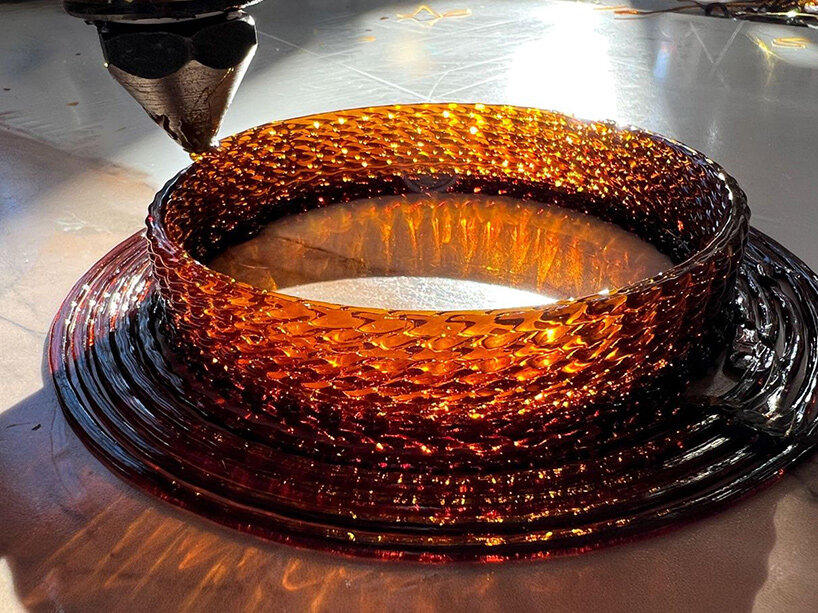
This experimental process explores whether a naturally occurring insect polymer can be successfully extruded through a 3D printer without requiring chemical modifications or synthetic additives. Temperature regulation and the material’s unique behavior during extrusion dictate how the forms take shape, intentionally leaving behind irregular surfaces, visible layers of hardened resin, and raw textural variations.
Her Morphogenesis vessel series offers a compelling window into this emerging manufacturing technique. These objects rise upward in undulating, cellular walls, where prominent ridges of deposited resin form dense, interwoven networks around hollow interiors. By bridging ancient biological processes with advanced digital tools, Merhav demonstrates how natural materials can be integrated into contemporary industrial workflows.
A Woven Insect Canopy Takes Shape in London
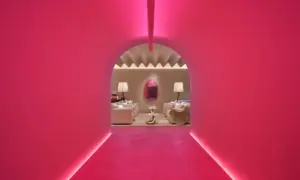
Merhav’s ongoing research recently materialized into a fully immersive environment with her solo exhibition at the Sarah Myerscough Gallery in London. Titled Portal Into The Multi-Species, the exhibition transformed the gallery’s entrance corridor through an installation of delicate shellac bubbles anchored to slender steel branches. Moving deeper into the space, the scale and texture of the works intensified significantly.
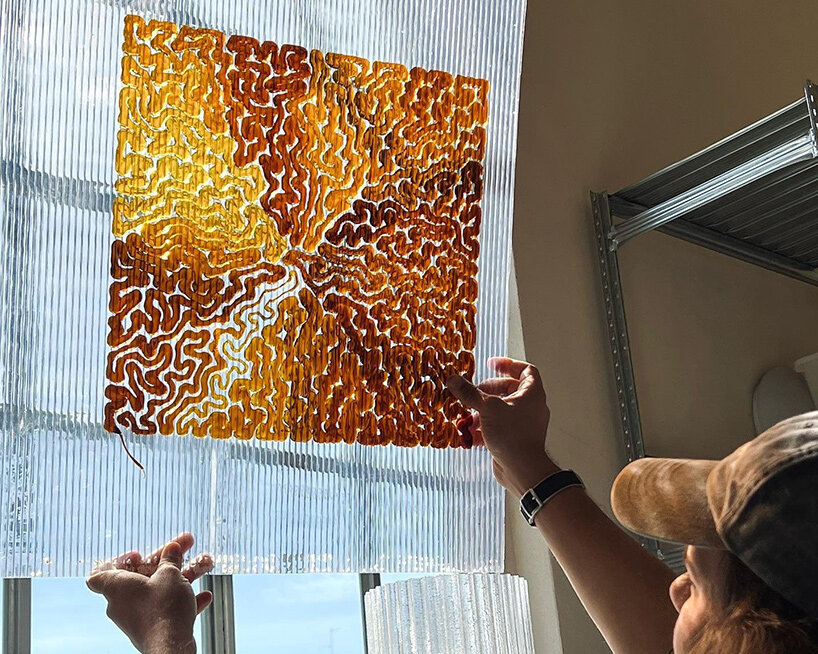
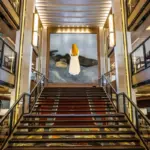
Among the exhibition’s centerpieces is The Woven Insect Canopy, an ambitious installation featuring natural palm sheaths coated in insect-produced resin and secured within sculptural steel supports. Illuminated from within by integrated LED lighting, the fibrous, amber-tinted surfaces reveal their intricate internal structures to viewers passing underneath.
The series encompasses distinct works such as Awakening, Regeneration, and Bifurcation—the latter standing at an impressive 140 centimeters in height. As light filters through the shellac-infused fibers, the underlying craftsmanship and biological origins of the materials become starkly apparent. Together, these pieces propose a radical vision of interior architecture shaped directly by interspecies collaboration, where a substance originally evolved for micro-scale insect survival is scaled up to form human-scaled shelter.
Reimagining the Origins of Our Built Environment
At its core, Merhav’s practice provokes critical questions regarding mutualism, agency, and the origins of the materials that surround everyday human life. The lifecycle of shellac depends on an intricate chain of ecological dependencies: the insects rely entirely on host trees for nourishment, farmers carefully manage forestry and reproductive cycles, and contemporary designers transform the harvested resin into functional objects.
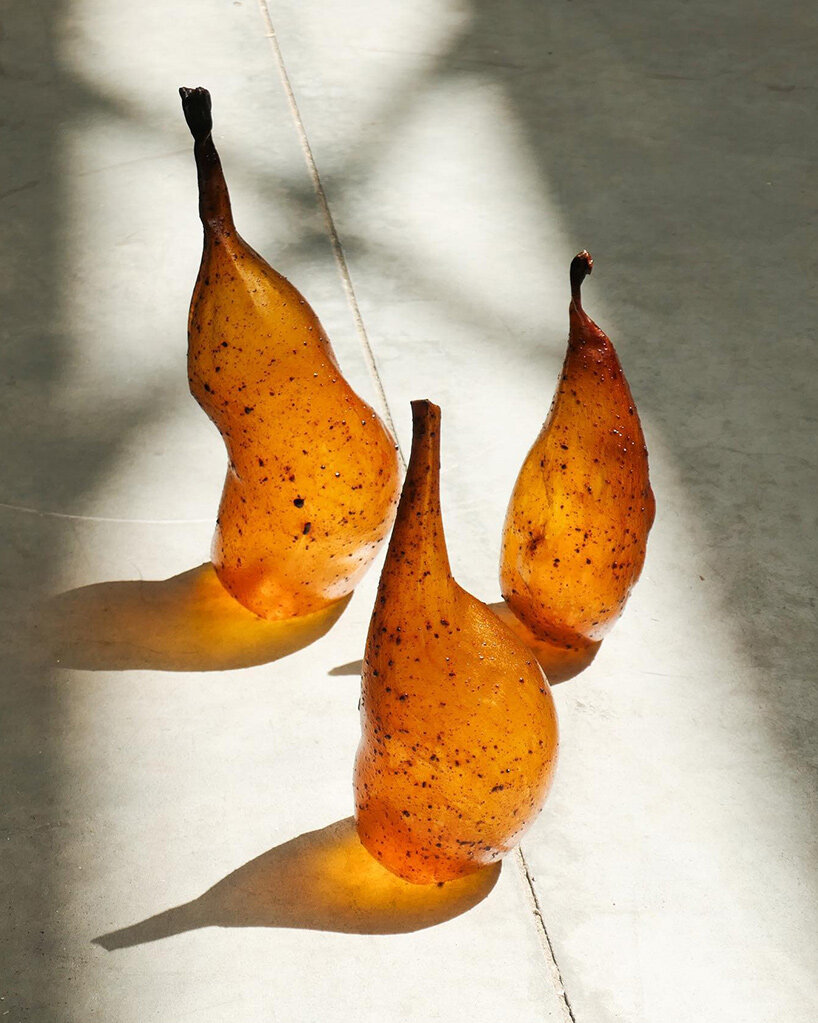
While the ecological realities of production are undeniably complex, Merhav’s research successfully highlights the multitude of non-human and human participants involved in material creation. Her lamps, vessels, and architectural canopies remain experimental, constantly negotiated by the intrinsic fragility of shellac and the rigorous demands of advanced fabrication. Yet, through her visionary lamps and structural vessels, Ori Orisun Merhav offers a tangible glimpse into an alternative manufacturing future—one where an insect secretes a polymer to survive on a distant tree branch, and generations later, a designer studies that precise geometry to pioneer new ways of building our world.