





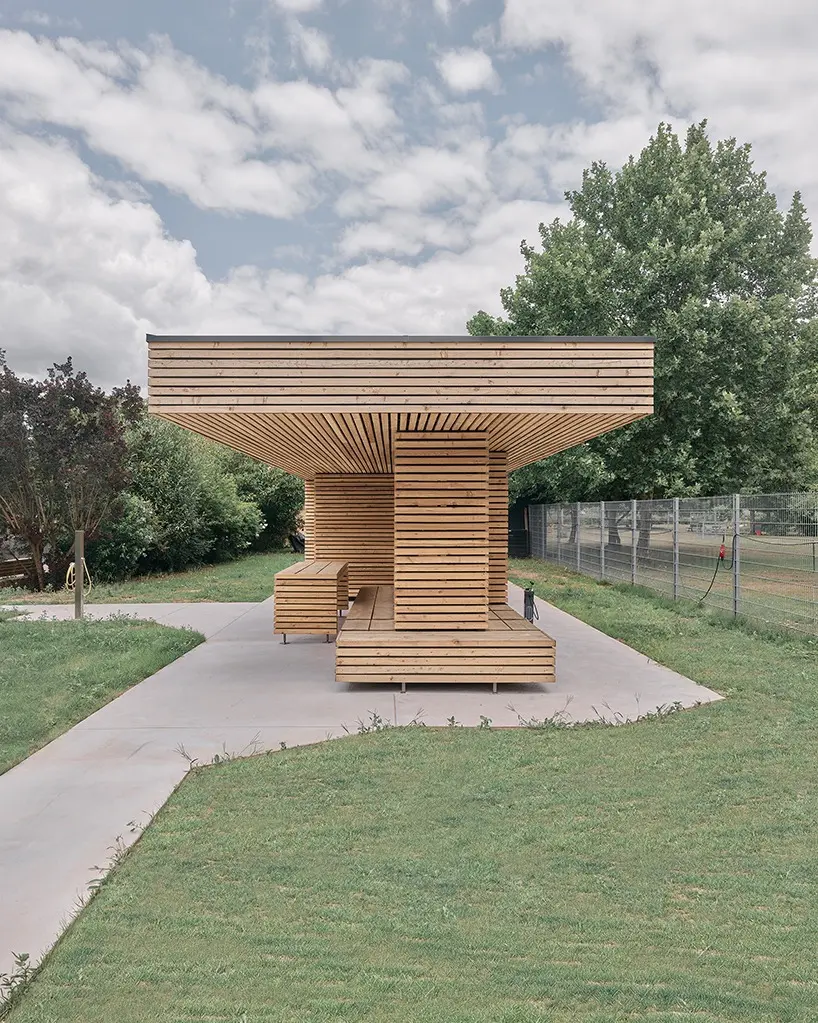
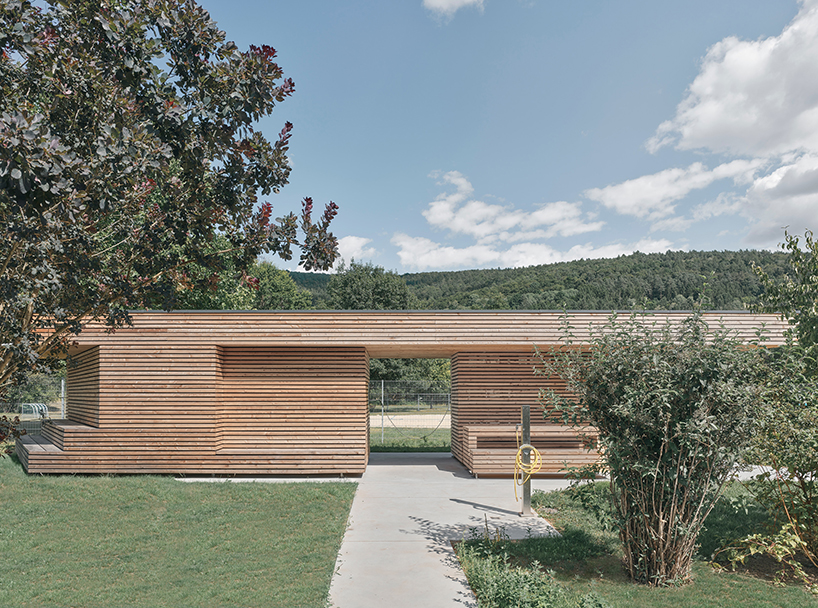
ToB.Studio has completed the Burgsinn Cycling Rest Station, a striking public service hub positioned along the D9 cycle route in Germany. Serving as a vital infrastructural link at the precise transition point between the urban fabric of the town and the surrounding natural landscape, the project reinterprets regional forestry traditions through contemporary architecture. Designed by the architectural practice and captured through the lens of photographer Benjamin Brückner, the compact building draws its primary visual and spatial cues from the familiar local geometry of stacked timber logs.
The facility addresses the growing demand for modern, sustainable transit infrastructure while integrating seamlessly into its rural environment. By offering a comprehensive suite of digital and physical amenities, the station supports cyclists, local residents, and visitors to the nearby public swimming pool alike. Its architectural concept marries vernacular references with cutting-edge sustainable construction methods, establishing a benchmark for rural public architecture along popular touring routes.
Log Pile Geometry Shapes Timber Cycling Hub
The foundational concept behind the Burgsinn Cycling Rest Station centers on a solid, volumetric massing that evokes a stack of harvested timber logs. This bold design choice pays direct homage to the rich forestry history of the region, embedding a narrative of local industry and natural material use into the architecture itself. Rather than appearing as an alien addition to the landscape, the building feels rooted in its geographic context.
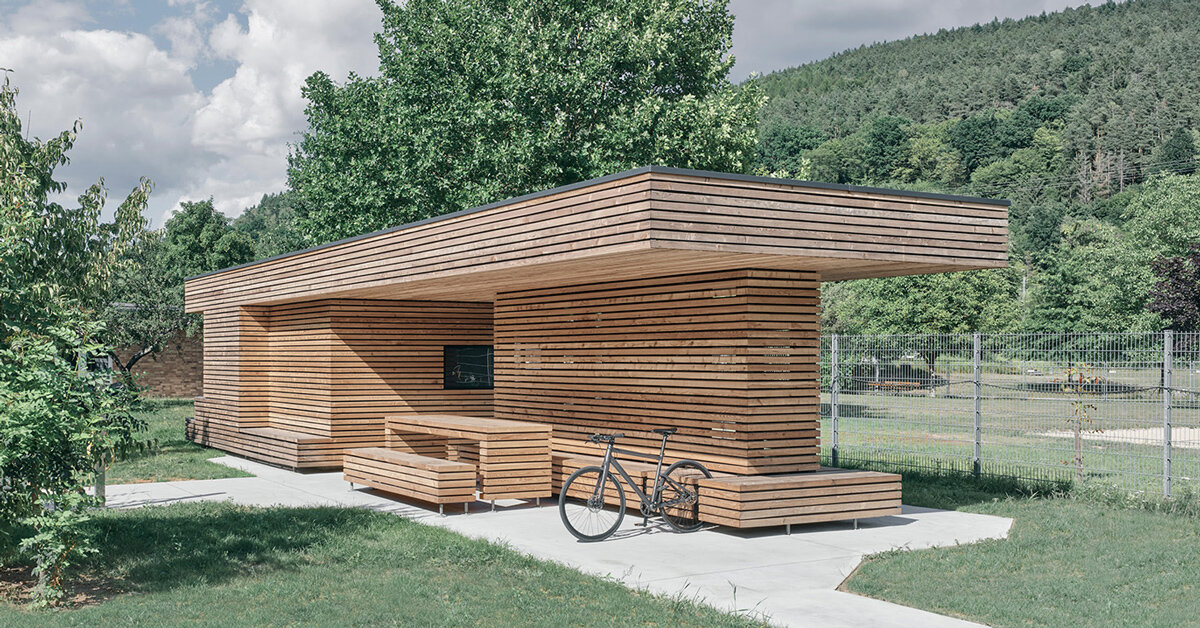
The solid volume of the structure is carved away at strategic points, creating a series of deep niches that accommodate sheltered seating areas, main entrances, and functional service points. These cutouts allow the building to open up in multiple directions, inviting travelers to arrive, rest, and congregate. Hovering above these dynamic spatial interactions is a broad, overhanging green roof that provides natural weather protection, thermal regulation, and a living canopy that enhances the biodiversity of the site.
Rough-Sawn Larch Cladding Wraps Bike Station’s Exterior
Material selection plays a critical role in the identity and ecological footprint of the Burgsinn Cycling Rest Station. The exterior of the compact building is wrapped in rough-sawn larch cladding, a locally sourced timber renowned for its durability and weathering characteristics. Left untreated, the wood will naturally age over time, further embedding the structure into its surrounding landscape as it develops a silvery patina.
Beneath the wooden exterior, the building employs a prefabricated timber frame engineered according to stringent Design for Disassembly principles. This construction methodology utilizes reversible mechanical connections rather than permanent adhesives or composite materials, facilitating straightforward future maintenance, component replacement, and eventual material-specific recycling at the end of the building’s lifecycle.
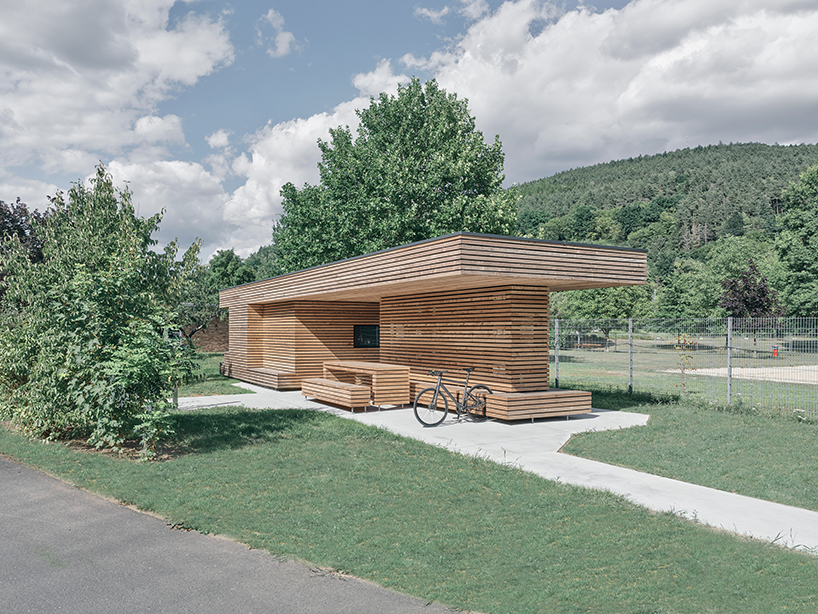
The wall assembly is refreshingly straightforward, featuring natural wood-fiber insulation within a membrane-free framework that promotes breathability and moisture regulation. Rather than relying on a complex subterranean foundation network, the entire structure rests upon a single reinforced-concrete slab. This robust slab serves a triple function: it acts as the primary foundation, functions as an engineered flood barrier to protect against seasonal weather events, and provides the finished, polished floor surface for the interior spaces.
Comprehensive Public Amenities for Cyclists and Community
Beyond its architectural and structural innovations, the Burgsinn Cycling Rest Station is designed as a fully equipped public service hub. Recognizing the evolving needs of modern cyclists—particularly with the widespread adoption of power-assisted transit—the station integrates dedicated e-bike charging stations powered by sustainable energy concepts. These charging points ensure that long-distance travelers can quickly recharge their vehicles while taking a well-deserved break.
In addition to power infrastructure, the facility provides comprehensive maintenance and upkeep amenities. A specialized repair and wash area is integrated into the site, giving cyclists the tools and space needed to tune up their bicycles, fix flat tires, or clean off mud and road debris before continuing their journeys. To keep travelers informed, digital information displays are installed on-site, offering real-time data on local weather conditions, regional cycle routes, public transit schedules, and community events.
The station also bridges the gap between a simple travel stop and a comfortable community amenity by including fully accessible public restrooms and shower facilities. These amenities are designed to accommodate all visitors, including individuals with mobility challenges, ensuring universal access. By combining practical mechanical infrastructure with high-quality social and sanitary spaces, ToB.Studio’s timber bike station transforms a routine transit stop into a welcoming destination along the D9 route.