





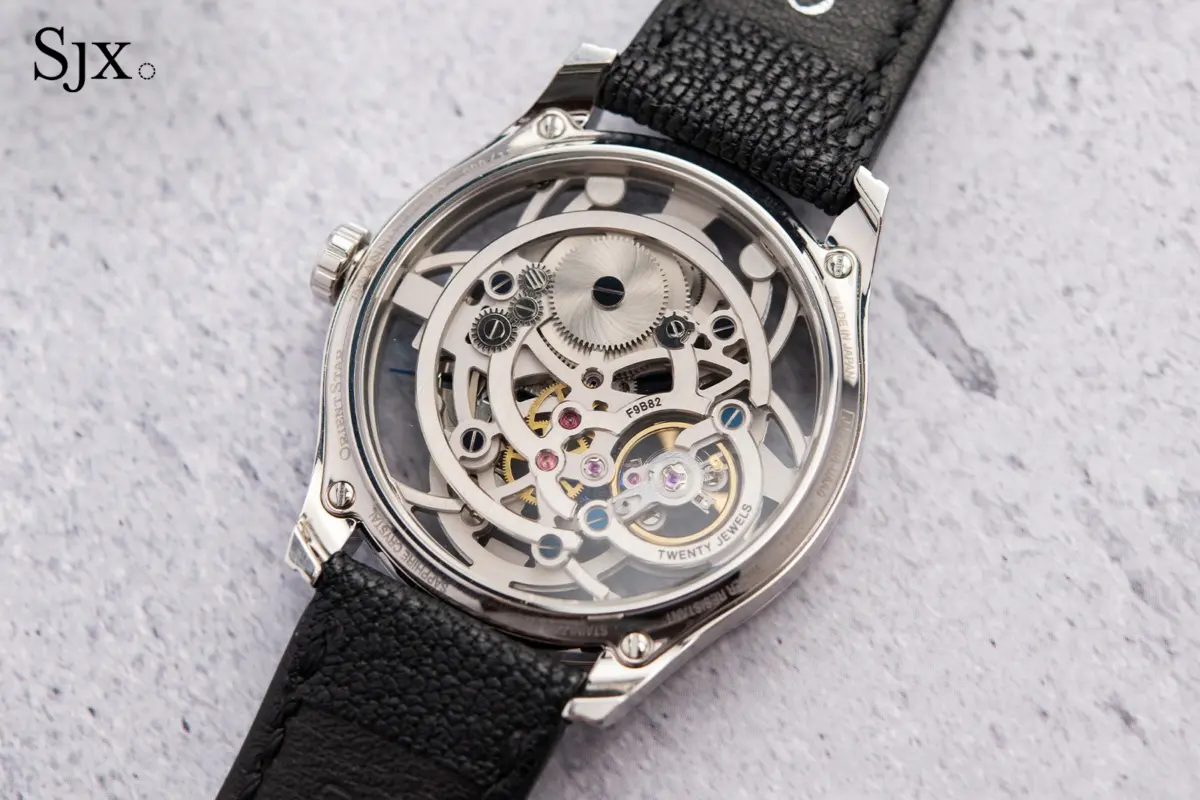
Orient Star is marking a monumental chapter in its history with the release of the ambitious new Orient Star Skeleton 75th Anniversary Flagship Model, reference RE-BR0001N. This striking timepiece represents a convergence of two major milestones for the Japanese brand: celebrating 75 years as an esteemed watch manufacture and commemorating 35 years of dedicated expertise in crafting skeletonised watches. Issued as an exclusive, limited edition of just 130 pieces globally, this flagship release introduces the brand-new F9 movement family. By combining some of Orient Star’s finest finishing techniques and advanced horological technology—including a prominent blue silicon escape wheel and gleaming diamond-milled chamfers inside a zaratsu-polished stainless steel case—the brand has positioned this model as a bold statement of intent for the future of high-end Japanese watchmaking.
Initial thoughts
When evaluating the design of the open-worked dial plate, Orient Star points to three distinct aesthetic inspirations drawn from traditional Japanese culture and the cosmos: the serene ripples of a Zen garden, the intentional use of negative space known in Japanese as ma, and the orbital paths of planets. This astral theme has long underpinned Orient Star’s higher-end design philosophy, and the resulting overlapping circular motifs create a visually appealing geometry that provides ample surface area for intricate decoration.
The Orient Star Skeleton is, by its very nature, a movement-forward timepiece. Its mechanical heart, the calibre F9B82, is proudly displayed beneath a chamfered dial plate that frames the rotating components. However, there is considerably more to this skeleton watch than just its open-worked dial. The gleaming stainless steel case is as sharp, clean, and mirror-bright as connoisseurs have come to expect from top-tier Japanese luxury watchmaking. This elevated level of exterior finishing directly addresses a relative weakness of past collections and helps justify the brand’s confident entry into a significantly higher price segment.

While the interlocking ring motif brings a sense of structural order and visual harmony to the dial, the balance wheel is arguably emphasized to a degree that occasionally interrupts the overall symmetry. This pattern interruption feels somewhat abrupt in part because it reveals the less decorative underside of the balance wheel. Even with these minute artistic choices, the watch stands unquestionably as the most luxurious Orient Star Skeleton produced to date. With a retail price of US$8,000, it is also the brand’s most expensive contemporary offering. By planning a strict production run of just 130 pieces, Orient Star is demonstrating profound confidence in its new product, notwithstanding its elevated upmarket positioning.
Of course, an $8,000 price tag is high only when compared against Orient Star’s traditional baseline of accessible mechanical watches. When evaluated alongside Swiss skeleton watches offering comparable levels of finishing, technical sophistication, and material quality, the pricing begins to align more closely with industry standards. To further instill consumer confidence, Orient Star has backed the release with an extensive 10-year warranty, which includes up to three complimentary full services during this period for owners who choose to follow the brand’s recommended service interval of every three to five years.
The star of the show
Although the open-worked dial plate gleams brightly at arm’s length, a closer inspection reveals a degree of meticulous hand craftsmanship that remains uncommon in this market segment. The fine black accent lines across the dial architecture, for instance, are not simply printed using conventional industrial methods. Instead, the recessed grooves are carefully flooded with black ink applied manually via a handheld syringe, adding remarkable depth to both the color saturation and the underlying geometry. Similarly, the vertically brushed texture found on components is executed freehand by dragging the dial plate across a specialized abrasive surface.

The polished chamfers framing the cutouts are diamond-cut, a precision process that, when executed correctly, yields an exceptionally smooth, mirror-like surface. Single-point diamond turning, utilizing a stationary diamond cutter against a spinning workpiece, is a technique traditionally reserved for high-end components such as Grand Seiko dial furniture and Patek Philippe movement parts. The inverse method—employing a spinning cutter against a stationary workpiece—is frequently used to machine bevels on movement bridges and plates. While this latter approach is notoriously vulnerable to microscopic chatter during the cutting process, the resulting smoothness of these bevels on the F9B82 is notably above average.
The dial plate serves as a dramatic frame for Orient Star’s Milky Way-styled silicon escape wheel. While silicon components disrupted and transformed the Swiss watch industry years ago, Orient Star remains the first and only Japanese watch brand to successfully adopt and manufacture with the material. Whereas traditional metal escape wheels can be press-fit or riveted into place without complication, silicon parts demand a much lighter, more delicate touch. Rather than gluing the escape wheel into position—which remains standard practice across much of the industry—Seiko Epson engineers engineered a series of flexible, micro-machined arms directly into the escape wheel itself, allowing it to tightly and securely hug the escape pinion.
The vivid, iridescent blue color of the escape wheel originates from an ultra-thin layer of poly-crystalline silicon. The exact thickness of this layer dictates the specific wavelength of reflected light, creating hues that can shift from blue-green to deep purple. This optical phenomenon mirrors the traditional heat-blued steel hands found in classical watchmaking, where heating carbon steel causes it to react with atmospheric oxygen to form a protective and colorful oxide layer.

In this specific model, the process is complicated further by the skeletonized design of the dauphine-style hands. Because of their open-worked structure, heating can be uneven, leading to inconsistent oxide-layer thickness and potentially blotchy coloring. Due to these strict aesthetic demands, the production failure rate hovers around 50 percent, meaning that only half of the hands produced ultimately pass inspection and are deemed suitable for the flagship model.
As a final decorative flourish unique to this anniversary reference, the heads of the screws used to affix the dial plate directly to the movement are meticulously lapped. This finishing step imparts an exceptionally flat, mirror-finished surface to the dial-side screw heads, causing them to visually shift into a deep, light-absorbing black when viewed from certain angles.
An elevated case
While previous high-end Orient Star models featured components crafted by Seiko Epson’s renowned Shinshu Watch Studio—a historic center of excellence for elite Japanese watchmaking—this release marks the brand’s very first timepiece where the watch case is manufactured there as well. The resulting difference in quality, sharpness, and polish between this case and those of standard Orient Star references is immediately apparent.

The case construction is significantly more complex, particularly around the architecture of the lugs, and benefits from comprehensive zaratsu polishing. This traditional mirror-finishing technique, closely associated with the finest Grand Seiko timepieces, utilizes the flat side of a spinning tin lap plate to create a distortion-free, mirror-like surface that cannot be replicated using conventional, softer polishing wheels.
The case back is secured using four robust screws positioned neatly behind the lugs. This mounting method, reminiscent of techniques used on early Spring Drive watches, permits thinner case walls—an ideal characteristic for a skeletonized watch. This design choice gave Orient Star the structural freedom to expand the base movement from its previous 27.6 mm diameter to a pocket watch-sized 36 mm, allowing it to comfortably fill the 40 mm case interior without requiring a plastic or metal spacer ring. Moreover, the overall case is remarkably well-proportioned, measuring a slender 9.5 mm in height.
Orient Star did not merely enlarge the dial plate to fit the expanded case architecture; the brand fully optimized the interior space by rearranging the gear train, aligning the balance wheel, escapement, and fourth wheel in a clean, straight visual line. Furthermore, the open-worked dial plate appears strikingly vivid thanks to the dual-sided anti-reflective coating applied to the sapphire crystal. This specialized treatment causes the crystal to virtually disappear from view without casting the typical blue glare associated with lower-grade crystals, though the exhibition case back crystal remains uncoated.

Completing the exterior presentation is a strap fashioned from hand-massaged, vegetable-tanned goat leather. The material is remarkably supple and comfortable on the wrist while possessing the durability required for long-term daily wear.
A next-generation calibre
While the inaugural movement of the F9 calibre family prioritizes visual aesthetics and open-worked architecture, it also introduces several notable technical enhancements over Orient Star’s preceding F8 platform. Most prominent among these is the addition of an eccentric screw to the balance regulator, which allows for vastly more precise rate adjustments.
The practical difference in daily operation is easily quantifiable: moving a conventional regulator pin directly by a single degree alters the rate by roughly 15 seconds per day, whereas turning the F9’s eccentric screw by the exact same degree adjusts the rate by only about one second per day. Consequently, Orient Star has tightened the official timekeeping tolerances for the F9B82 to an impressive +10 to -4 seconds per day.

To optimize energy transmission and reduce mechanical friction, the leaves of the second, third, and fourth wheel pinions are hand-buffed individually using fine abrasive powder and a traditional boxwood polishing wheel. While highly labor-intensive, this artisanal finishing trick is famously utilized in Spring Drive manufacturing to maximize power delivery and efficiency. In the F9B82, this functional finishing successfully yields an additional two hours of operating autonomy, bringing the total power reserve up to a robust three full days.
Key facts and price
Orient Star Skeleton
Ref. RE-BR0001N
Diameter: 40 mm
Height: 9.5 mm
Material: Stainless steel
Crystal: Sapphire
Water resistance: 30 m

Movement: F9B82
Functions: Hours, minutes, seconds, and power reserve indicator
Frequency: 21,600 vibrations per hour (3 Hz)
Winding: Hand-wound
Power reserve: 72 hours
Strap: Black goat leather with a stainless steel folding clasp
Limited edition: Yes, 130 pieces globally
Availability: From December 2026 at authorized retailers and the official Orient Star online store
Price: US$8,000 excluding taxes (JPY 1,100,000)