






It is hard to believe that a quarter-century has passed since Balenciaga’s Le City bag first arrived on the global fashion scene. With a design riffing on a classic motorcycle jacket and a distinct sans-logo attitude, the accessory was unapologetically cool from day one. Now, twenty-five years later, that span of time is long enough that some fashion enthusiasts view the bag primarily through a lens of profound nostalgia, while younger generations are discovering its coveted "It-status" for the very first time.
Against the backdrop of the mythic fashion house’s continuous creative evolutions—including leadership shifts from Nicolas Ghesquière through Alexander Wang and Demna, who proposed his own updated iteration, the Neo City, in 2020—Le City remains an enduring constant. It has successfully ridden out every era of the brand’s modern history without ever losing its cultural cachet.
To celebrate this milestone, Balenciaga is launching a series of celebratory activations across several major cities around the world. The immersive pop-up experience, dubbed Le City House, will debut in its Paris hometown for a nine-day residency before traveling to New York, Tokyo, Shanghai, Beijing, and Seoul through the end of the year. These spaces also serve as the launchpad for a major collaborative project with the provocative contemporary artist Damien Hirst. Titled "Damienciaga," the limited-edition capsule collection transposes some of Hirst’s most famous artistic motifs directly onto the bag’s characteristic Arena leather.
Days before the official global reveal, a site visit to the historic address at 10 Avenue George V—where founder Cristóbal Balenciaga established his original atelier and where customers more recently purchased Demna’s haute couture creations—offered a glimpse into the anniversary space. Le City House is designed as a multi-modal, Y2K-coded experience that feels sleek, visitor-friendly, and undeniably playful.
Upon entering the Parisian venue, visitors are greeted by a rare prototype of Le City from 2001. Compact and rendered in brown cotton canvas, it sits inside a see-through cube atop a Parisian bench painted in a glossy shade of blue. Beyond the entrance lies a floor-to-ceiling display of Le City variations that serve as visual eye candy: bags rendered in vivid shades of Maldives Green and Ultra Violet, executed in surface treatments like tweed panels and brogue trims, and displayed alongside novelty one-offs. Among these collector’s pieces is Ghesquière’s original Multicolor City Mondriaan in red, yellow, and blue.
Nearby, a series of "closets" showcase authentic bags belonging to prominent celebrity collectors, including Nicole Ritchie, French footballer Hugo Ekitike, Clémence Poésy, and Isabelle Huppert. Each global Le City House will feature a different rotation of boldface names, with the displays propped up by daily items and vintage BlackBerry devices from the mid-2000s that double as playful owner labels—such as Ritchie’s device dating back to 2005. Small screens flash iconic Parisian landmarks while a full-length digital panel rotates editorial spreads, street style images, and classic paparazzi photographs featuring style icons like Kate Moss, Chloë Sevigny, Mary-Kate Olsen, and Sienna Miller. Yet, despite the star-studded imagery, Le City remains the undisputed focal point of the installation.

Further back in the space, past a metal railing bedecked with heavy padlocks, lies a dedicated room housing Damien Hirst’s creations. The most rarefied piece in the collection is done entirely by hand, doused in vibrant splashes of pigment reminiscent of his famous Spin Paintings, and limited to an ultra-exclusive edition of just 25 pieces. Other items from the collaboration—featuring his multicolored spots arranged like butterfly wings, a mandala of wings, a uniform grid of dots, and a compilation of his iconic concepts rendered as embroidered patches—will be made more widely available to collectors.
A secondary space within the activation, appropriately dubbed "Le Salon," functions much like a high-end leather workshop-turned-bag spa. Artisans stationed on Platner stools are on hand to personalize bags for clients, replacing the delicate lacing along the top handles, offering custom charms, and hand-painting or etching initials onto the rectangular pocket mirror that has remained one of Le City’s defining functional details. Visitors can also schedule appointments to have their vintage bags assessed for specialized refresh services.
The experience concludes with a photo kiosk programmed to mimic a late-1990s teen magazine personality quiz. Instead of prompting users about their celebrity crushes or future careers, however, the interactive screen determines which specific version of Le City matches their personality. One result might yield Le City Moto, described as "Bold, confident, and a little rebellious," while another suggests Le City Mini Backpack for those whose "match understands that you have your hands full." While visitors do not walk away with a complimentary handbag, the playful touch captures the pop-culture spirit of the era.
While Le City House represents a vibrant, public-facing commemoration of Balenciaga’s best-selling handbag, the maison’s vast, temperature- and humidity-controlled archive on the outskirts of Paris provides deeper historical context. Guided by Heritage and Cultural Director Gaspard de Massé, the 3,000-square-meter facility houses institutional mobile shelving units filled with patrimonial furniture, Cristóbal Balenciaga’s actual library, and two striking standalone paintings: one by Bernard Buffet depicting his wife, Annabel, wearing a pink Balenciaga gown, and another of Gabrielle Chanel dressed in a sophisticated white ensemble by A.M. Cassandre.
Deep within the archive are the rows of pristine Le City models preserved directly from the workshops. With approximately 879 variations counted to date, the sheer variety is staggering. Every conceivable shade is represented alongside technical evolutions, such as burnished studs that morphed to resemble sewing thimbles, brogue trims evoking traditional Derby shoes, and alternative structural formats like the Part Time with its distinctive center seam and the square Velo format, which was originally designed to fit neatly inside a bicycle basket.
Reflecting on how Le City managed to endure as a hero piece for a quarter-century, De Massé points to its distinct visual identity. "I think it’s extremely identifiable, and because of that, it doesn’t really feel like taking a risk," he explains. "You know that you’re buying this particular bag for a specific reason; and undoubtedly, part of that reason is that you’re joining all those other people who already own one. There’s something of a community spirit around it; it’s not an exclusively ultra-luxury community, nor is it mass market. It occupies this interesting space somewhere in between."
He adds that for contemporary generations, the accessory acts as a form of cultural memory. "For today’s generations, it can also function as a kind of madeleine de Proust, something that evokes a particular moment or memory. I remember Britney Spears in the 2000s, for example. Even if I didn’t personally experience that period in the same way, those images are part of my imagination, and the bag allows me to reconnect with an aesthetic or a moment that I liked. There’s something reassuring about that."

Few accessories in modern fashion history have maintained such profound staying power independently of aggressive promotional machines or short-lived hype cycles. Part of Le City’s enduring appeal lies in its practicality. The slouchy, non-boxy silhouette proved effortlessly easy to carry, and the signature Arena leather was designed to look comfortably lived-in from the start, growing more cherished as it accumulated the gentle scuffs of everyday life. Mary-Kate Olsen’s long-standing attachment to her mint green bag—cherished not despite, but perhaps because of, a prominent red wine stain—remains a legendary example of the bag’s resilient charm.
Although Le City has never required a radical reinvention, the design was carefully updated in 2024 following an extensive study of various vintage styles. The resulting construction, hand-assembled from 25 distinct panels, represents a faithful amalgamation of its historical iterations. That relaunch was heralded by a portrait campaign lensed by Mario Sorrenti, starring Kate Moss alongside Mona Tougaard, Juyeon, and Yang Chaoyue. An ultra-luxe version subsequently marked the bag’s first-ever appearance on the runway, coinciding with Pierpaolo Piccioli’s debut, followed by a reunion campaign photographed by David Sims, Le City’s original fashion photographer.
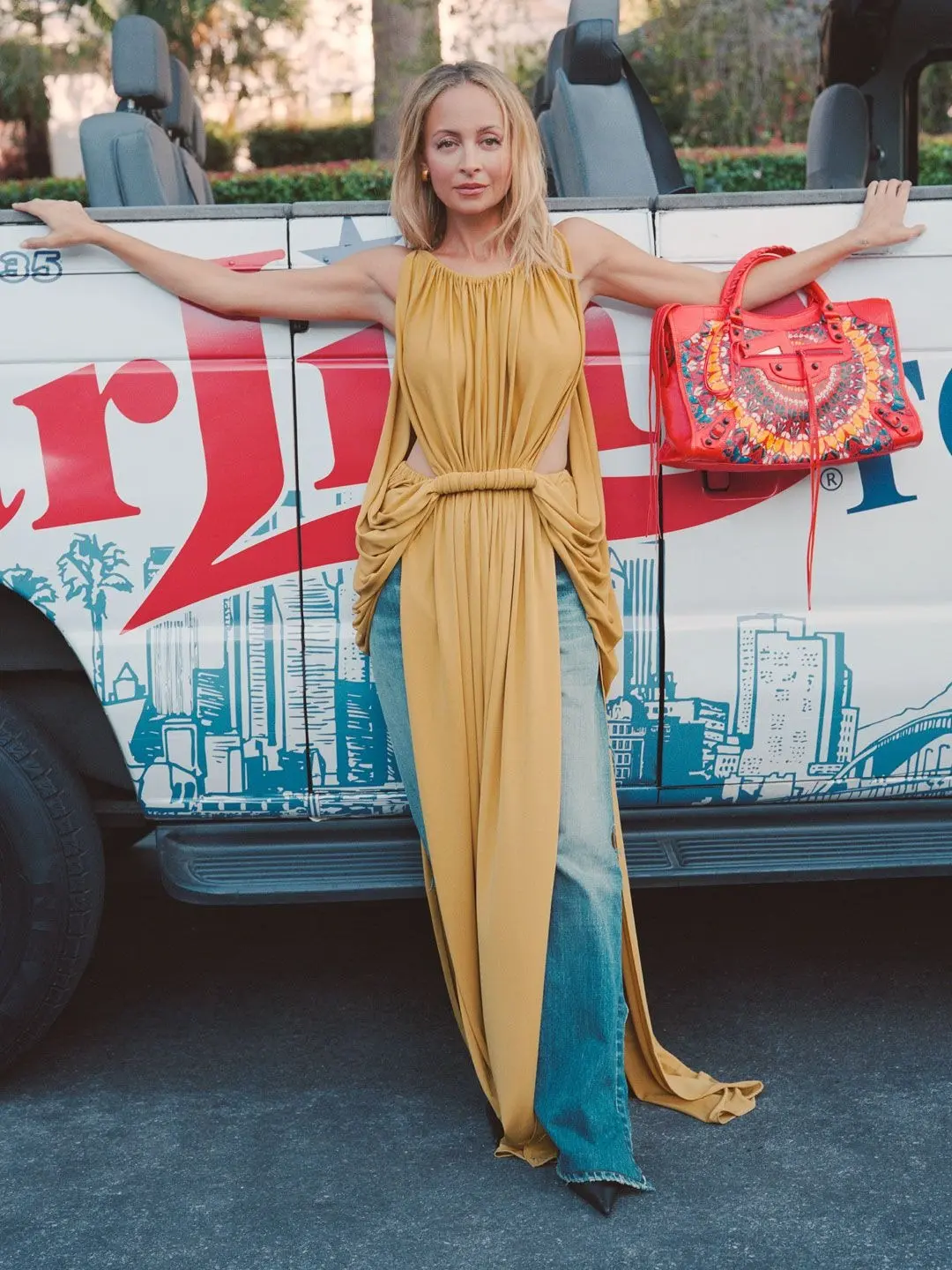
The campaign imagery for the new Damien Hirst collaboration features Nicole Ritchie draped in a yellow top over denim, holding the mandala butterfly bag on her forearm, while Hugo Ekitike cradles a patchwork style along the banks of the Seine. For Hirst, the bag was already deeply ingrained in his cultural consciousness long before the partnership materialized. "I think everyone knows it, don’t they? It’s one of the most iconic bags of the last 25 years," Hirst shared via email. "You associate it with the noughties, with Kate Moss, yet it’s still remained so relevant."
While Hirst is widely known for more jarring conceptual works—such as preserving sharks in formaldehyde tanks or encrusting human skulls with diamonds—his contribution to the Balenciaga collaboration retains a subtle sense of subversion. His original Spot Paintings were famously named after pharmaceutical drugs and chemical compounds, while his butterfly mandalas have long alluded to themes of mortality, spirituality, and the passage of time.
The 25 hand-painted Le City bags are expected to hold significant collector value, their thick layers of vivid pigment leaving barely a trace of the original leather surface beneath. For Hirst, however, the ultimate success of the project lies in how individual owners interact with the pieces. "It’s not just a ‘Balenciaga’ or a ‘Hirst’… they’re adding their personality to it. And I think that’s what fashion is all about."
As global activations introduce new audiences to an aesthetic that predates the era of quiet luxury, the anniversary confirms that Le City is firmly back in the cultural conversation. To mark the occasion, the Le City x Hirst collection features a subtle new signature detail: the hybrid name "Damienciaga" etched in fine silver script along the side of the bag.