






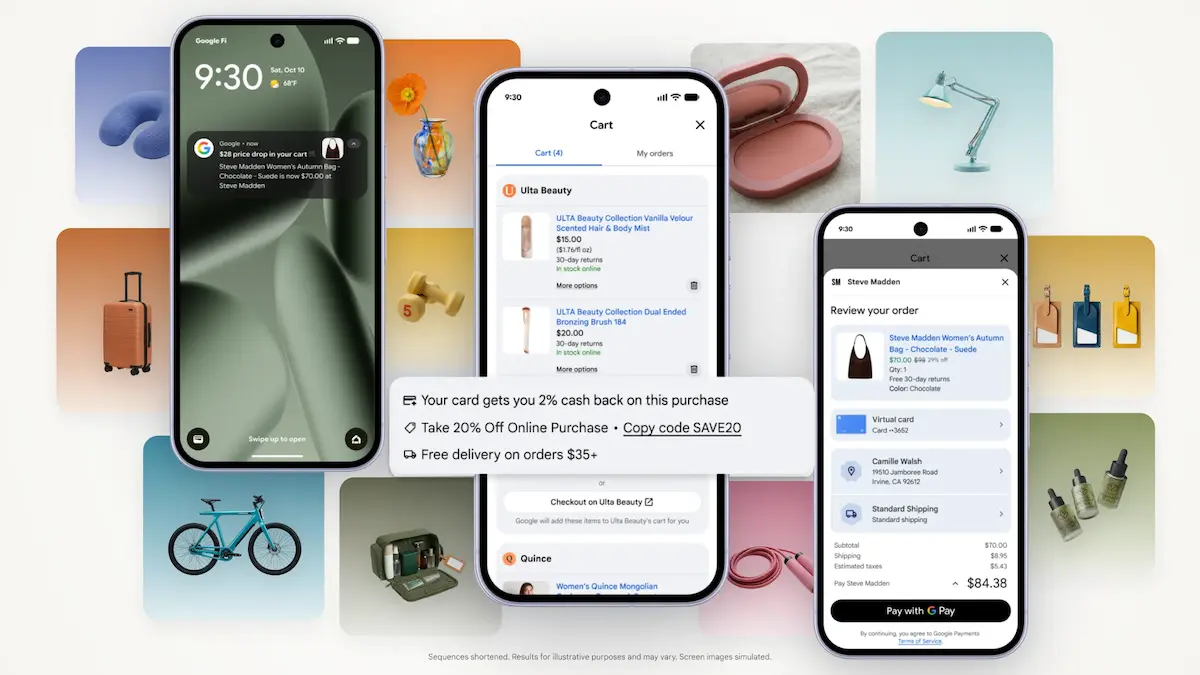
Google has officially rolled out "Universal Cart," a newly minted tool designed to help users seamlessly collect, monitor, and manage products discovered across Google Search and the Gemini app. Initially previewed earlier this year at the Google I/O developer conference in May, the tool is now officially available to users across the United States.
The core premise behind Universal Cart is to alleviate the friction and fragmentation typically associated with online shopping. Modern consumers frequently browse across multiple platforms, search engines, and retailer websites, often losing track of items or having to restart their product research from scratch when returning to complete a purchase. Universal Cart addresses this pain point by acting as a centralized hub for browsing and keeping track of potential purchases across various retailers. When a user finds a product they like, they can save it directly to their cart and move on. Upon returning later, their items and overall shopping progress remain intact, eliminating the tedious process of hunting down the same products or navigating back through dozens of browser tabs.
Beyond serving as a persistent holding place for items, Google has engineered the cart to act as an active assistant that helps shoppers stay on top of deals, pricing fluctuations, and inventory availability. The system is capable of dispatching notifications directly to users when a saved product undergoes a price drop or when an item that was previously out of stock becomes available for purchase once again. This proactive approach aims to transform a traditionally passive bookmarking habit into an intelligent shopping assistant that monitors market changes on behalf of the consumer.
The utility of Universal Cart extends further into the final stages of the consumer journey by offering tailored, intelligent assistance during the payment process. According to Google, the tool can take individual credit card perks and rewards into account when helping users determine the most advantageous way to pay for their items. Additionally, the system can automatically surface relevant promotional codes, helping shoppers maximize discounts without having to manually search third-party coupon websites.
At the technical foundation of this new checkout experience is Google’s Universal Commerce Protocol, commonly referred to as UCP. Introduced by the company earlier this year, UCP is an open standard designed to facilitate seamless interaction between AI agents and diverse retailers. The protocol bridges the gap across various parts of the shopping journey, providing the underlying infrastructure necessary to handle complex tasks, including secure and streamlined checkout processes across disparate retail platforms.
The introduction of Universal Cart underscores Google’s deep and ongoing investment in artificial intelligence-powered shopping experiences. The tool arrives as the latest in a growing suite of features intended to make commercial interactions more convenient and conversational. It integrates naturally alongside other recent rollouts, such as conversational product discovery embedded within Search’s AI Mode. It also complements specialized capabilities like Google’s "Let Google Call" tool, which deploys an AI agent to contact nearby brick-and-mortar stores on behalf of the user to verify whether a specific item is physically in stock before they make a trip.
Google is far from alone in its race to infuse artificial intelligence into the e-commerce landscape. Major technology competitors have similarly recognized the potential of transforming static retail websites into dynamic, agent-driven ecosystems. Industry giants including Amazon and OpenAI have introduced their own agentic commerce features over the past year. These developments highlight a broader competitive push across the technology sector to develop AI tools capable of assisting consumers with complex transactions, ensuring that chatbots and digital assistants deliver practical utility well beyond merely answering informational queries.
As these agentic commerce ecosystems continue to mature, tools like Universal Cart represent a significant step toward a more unified digital marketplace where artificial intelligence acts as a continuous thread connecting discovery, evaluation, and final acquisition across the entire internet.