




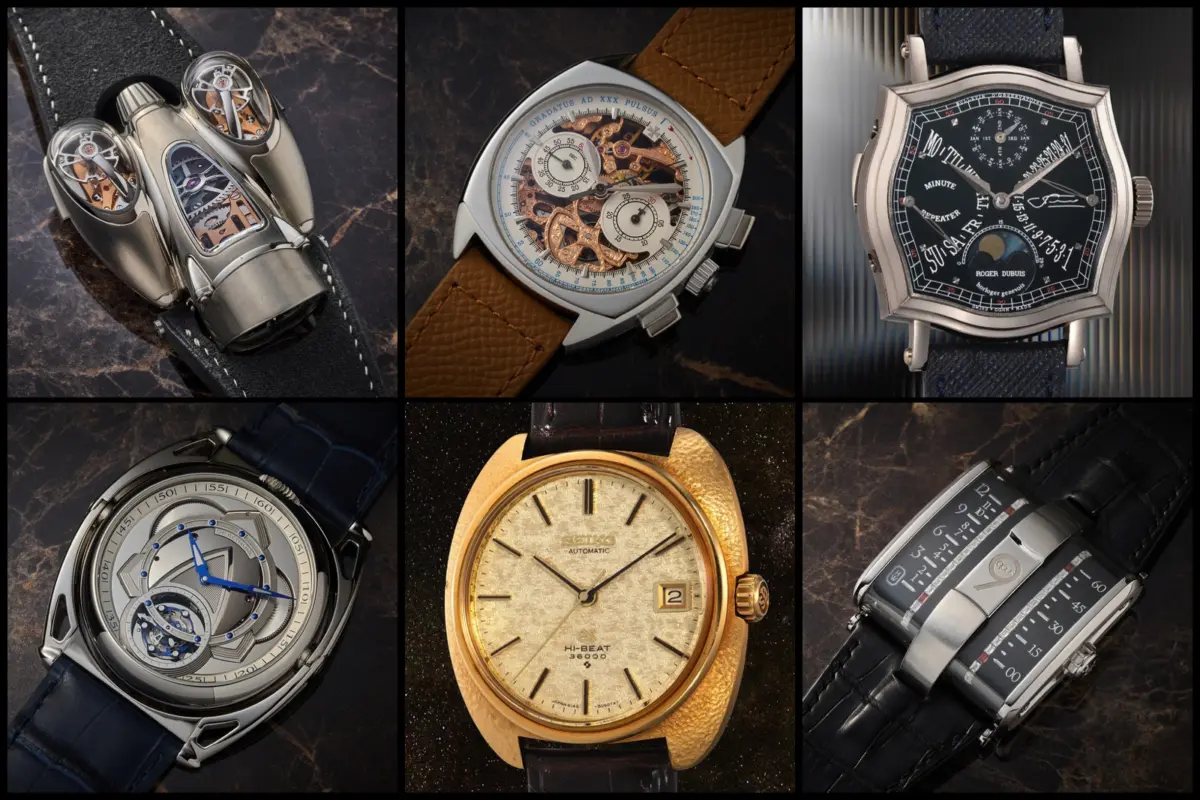
As the international auction calendar reaches its final stretch, Phillips is preparing for the penultimate sale of its fall season. The Hong Kong Watch Auction: XXIII, scheduled to take place from November 21 to 22, 2026, promises a remarkable assembly of timepieces spanning traditional craftsmanship, historical revivals, and avant-garde horology. Featuring a broad spectrum of case shapes, complications, and design philosophies—ranging from the understated to the deeply unconventional—the upcoming auction highlights some of the most intriguing mechanical achievements of both the vintage and contemporary eras.

Lot 848 – Vacheron Constantin Medicus Openworked
Among the mechanical highlights of the sale is Lot 848, a Vacheron Constantin Medicus Openworked. Launched initially in the year 2000 as a contemporary interpretation of the classic doctor’s watch, the Medicus successfully revived the distinctive cushion-shaped case profile found within Vacheron Constantin’s historical archives. Alongside the standard production models, the Geneva-based manufacturer introduced this skeletonized iteration, which managed to preserve the vital pulsometer scale essential for medical professionals measuring heart rates.
From a movement perspective, the watch departs from conventional high-end chronograph design. Rather than utilizing the Lemania 2310 column-wheel chronograph caliber favoured by many elite Swiss manufactures of the period, this timepiece relies on the Lemania 1872—the very movement famously associated with the Speedmaster Professional Moonwatch. Notable distinctions between the two movements include alternative bridge architectures, a modified minute totalizer layout, and the implementation of a cam mechanism instead of a traditional column wheel to govern the chronograph functions.

Given that medical practitioners have historically been viewed as a well-compensated demographic, the pre-sale estimate of HK$200,000 to 400,000 (approximately US$25,600 to 51,300) positions the watch well within reach of its intended historical audience.
Lot 858 – De Bethune DB Kind of Two
Representing the more contemporary side of independent watchmaking is Lot 858, the De Bethune DB Kind of Two. Known for successfully bridging the gap between futuristic design and classical horological traditions, De Bethune sought to merge these dual identities into an inventive reversible tourbillon wristwatch upon its introduction in 2021.

The reverse side of the watch features a Breguet-inspired dial aesthetic that recalls De Bethune’s earlier models, most notably the sweep-seconds DB10. While that foundational historical piece relied on a modified A. Schild AS2072 base movement, the DB Kind of Two utilizes an entirely proprietary in-house tourbillon caliber capable of driving both display faces simultaneously.
The movement, designated caliber DB2579, delivers a robust five-day power reserve when fully wound. At the time of its release, it powered what was recognized as the world’s lightest tourbillon assembly, operating at twice the conventional frequency with a rotation speed of one complete revolution every 30 seconds. Beating at an energetic 36,000 vibrations per hour, the caliber also showcases exemplary hand-finishing, characterized by generous mirror-polished surfaces.

By ingeniously integrating the rotating case mechanism directly into De Bethune’s signature spring-loaded "floating" lugs, the brand avoided the added bulk typically associated with reversible watches, such as the classic Jaeger-LeCoultre Reverso. With an estimate ranging from HK$750,000 to 1.5 million (US$96,200 to 192,000), collectors can view the timepiece as offering two distinct aesthetic and mechanical experiences within a single wrist presence.
Lot 863 – Harry Winston Opus 9
Harry Winston cemented its reputation as a serious patron of independent horology through its ambitious, decade-and-a-half-long Opus program, which saw the historic jewelry house collaborate with 14 different independent watchmakers, beginning with François-Paul Journe. Limited to just 100 examples, the Opus 9 was developed in creative partnership with designer Eric Giroud and master movement constructor Jean-Marc Wiederrecht.

Housed in a substantial white gold and sapphire case whose geometric silhouette draws visual parallels to a First World War tank—complete with moving tracks—the watch displays the time through two parallel, chain-driven systems. Each chain is set with 33 emerald-cut diamonds and three garnets, culminating in a total diamond weight of approximately 2.15 carats and roughly 0.22 carats of garnets.
These gemstones required custom cutting to fit securely onto the maillechort chain links, a rigorous production process that reportedly resulted in a high rejection rate for imperfect stones. Beneath this sculptural exterior lies an automatic Frédéric Piguet base caliber that delivers a reliable 72-hour power reserve. Despite its complex engineering and unconventional architecture, the watch maintains a practical 30-meter water resistance rating. Maintained in exceptional condition more than a decade after its initial debut, the Opus 9 carries an estimate of HK$350,000 to 600,000 (US$44,900 to 76,900).

Lot 923 – Gérald Genta Grand Complication with Coral Dial
Gérald Genta’s eponymous brand played a pivotal role in leading the mechanical complications renaissance of the late 20th century. The house introduced the world’s first self-winding minute-repeating wristwatch in the early 1980s, followed by the groundbreaking self-winding grande et petite sonnerie in the subsequent decade, which stood at the time as the most complicated wristwatch ever produced.
Lot 923 exemplifies this golden era of independent complications. Despite wearing with a larger visual presence on the wrist, the watch is housed in a compact octagonal case measuring just 33 mm in diameter. Remarkably, this space accommodates both a perpetual calendar module and what remains one of the thinnest self-winding minute repeater mechanisms ever engineered.

During this period, the Gérald Genta manufacture was exceptionally vertically integrated, producing not only its own sophisticated calibers but also manufacturing its own cases, bracelets, and dials. This particular specimen features a striking natural coral dial complemented by a lapis lazuli moonphase display. Furthermore, the gold-tone movement is entirely freehand engraved—a decorative technique frequently employed on high-end complicated watches of the era by elite manufactures like Breguet, Blancpain, and IWC.
The brand famously catered to an exclusive clientele of VIP collectors, most notably members of the Brunei royal family. The personalization on this specific movement—featuring the initials "LG" rather than the standard "GG"—suggests it was crafted for a particularly distinguished client. Offered alongside a solid gold integrated bracelet, the estimate of HK$250,000 to 500,000 (US$32,100 to 64,100) represents an exceptional proposition for a grand complication in solid gold.

Lot 926 – Roger Dubuis Sympathie Bi-Retrograde Calendar Minute Repeater
Representing the pinnacle of Roger Dubuis’s early independent watchmaking philosophy is Lot 926, featuring the distinctive Sympathie case shape paired with a Bi-Retrograde Calendar. This exceptional piece pairs an Agenhor perpetual calendar module with a Lemania-based minute-repeating movement bearing the prestigious Geneva Seal.
The watch is notable for its scarcity. Recorded as the fifth piece of a 24-piece limited edition series that production records suggest was never fully realized, Phillips classifies the watch as "possibly unique." While it shares its case construction and caliber RD 2607 architecture with an earlier nine-piece limited series, this model is distinguished by its deep black dial and signature typography.

Similar signatures have been observed on other fresh-to-market pieces from contemporaries like Daniel Roth and Kari Voutilainen featured in the sale, pointing toward a single cohesive consignor collection. Given the complexity of the mechanism, the solid gold case construction, and the rare dial execution, the estimate of HK$320,000 to 640,000 (US$41,000 to 82,100) positions it as an accessible entry point for collectors of independent masterworks.
Lot 982 – Cartier Baguette Coulissante “Duoplan”
Offering a masterclass in miniature mechanical artistry, Lot 982 is a Cartier Baguette featuring a coulissante, or sliding visor, designed to conceal the dial when not in active use. By contemporary standards, the watch is exceedingly petite, measuring just 17 mm in width, an impression further emphasized by the complete absence of a traditional winding crown on the case exterior.

Instead, the timepiece relies on the inventive "Duoplan" movement engineered by Edmond Jaeger. This proprietary caliber utilizes a clever two-layer vertical construction, positioning the balance wheel and escapement on an elevated platform directly above the gear train, while integrating the winding crown into the case back itself. This space-saving architecture resulted in one of the most compact mechanical movements ever brought to series production. While vintage Cartier creations remain highly sought after by collectors, the market for ultra-small watches tends to be more selective, accounting for the accessible estimate of HK$50,000 to 100,000 (US$6,400 to 12,800).
Lot 1023 – MB&F HM9
Stepping firmly into avant-garde territory, Lot 1023 features an MB&F HM9 from 2018. Strongly reminiscent of the cult-favorite HM4 "Thunderbolt," the HM9 is a sculptural driver’s watch featuring a vertical time display optimized for legibility while keeping hands positioned on a steering wheel.

Developed over a three-year period by in-house constructor Guillaume Thévenin, the entirely bespoke 301-piece movement is regulated by twin oversized balance wheels linked via a planetary differential that averages their rates for enhanced chronological stability. Each balance assembly sits beneath an individual sapphire porthole, while an additional crystal window offers a magnified, distorted view of the interior architecture.
Despite its aggressive aerodynamic geometry, the titanium case—composed of 44 separate components—is designed for ergonomic wearability, aided by short underside lugs and an innovative three-dimensional gasket system that ensures a practical 30-meter water resistance. Carrying an estimate of HK$700,000 to 1.4 million (US$89,700 to 179,000), the HM9 represents a distinctively daring chapter in modern independent watchmaking.

Lot 1067 – Seiko Grand Seiko 61GS Hammered Case with “Starlight” Dial
Rounding out the highlights is Lot 1067, a vintage Seiko Grand Seiko 61GS referencing the 6145-8030 from 1968. The 61GS line derives its name from caliber 6145 inside, positioned within Suwa Seikosha’s internal hierarchy just above chronometer grade and directly below the ultimate high-frequency 6185 VFA. Operating at a blistering 36,000 vibrations per hour—a frequency that remains a cornerstone of Grand Seiko’s modern identity—the movement earned a reputation for exceptional durability, reliability, and precision.
The hand-hammered case was executed by Hayashi Seiki Seizo, one of Japan’s premier case manufacturers, which famously imported German Sallaz polishing machinery and popularized the terminology for "Zaratsu" polishing. The dial features a sparkling texture inspired by Kirazuri, drawing from the Edo-period ukiyo-e printmaking tradition of dusting finely ground mica onto woodblock art to create a shimmering effect. Estimated at HK$48,000 to 95,000 (US$6,200 to 12,200), the piece offers a compelling entry into vintage Japanese high horology.

Preview and Auction
The complete pre-sale public exhibition and subsequent auction will take place at Phillips Hong Kong, situated within the West Kowloon Cultural District.
The preview exhibition is open daily from November 16 to 22, 2026, operating between 10:00 am and 7:00 pm local time.

The live auction sessions will commence at 12:00 pm on both November 21, covering Session I (Lots 801 to 958), and November 22, covering Session II (Lots 959 to 1129). All scheduled times are local to Hong Kong (GMT+8).
Location details:
G/F WKCDA Tower
West Kowloon Cultural District
8 Austin Road West
Kowloon, Hong Kong