






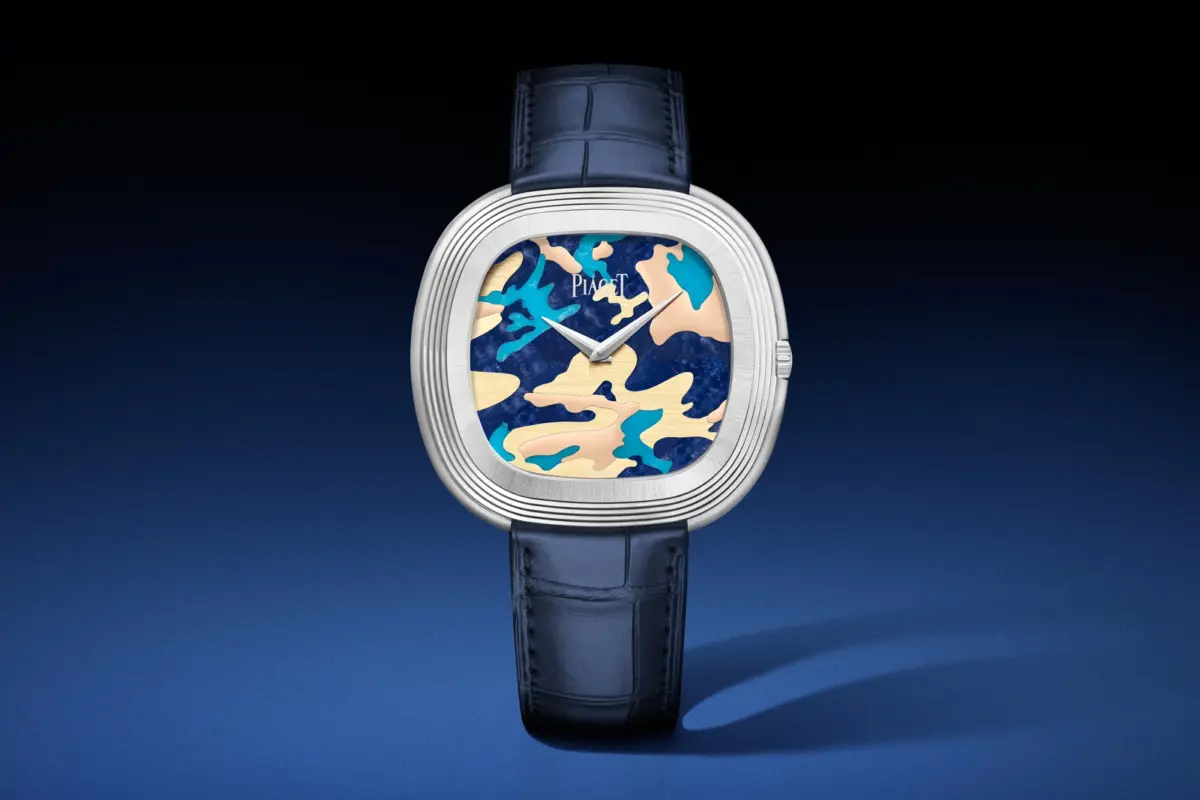
The intersection of haute horlogerie and pop art has reached a new pinnacle of craftsmanship with the introduction of the Piaget Andy Warhol ‘Camouflage’. Reinterpreting the iconic artist’s late self-portraits and his famous camouflage series, this remarkable timepiece features a complex marquetry dial meticulously assembled from 27 individual pieces of sodalite, turquoise, and gold. Following last year’s lauded Collage edition, this new release pushes Piaget’s historic expertise in ornamental stones to far more ambitious heights. Instead of relying on a simple, uniformly printed motif, the maison has transformed an easily reproducible industrial pattern into a painstaking, microscopic exercise in traditional stone marquetry.
Stone dials have experienced a widespread resurgence across the contemporary watchmaking landscape, but Piaget was a true pioneer of the format. Long before mineral and ornamental stones became the defining aesthetic of flamboyant 1970s watch design, the Swiss watchmaker was championing their use. The Camouflage continues

that rich legacy, delivering a dial that transcends a mere polished slice of mineral.
While most modern stone dials are cut as single, uniform wafers whose appeal depends entirely on the natural color and grain of the raw material, stone marquetry is an entirely different discipline. It demands an extraordinarily deft hand to cut, shape, and combine dozens of individual, irregular components into a deliberate, cohesive composition. It remains one of Piaget’s ultimate specialties, as demonstrated by last year’s Andy Warhol Collage, and it is now put to brilliant use to honor one of the final bodies of work from the undisputed king of pop art.
Piaget’s master artisans have executed an admirable translation of Warhol’s vibrant camouflage works into a palette of deep blue sodalite, striking turquoise, and precious gold. The irregular contours and incredibly close-fitting pieces make the underlying expertise immediately apparent. Furthermore, the contrasting textures give the dial surface a sense of depth and variety that color alone could never achieve.

If the contemporary industry-wide trend for stone dials is to enjoy genuine staying power, it will be driven by exceptional releases like this that push the absolute boundaries of the segment. Far more than an empty exercise in decorative marquetry for its own sake, the camouflage motif gives the individual stones an active role in a larger visual narrative. Each completed dial serves as a dual expression of Warhol’s distinct imagery and Piaget’s enduring watchmaking craft.
Limited strictly to 86 pieces—a deliberate tribute to the year 1986 when Warhol began working on his famous Camouflage series—the new watch retains both the core strengths and minor limitations of the broader Andy Warhol collection. Its striking cushion-shaped case and elaborate, artistic dial remain the primary attractions. Meanwhile, the automatic Calibre 501P1 powering the watch is reliable and effective, though ultimately unremarkable, safely concealed behind a solid gold case back.
Hiding in Plain Sight

Andy Warhol initiated his extensive Camouflage painting series in 1986, cementing the motifs among the final creations of his illustrious career. The inspiration for the pattern came from actual military camouflage fabric, which had been originally acquired by his studio assistant, Jay Shriver, from an army surplus store located in Manhattan.
This utilitarian, functional motif suited Warhol’s lifelong fascination with mass production and abstraction, while simultaneously maintaining a clever connection to an instantly recognizable, everyday image. Rendered in bright, unnatural, and high-contrast colors, the traditional military camouflage pattern was effectively transformed into conspicuous, high-fashion decoration.
Camouflage also famously appeared layered directly over Warhol’s own face in his late self-portraits. However, rather than attempting a literal reproduction of the portrait itself, Piaget cleverly extracted the abstract pattern, reinterpreting and scaling it down to successfully fit the intimate confines of a wristwatch dial.

The fascinating tension between Warhol’s industrial artistic methods and the traditional, handcrafted techniques of Piaget’s marquetry artisans forms a central pillar of the watch’s appeal. Warhol famously utilized screenprinting to repeat imagery rapidly and experiment freely with explosive color combinations across multiple canvases. Stone marquetry, by stark contrast, cannot be industrialized or easily replicated; each individual dial requires countless hours of painstaking, manual labor to complete.
A Puzzling Dial Construction
The complex dial of the Camouflage is composed precisely of 27 individual elements of ornamental stone and precious metal. Deep blue sodalite and vivid turquoise supply the primary chromatic blocks, which are then artfully interspersed with brushed yellow gold and polished rose gold inlays.

This material contrast brings the iconic pattern to life in a manner remarkably faithful to Warhol’s original paintings. Sodalite introduces a mottled, organic grain to the darker areas of the design, whereas turquoise provides brighter, more uniform patches of brilliant color. In stark contrast, the brushed yellow gold features a directional texture that resembles fine wood grain, while the polished rose gold remains overtly metallic and reflective in its appearance.
For the artisan specializing in marquetry, the primary challenge lies entirely within the geometry of the shapes. Conventional stone dials already require immense care because thin slices of mineral stone are notoriously brittle and highly prone to cracking during cutting and finishing. However, the organic, flowing look of the Camouflage dial dictates several impossibly thin elements and irregular junctions. Each component must fit its surrounding neighbors with microscopic precision so that the overarching pattern appears completely continuous.
Familiar Form and Ergonomics

The stunning Camouflage dial is housed within the familiar 45 mm cushion-shaped case crafted from 18-karat white gold. This distinctive model was previously known across the industry as the Black Tie Vintage before Piaget officially acquired the legal rights to utilize the legendary artist’s name in 2024 through a formal licensing partnership.
This agreement represents a logical collaboration given the documented historical connection between Piaget and Andy Warhol himself. During his lifetime, Warhol was a notable collector of the brand’s avant-garde watches, most famously owning the reference 15102 upon which the modern Andy Warhol collection is directly based.
The appeal of the Andy Warhol model stems largely from its clever balance of physical size and slender proportions. While a 45 mm measurement might initially suggest an oversized timepiece, the headline figure is ultimately misleading, as the watch wears significantly smaller and more elegantly than the specifications imply.

Crucially, the short lugs are seamlessly integrated directly into the case band, resulting in a minimal lug-to-lug length that guarantees a comfortable fit even on more slender wrists. Furthermore, the overall weight distribution gives the watch a wonderfully low-profile feel on the wrist, aided by its solid gold case back and clean, stepped bezel construction.
Beating inside the case is the automatic Calibre 501P1. While this movement successfully preserves the watch’s exceptionally slim profile, it remains the most functional and least visually exciting element of the package. A more sophisticated, high-horology movement featuring an extended power reserve might have been welcomed by purists, but the overwhelming visual appeal of the marquetry dial is arguably more than sufficient to allow the movement to take a supportive, background role. After all, Andy Warhol himself was famously known for wearing watches without even bothering to set the time.
The Piaget Andy Warhol ‘Camouflage’ (Ref. G0A51242) features an 18k white gold case measuring 45 mm in diameter and 8.08 mm in height, protected by a sapphire crystal and offering water resistance up to 30 meters. It is powered by the automatic Calibre 501P1, operating at a frequency of 28,800 vibrations per hour with a 40-hour power reserve. Fitted on an alligator leather strap with a matching pin buckle, the watch is produced as a limited edition of 86 pieces and is available through Piaget boutiques and authorized retailers with pricing provided upon request.