





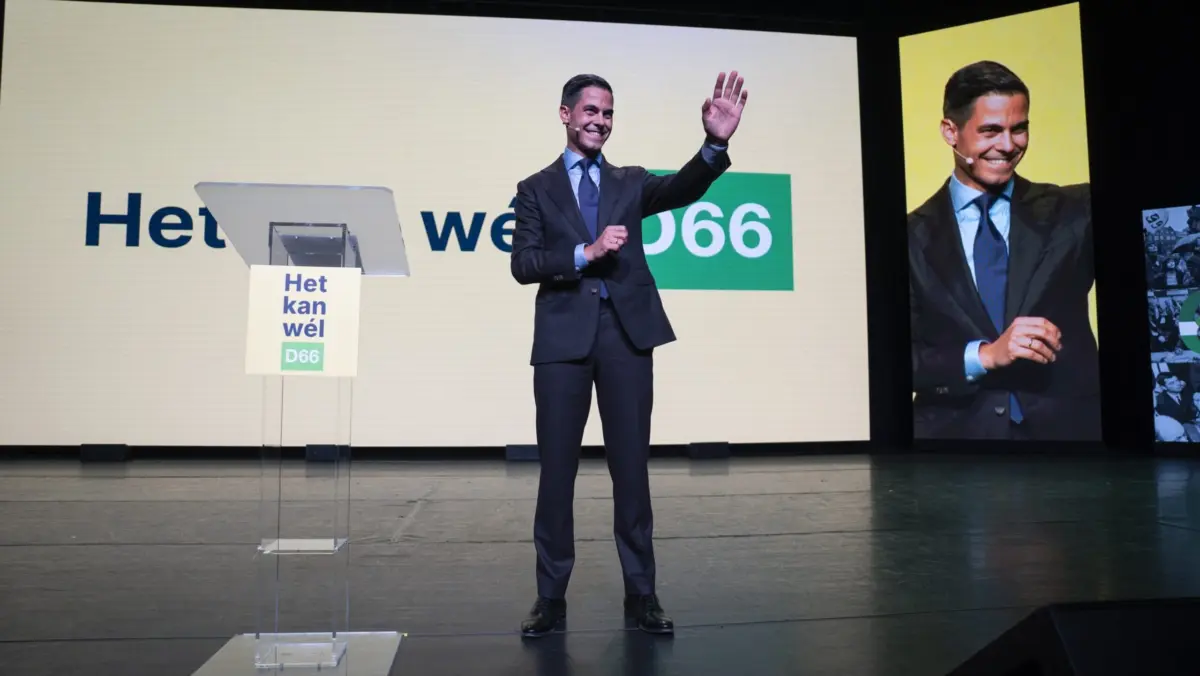
AMSTERDAM — Prime Minister Rob Jetten faced a turbulent moment during a landmark address to his D66 party on Sunday, when his speech at the weekend conference was briefly interrupted by demonstrators protesting Israel’s military intervention in Gaza.
The incident occurred at the Amsterdam RAI arena as delegates gathered to mark the 60th anniversary of the founding of the progressive, centrist Democrats 66 (D66) party. The weekend gathering was historic for the movement, representing the first time a sitting Dutch prime minister had addressed the autumn conference. However, the celebratory atmosphere was punctured early in Jetten’s remarks when activists voiced their opposition to the government’s stance on the Middle East conflict.
As Jetten took the stage to deliver his keynote address, he was interrupted twice by hecklers at the very beginning of his speech. The demonstrators wore distinctive T-shirts bearing critical slogans such as "Bloedcoalitie" ("blood coalition") and "Liberaal/Neutraal/Genocidaal" ("liberal, neutral, genocidal").
Security guards briefly escorted Jetten from the stage as the initial shouting broke out. Demonstrating a calm demeanor upon his return, the prime minister initially attempted to de-escalate the tension by telling the protesters that they could remain inside the conference hall provided they sat down "so you don’t bother those sitting behind you." However, after a second interruption moments later, security personnel intervened and escorted a handful of demonstrators out of the arena.
Addressing the audience directly after the interruptions, Jetten acknowledged the gravity of the protesters’ cause. "I see that you want to highlight the situation in Gaza and I understand that very much," he told the delegates, striking a measured tone that balanced security with an acknowledgment of free expression.
Speaking to broadcaster RTL Nieuws after the event, Jetten elaborated on his perspective regarding the disruption, describing the protest as respectful despite its intrusive nature. "The right to demonstrate and have your say is one of the strengths of our democracy, as long as it’s done respectfully, and that’s what we saw here in the hall," Jetten said.
The demonstration underscored the delicate political balancing act facing the current minority government, which comprises a coalition of D66, the Christian Democratic Appeal (CDA), and the People’s Party for Freedom and Democracy (VVD). Operating without a majority in either the House of Representatives or the Senate, the cabinet must navigate intense public scrutiny, passionate domestic debates over international affairs, and arduous legislative negotiations to keep its governing agenda afloat.
Budget Delays and Legislative Challenges
Beyond the interruptions in the auditorium, Jetten’s anniversary speech served as an opportunity to take stock of his administration’s achievements and the hurdles still facing the minority coalition. The 60th-anniversary conference of D66 brought together party stalwarts, local politicians, and national lawmakers to reflect on six decades of political history, from its founding roots as a reform-minded movement aimed at democratizing Dutch political structures to its current position leading the country.
During his address, Jetten highlighted areas where his cabinet has made tangible progress since taking office. Among the key accomplishments he cited were the development of comprehensive policy plans aimed at cutting persistent nitrogen pollution—a long-standing and legally fraught challenge for the Netherlands—and successfully preventing the online government services portal DigiD from being sold to an American company, thereby retaining vital digital infrastructure under public oversight.
However, the prime minister candidly admitted that governing via a minority coalition has not been without its frustrations, notably the slower-than-expected pace of negotiations over the upcoming national budget. Securing a deal to pass next year’s financial plan has proven complex, as the D66-CDA-VVD coalition requires the backing of at least two additional parties in both houses of parliament to ensure a legislative majority.
Despite the delays, Jetten offered a reassuring assessment of the political landscape. He noted that during discussions held over the preceding week, he had observed encouraging signs that political factions spanning "from left to right" were genuinely prepared to negotiate in good faith. According to the prime minister, these developments demonstrated that "broad co-operation is possible with this generation of politicians," even in an era marked by deep political fragmentation.
Defending Democracy Against Extremism
Jetten used a significant portion of his anniversary address to confront the broader threats facing Dutch democratic institutions, drawing a sharp contrast between constructive political engagement and destructive extremism.
The prime minister firmly insisted that he would not yield to what he termed the "anti-Dutch forces that want to destroy our democracy from within." His remarks were a direct reference to violent demonstrations that had taken place in The Hague a week earlier, events marred by what he described as "appalling extreme right-wing slogans and even Nazi salutes."
Vowing that the forces of pluralism and tolerance would prevail, Jetten championed a "wave of optimism" that he argued would ultimately triumph over the loudest voices in the public square. In doing so, he echoed the sentiments of his political predecessor, former Prime Minister Mark Rutte, who famously called on Dutch citizens to vote for "doers, not yellers" during a major address years prior.
"They might shout louder, but we get more done," Jetten declared to the applauding delegates in Amsterdam.
The speech encapsulated the dual challenge defining Jetten’s tenure: managing the intricate mechanics of minority governance through legislative compromise while simultaneously pushing back against rising political polarization and extremism on both ends of the ideological spectrum. As D66 enters its seventh decade, the party’s leadership is banking on pragmatic delivery and resilience to maintain its central role in Dutch national politics.