




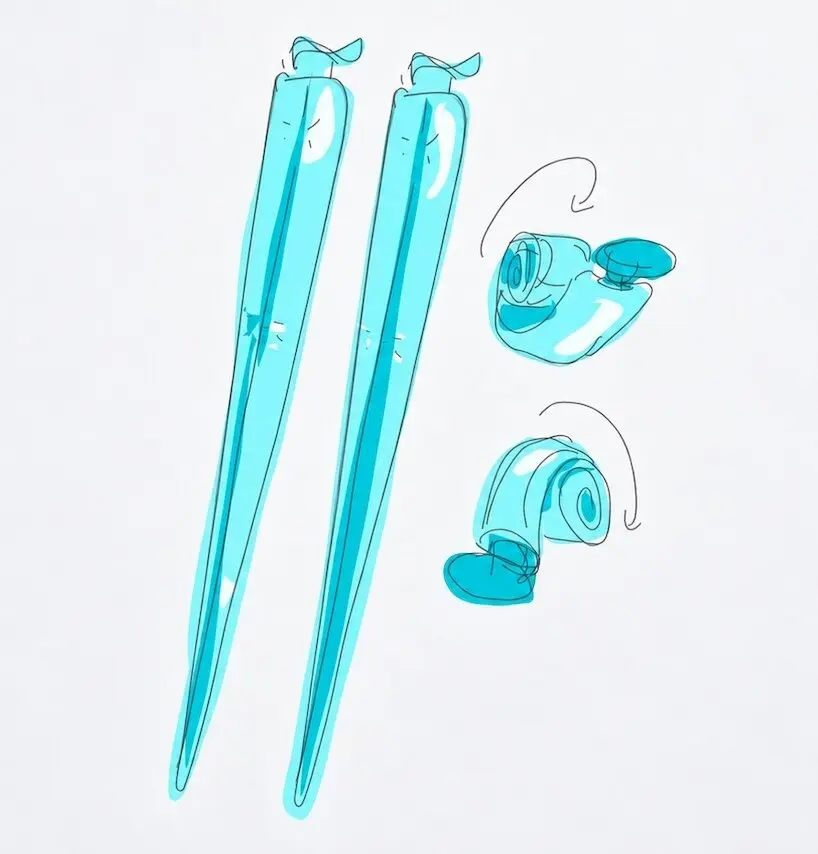
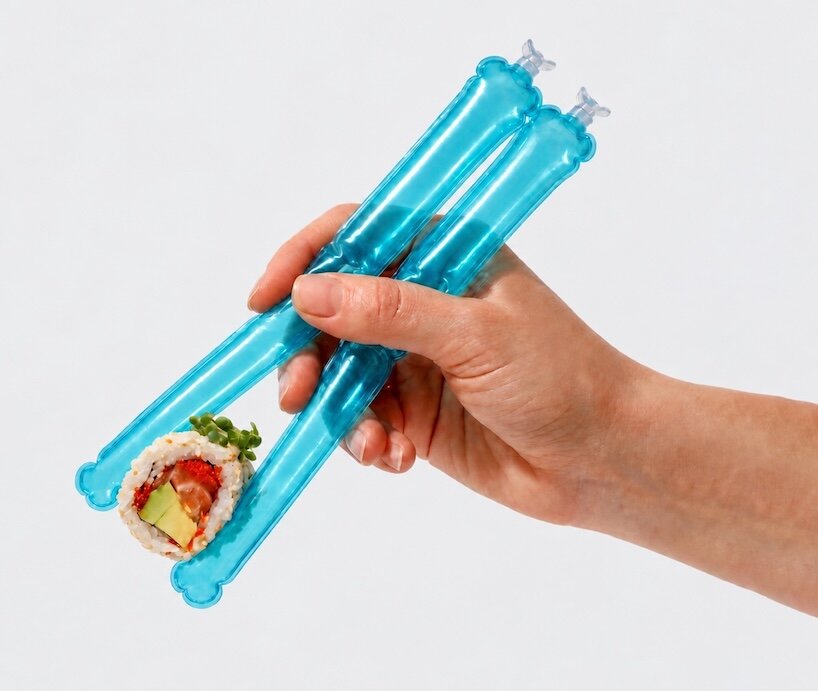
Some design ideas begin with a severe industrial problem, a structural failure, or an urgent environmental demand. Others, however, begin with the sudden, highly specific realization that you find yourself sitting down to a meal entirely devoid of proper cutlery. This is precisely the playful premise behind Popsticks, a whimsical conceptual project created by designer Liam de la Bedoyere of Bored Eye Design. The concept reimagines everyday dining utensils as a pair of portable, inflatable chopsticks that can be neatly rolled up, slipped into a pocket, and inflated whenever a dining emergency arises.
Rather than relying on mechanical hinges, collapsible joints, or modular pieces that snap together, these unconventional utensils rely entirely on air to achieve their final form. The project approaches traditional tableware through an unexpected lens, transforming the routine act of setting a place at the table into an interactive and tactile experience. Instead of reaching for traditional wooden or metal chopsticks, a user simply pulls a compact, deflated spiral from their pocket, blows air into the material, and prepares for dinner.
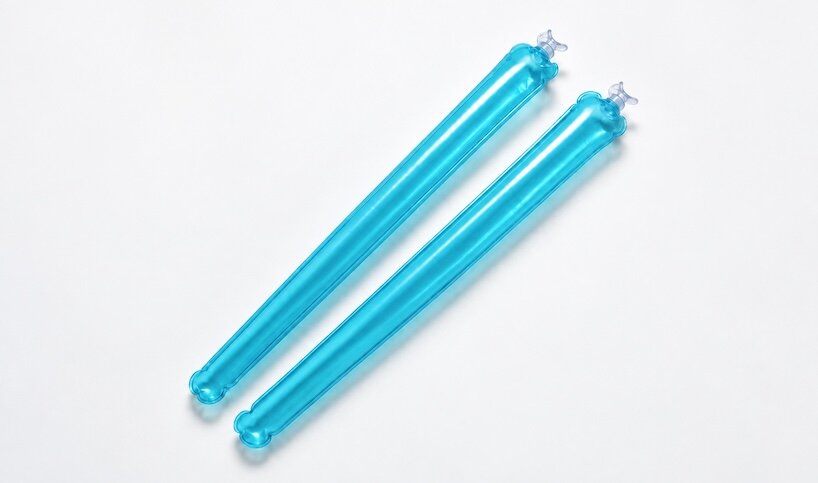
The visual identity of Popsticks draws heavily from the aesthetic of 1990s inflatable furniture and pool accessories. Featuring translucent blue material choices, the miniature inflatables look remarkably like scaled-down beach toys, evoking a strong sense of nostalgic familiarity. Renderings and promotional images captured for the concept demonstrate the full lifecycle of the design, contrasting the neatly rolled, pocket-sized spirals with the elongated, fully inflated chopsticks ready for use. By bridging the gap between childhood memories of inflatable home decor and modern minimalist tableware, de la Bedoyere manages to challenge standard assumptions regarding how dining tools should be manufactured, transported, and utilized.
Productober Challenge Inspires Nostalgic 1990s Inflatable Aesthetic
The genesis of Popsticks can be traced back to Productober, an annual Instagram-based creative challenge that regularly tasks industrial designers and concept creators with responding to specific daily or monthly prompts. When presented with the theme of "Inflatable," de la Bedoyere decided to move far beyond a standard two-dimensional sketch. Instead, he chose to develop a fully fleshed-out three-dimensional proposal, investigating how ordinary, rigid household objects might behave when subjected to a pneumatic structure more commonly found in temporary furniture, pool floats, and nostalgic novelty items.
The designer’s creative process blended modern digital visualization tools with nostalgic design cues. While computer-aided design software and KeyShot render engines form a standard part of his typical professional workflow, de la Bedoyere specifically integrated Vizcom into his process for this project. This AI-assisted visualization tool helped capture the distinct, soft, translucent sheen characteristic of 1990s plastic inflatables. The resulting aesthetic sits comfortably between a functional dining accessory and a playful collector’s novelty, questioning what happens when physical softness and flexibility become the defining characteristics of a typically rigid utensil.
Continuing a Tradition of Unnecessary Emergency Products
While the notion of inflatable chopsticks might seem entirely unprecedented, it actually aligns neatly with de la Bedoyere’s broader body of conceptual work. The designer has a well-established history of imagining witty, tongue-in-cheek solutions to minor, highly improbable life inconveniences. Reflecting on his portfolio, the designer notes that Popsticks is far from his first foray into humorous product design.
Approximately a decade prior to conceiving Popsticks, de la Bedoyere created another satirical emergency accessory known as the Emergency Moustache. This ongoing fascination with improbable emergencies fuels his broader creative output, allowing him to use design as a medium for humor and critical reflection. By treating a minor daily inconvenience—such as a sudden lack of proper utensils—as a legitimate design brief, the creator experiments with how familiar objects can alter their form, travel logistics, and behavioral interactions with the user.
At present, Popsticks remains firmly in the realm of speculative concept design rather than commercial manufacturing. Consequently, practical questions regarding the long-term durability of the material, hygiene maintenance, ease of cleaning, and the exact rigidity required to successfully pick up food remain unanswered. Yet, the true charm and value of the project do not lie in solving a global culinary crisis. Instead, the conceptual tableware succeeds by questioning the rigidity of everyday objects and inviting users to rethink the accessories they carry with them. Whether inflatable chopsticks will ever become a genuine culinary staple remains to be seen, but the design successfully transforms the mundane preparation of a meal into an entertaining and memorable moment.