




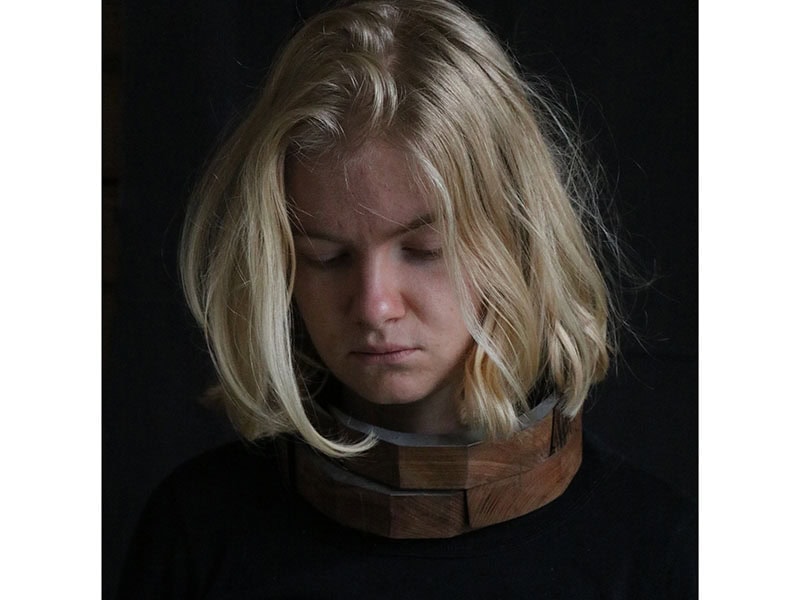
Contemporary jewelry has long battled preconceptions that limit its scope to symbols of wealth, power, and conventional beauty. For emerging artist Marie-Caroline Locquet, however, jewelry serves as an entirely different medium: a conceptual tool for provocation, social reflection, and psychological exploration. Producing works that function as restraints and defensive weapons, Locquet crafts unique wearing experiences that deliberately interrogate our shared human fragility.
Recognizing this bold, disruptive vision, the Art Jewelry Forum (AJF) has named Locquet a finalist for its prestigious Young Artist Award. Supported biennially by Karen and Michael Rotenberg, the award acknowledges promise, innovation, and individuality in the work of emerging jewelry artists aged 35 or younger. By spotlighting pioneering voices like Locquet’s, AJF aims to support new and exciting work that will inspire future developments in the contemporary art jewelry field.
A Radical Introduction to the Definition of Jewelry
Locquet’s artistic journey began during her early art studies when she first encountered works that fundamentally challenged her understanding of adornment. Rather than focusing on aesthetics or the display of affluence, these radical pieces struck her as strange, uneasy, and even dangerous. She points to the bottleneck creations of Bernhard Schobinger and the works of Dorothea Pruhl as pivotal influences that shifted her perspective on art entirely.
"It really changed my point of view on art," Locquet explains. "In a way, jewelry interests me as an object of disruption, reflection, and provocation."

Entering the field filled with curiosity and probing questions, Locquet found herself fixated on a central dilemma: Why make, and consequently wear, jewelry that seems so disturbing at first sight? What does it mean to craft an object that appears fundamentally unwearable? This profound exploration of unwearability quickly became the core engine driving her artistic research.
For Locquet, being selected as a finalist for the Young Artist Award is a deeply meaningful validation of a rigorous direction she has pursued for several years. It provides her with the critical confidence needed to continue pushing boundaries, taking artistic risks, and challenging herself, the wearer, and the viewer alike.
Exploring Violence, Confinement, and Fragility
Growing up in the north of France, Locquet experienced firsthand the societal pressures of self-demonstration and the subtle camouflage of social affiliations through early adornment. This upbringing seeded a conceptual interest in jewelry, prompting her to approach the field less through aesthetic affinity and more as a rich subject for critical study.
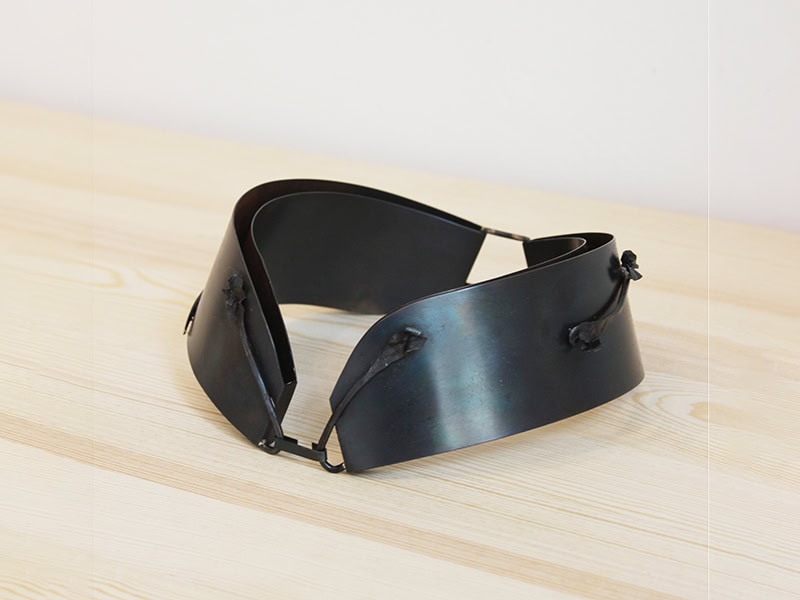
In her practice, every piece seeks to redefine the traditional status of jewelry. Instead of acting as a showcase object representing wealth or power, her creations function as direct confrontations loaded with a disruptive potential within public spaces. Her work rejects easy seduction or passive representation, leaning instead into deliberate disturbance, violence, fragility, seduction, domination, vulnerability, and confinement.
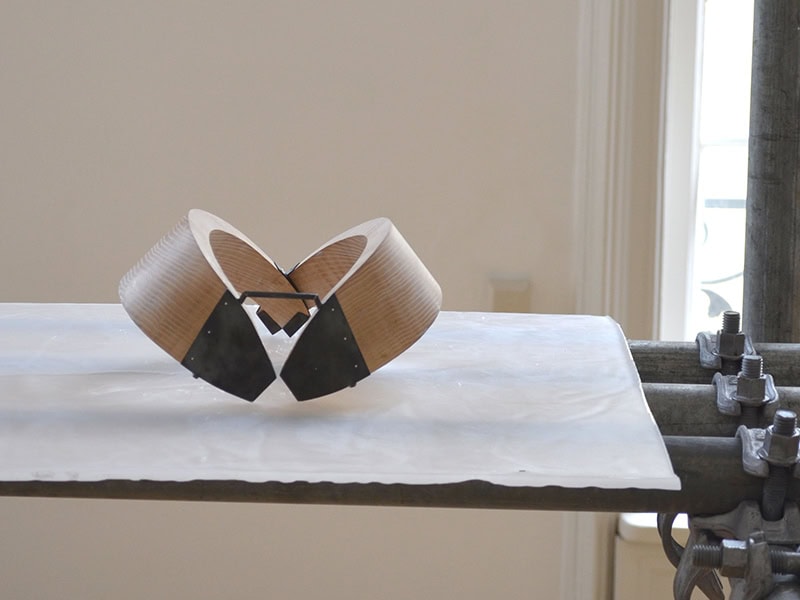
By pushing materials to their absolute limits, Locquet strips them down to bare essentials, revealing their true nature through forms that evoke both deep desire and death. Whether fashioned as defensive weapons or physical restraint devices, each piece offers a wearing experience that explores the delicate architecture of human vulnerability, maintaining a perpetual tension between social discomfort and the temptation of an embrace.
The Mechanical Intimacy of Hands
Locquet’s creative vocabulary draws inspiration from historical and cultural artifacts associated with confinement and submission. Past projects have referenced the collier d’appartenance—a collar given within submissive relationships—as well as the "slave collar" originating from 19th-century Norman and Auvergnat traditions, traditionally bestowed upon women at marriage as a token of possession. She has similarly explored animal-labor tools, such as the heavy collar used for working horses.
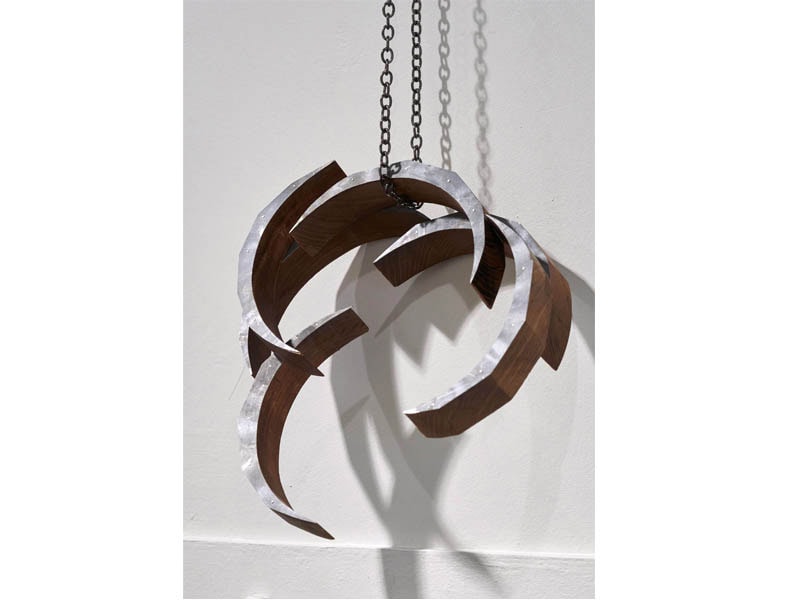
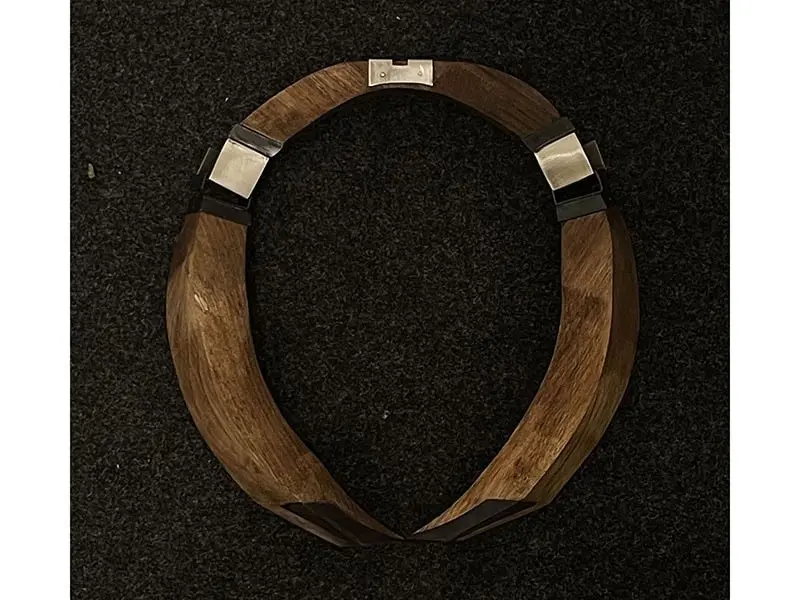
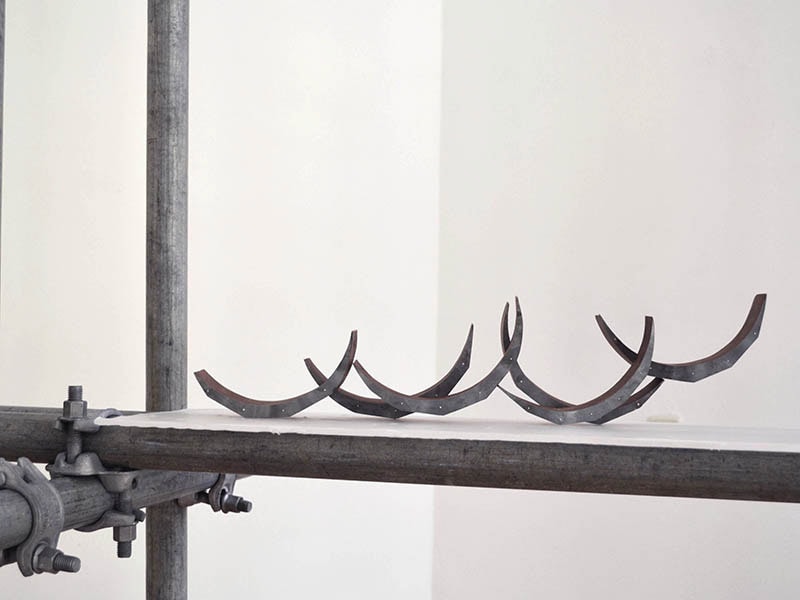
Among her notable applications is the 2024 neckpiece titled Hands, constructed from elm wood, zinc-plated steel, and silver. According to Locquet, the piece acts as a comprehensive distillation of her artistic methodology, highlighting her obsessive research into mechanical systems, movements, clasps, and the fragile border separating jewelry from standalone sculpture.
"The piece unfolds and occupies the space like a complex mechanical object, before closing around the neck… like an act of strangulation," Locquet describes. "It’s my most complex and intimate piece, expressing confinement and violence."
Shaping the Image of Society
What excites Locquet most about art jewelry is its unique capacity to anchor a holistic approach—spanning from the physical object itself and rigorous theoretical research to the creation of responsive exhibition spaces. More broadly, she is fascinated by how body ornament actively shapes the image of a society.
Everything we choose to wear, she contends, draws directly upon the references, boundaries, and values of the world we inhabit. To deepen this inquiry, Locquet initiated a comprehensive iconographic research project and collection centered around worn and unwearable items, playfully titled “Unwearable—adornment is impure, makeup is obscene, disguise is an abomination.” This ongoing project illuminates how ornament, when brought into direct contact with the body, reveals volumes about social representations and cultural norms, constantly shifting across the boundaries of intimacy, the private sphere, and public space.
Confronting Industry Frustrations and Risks
Despite the vibrant potential of the medium, Locquet remains candid about certain frustrations within the contemporary art jewelry landscape. Recalling an exhibition titled Jewelry Is Still a Risky Business, which she and her peers curated during Munich Jewelry Week in 2018 in reference to a work by Paul Derrez, she maintains that jewelry must fiercely retain its capacity for risk.
She notes that contemporary jewelry is frequently subjected to expectations that it must continually justify its presence within the broader contemporary art world. During her time studying jewelry at a French fine art school, she routinely encountered the dismissive notion that the discipline was somehow lesser, superficial, or overly niche.
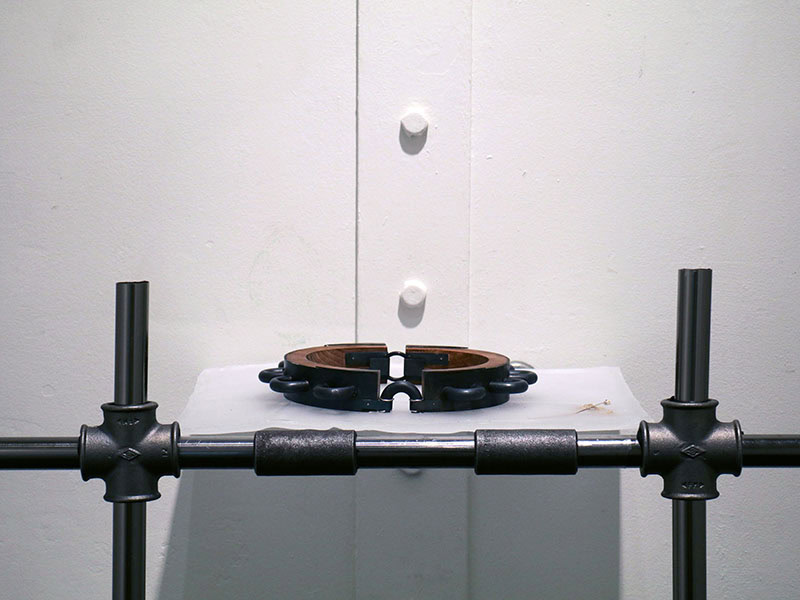
While this outsider status can act as a strength by fostering fresh perspectives and ways of looking, it also highlights a distinct distance between the specialized field and audiences beyond its established community. This realization informs the creation of more literal works in her repertoire, such as Panicroom Vector I, which function as accessible entry points into her broader conceptual universe.
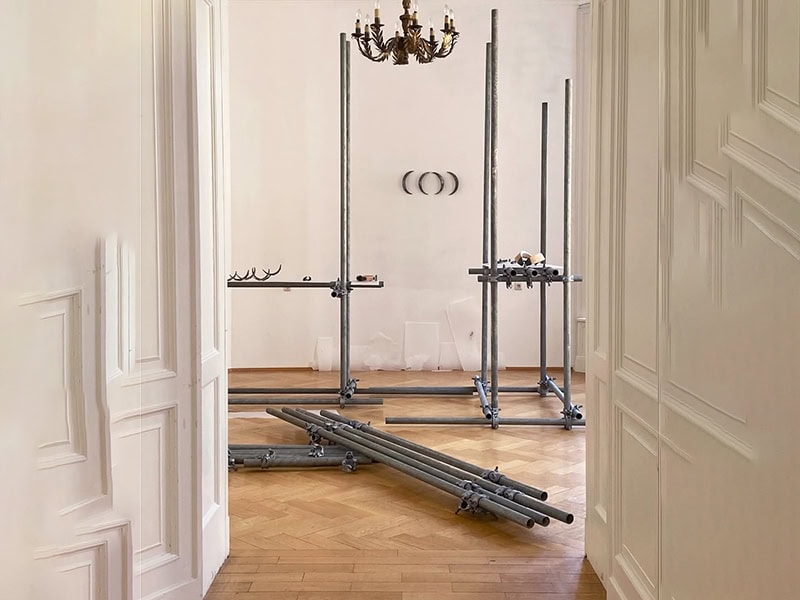
Looking ahead to the next five years, Locquet aims to build upon the momentum generated since her graduation. Having recently expanded her sculptural thinking to encompass entire physical spaces—a direction showcased in recent exhibition projects—she intends to continue developing her artistic language, pursuing residencies, and collaborating with fellow artists. Alongside her studio practice, she harbors a strong interest in research and teaching, viewing academic spaces as ideal environments to push forward collective notions of body ornament and continually question the shifting definitions of jewelry.